Home » How to Guides » How to Control Angle Grinder Speed (and When Not To)

How to Control Angle Grinder Speed (and When Not To)

Affiliate Disclosure: As an Amazon Associate I earn from qualifying purchases. Learn more.

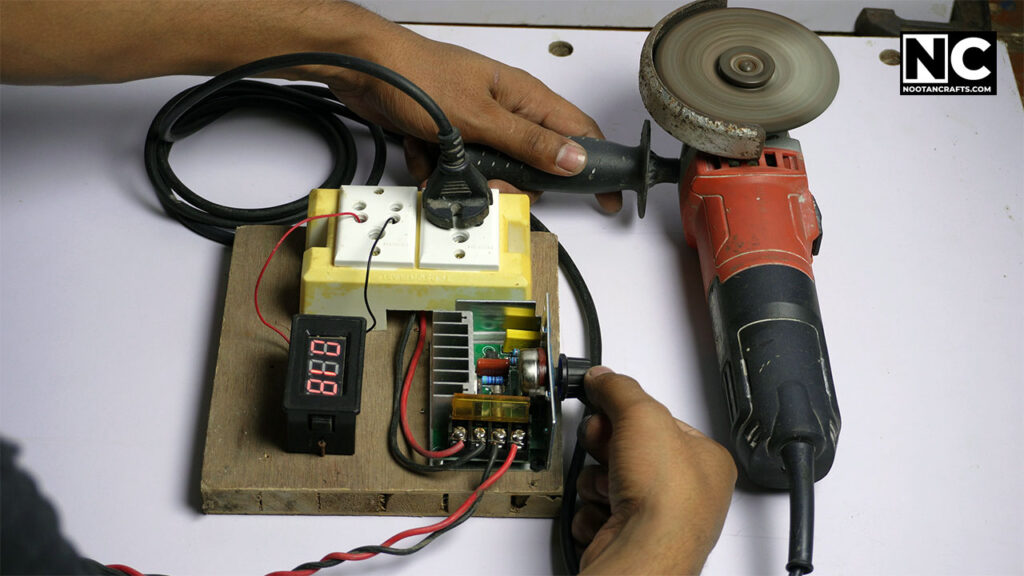
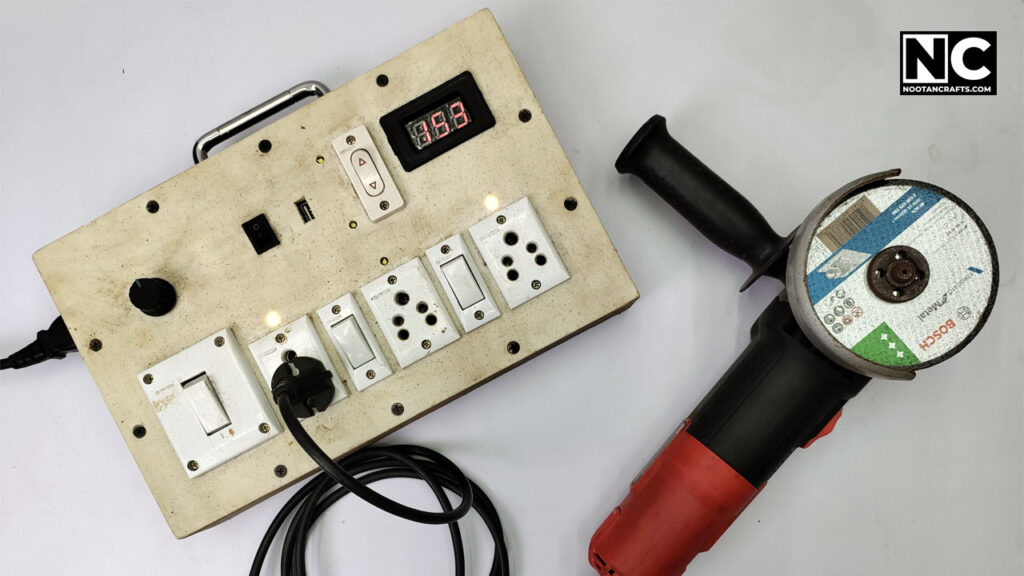
I built my own controller into an extension board, and it turned out more useful than I expected — it isn’t tied to the grinder at all. It lives on the bench and takes whatever tool needs slowing down.

Three ways, in order of how well they work. A grinder with built-in variable speed holds the speed you set even under load, because it senses the motor and compensates. An aftermarket SCR controller plugs between the outlet and any brushed grinder and lowers the voltage — cheap, effective, and it does not hold speed under load. A DIY SCR controller is the same thing built yourself for a fraction of the cost, and it will run any brushed power tool up to about 2,500 W.

The reason to bother is not comfort. It is that most of the accessories you’d want to fit — polishing pads, wire cup brushes, sanding discs — carry a maximum rpm lower than the grinder’s free speed. Fitting one to a tool that spins faster than its rating is how those accessories come apart.

Watch: the SCR controller wired up, and what the grinder sounds like as the speed comes down

Which Method for Which Situation

Your situationUseWhy
Buying a grinder and you know you’ll polish or wire-brushVariable-speed modelOnly method that holds the set speed when the disc meets the work
You already own a plain corded grinderAftermarket SCR controllerWorks on any brushed motor, costs very little, no modification to the tool
You want one controller for several toolsDIY SCR controllerBuild it into an extension board and it serves the whole bench up to about 2,500 W
Cordless grinderNone of theseThere is no AC supply to phase-control. Speed control has to be built into the tool
Grinder with soft-start or constant-speed electronicsNone of theseFeeding a chopped waveform to a tool that has its own control electronics can damage them
Heavy cutting or stock removalFull speedSlowing a grinder costs torque and cooling. For the job it was designed for, leave it alone

Last update on 2026-05-14 / Affiliate links / Images from Amazon Product Advertising API

Before you slow anything down

A slowed grinder runs hotter, and the disc rating still applies

Reducing the voltage to a universal motor reduces its speed, but it also reduces torque and — this is the part people miss — it slows the cooling fan, which is on the same shaft. A grinder running at half speed under load is being cooled at half rate while working hard. That is how motors get cooked. Feel the body regularly and let it run free to cool between passes.

Slowing the tool does not make an over-speed accessory safe either. The rating stamped on a disc or brush is a maximum, and a controller with an unmarked knob gives you no way to know what rpm you are actually at. Match the accessory to the grinder’s plate speed first, and use the controller to go slower still — never to justify fitting something rated below the tool.

  • An SCR controller is line wiring. If you build one, it goes in an insulated enclosure, correctly grounded, with the right current rating, and it is not left as a bare board on a bench.
  • Never use one on a tool with its own electronics — soft-start, constant-speed, or anything cordless. Phase control and control electronics do not mix.
  • Do not adjust the knob while the disc is in the cut. Set it with the tool running free, then work.
  • Check the disc’s rpm stamp against the grinder’s plate, every time. An under-rated disc can burst regardless of what the controller is set to.
  • Guard on, face shield over safety glasses. Slower does not mean safe — a wire brush at 5,000 rpm still throws wires.

What Speed Each Job Actually Wants

A typical 115 mm grinder free-spins around 11,000 rpm. Most of what people want a grinder to do besides cutting wants considerably less than that.

JobSpeedWhy
Cutting steelFullCut-off discs are rated for it and need the rim speed to cut cleanly
Grinding and stock removalFullTorque matters more than control; slowing it just makes the job longer
Flap disc on steelFull to three-quartersBacking off slightly reduces heat coloring on thin sheet
Wire cup or knotted brushReduced – check the brush ratingWire brushes usually carry a maximum rpm well below a grinder’s free speed
Sanding discs, paint removalAround halfFull speed burns the abrasive and the surface before it cuts
Polishing and compoundingLow – a quarter or lessHeat is the enemy; a fast pad burns the finish it is meant to bring up
Diamond pads on stone or tileReduced, per the padMost wet-use pads are rated well under a dry grinder’s speed

Read this before you buy a controller: if the accessory’s rating is the reason you want to slow down, check whether the accessory exists in a version rated for your grinder’s speed. Many do. A correctly rated wire brush at full speed is a better answer than an under-rated one on a dimmer, because a phase-angle controller gives you no readout of the actual rpm.

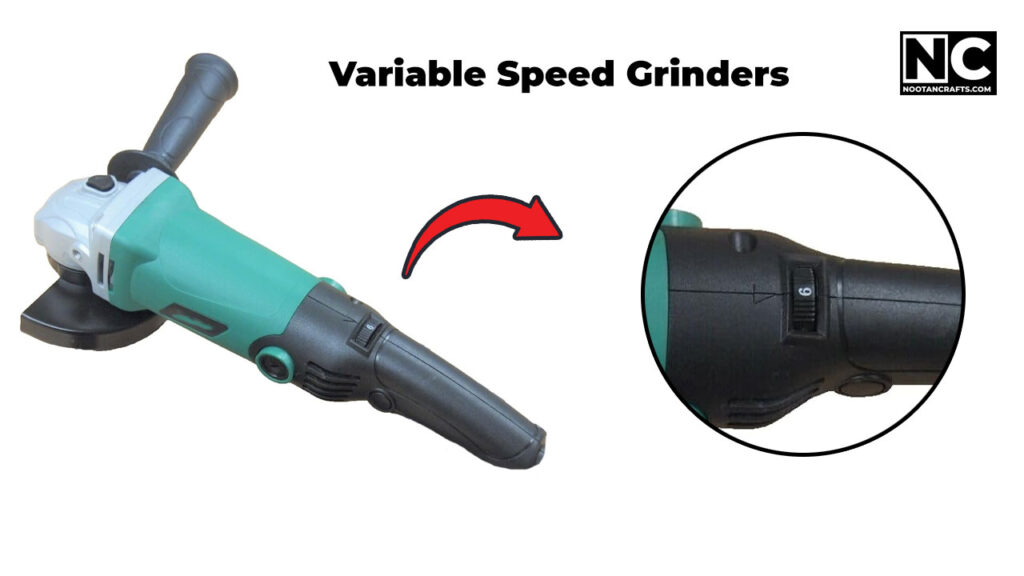
1. Grinders With Built-In Variable Speed

A dial or thumbwheel on the body, usually numbered one to six. Set it and go. The reason these cost more is not the dial — it is the electronics behind it, which monitor the motor and feed it more power as the load increases so the speed stays where you put it.

That is the whole difference between this and everything else on the page. A controller-on-the-plug lowers the voltage and lets the speed sag when the disc bites. A proper variable-speed grinder holds it. If you polish or wire-brush regularly, that difference is worth the price.

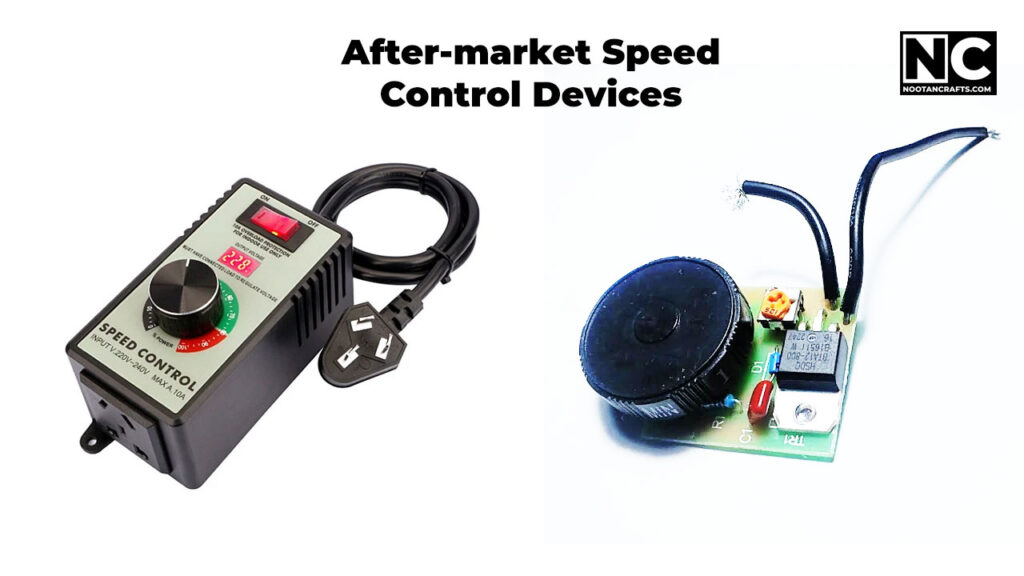
2. Aftermarket SCR Speed Controllers

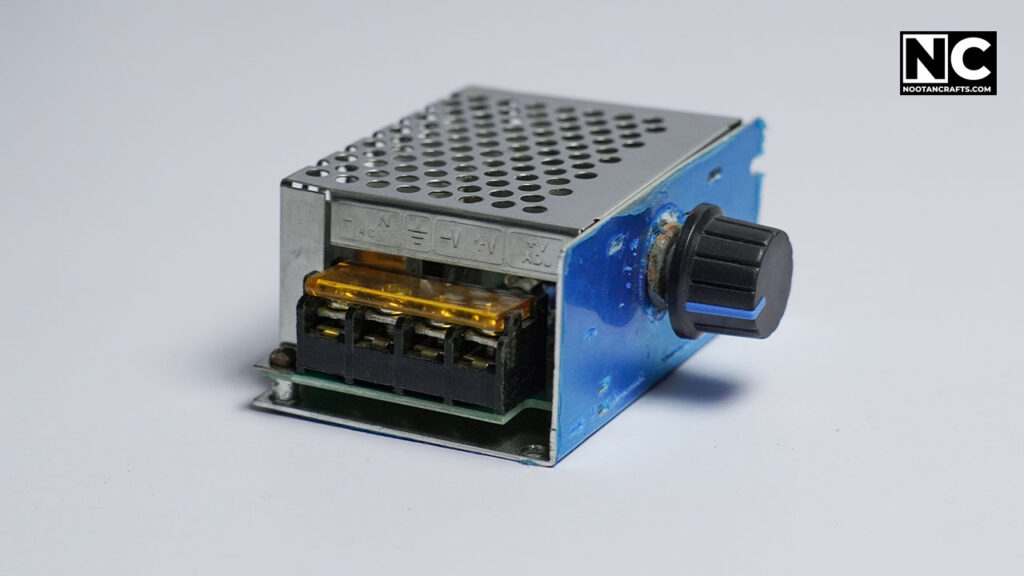
A box with a power cord, a socket and a knob. Plug the box into the wall, plug the grinder into the box, and the knob sets how much of the AC waveform reaches the tool. The part doing the work is an SCR — it switches on partway through each half-cycle, so the motor sees a lower average voltage and runs slower.

  1. Check the controller’s wattage rating against the toolThe controller must be rated comfortably above the grinder’s input power. Undersized is the common mistake and it kills the controller, not the grinder.
  2. Confirm the grinder is a plain brushed toolNo soft-start, no electronic constant-speed, not cordless. If it has any electronics of its own, do not put it on a phase controller.
  3. Controller into the wall, grinder into the controllerNot the other way round.
  4. Set the speed with the tool running freeTurn the knob down, let it settle, then bring it to the work. Adjusting mid-cut is neither safe nor useful.
  5. Watch the temperatureSlower fan, same load. Feel the body between passes and let it run free to cool.

It works, it costs very little, and it turns a single-speed grinder into a usable polisher. What it does not do is regulate: put a load on and the speed drops, and you compensate with the knob. For occasional polishing that is a fair trade. For anything you do often, buy the variable-speed tool.

If cutting is what you mostly use the grinder for, leave it at full speed — cutting metal with an angle grinder covers why slowing it there works against you.

3. Building Your Own SCR Controller

I built mine, and it turned out more useful than I expected — it isn’t tied to the grinder at all. It runs any brushed power tool up to about 2,500 W, so the same box slows a drill, a router or a polisher.

What you need
  • SCR voltage regulator module, rated above your heaviest tool
  • AC socket
  • On/off switch
  • Insulated enclosure or extension board
  • Power cord and plug, correctly rated
  • Cable gland and strain relief
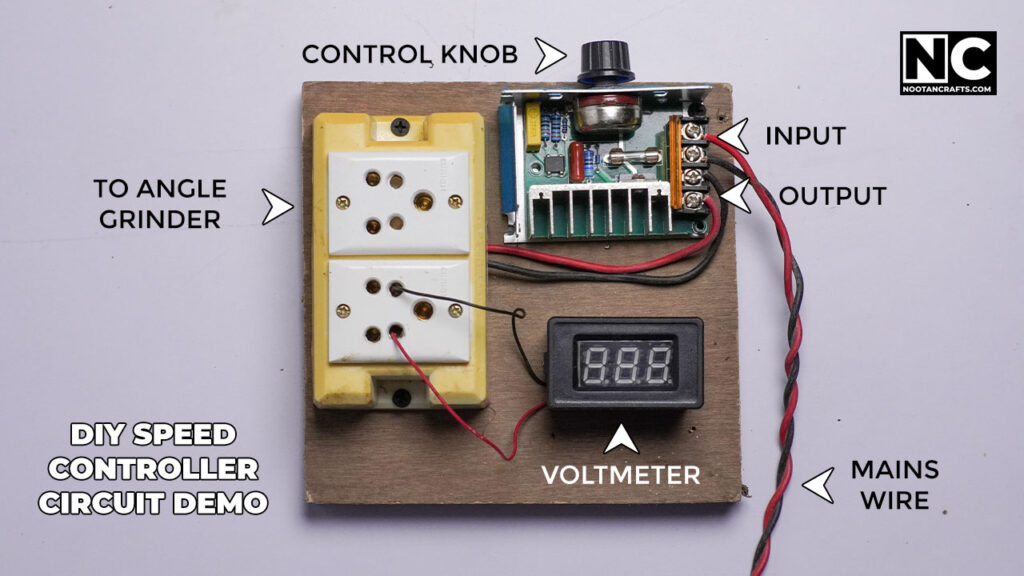
  1. Find the input and output terminals on the moduleThey are labeled. Getting these the wrong way round is the one mistake that matters most, and the labels are the only thing telling you which is which.
  2. Connect the two input wires to the line sideLive and neutral from the incoming flex.
  3. Take the output through the switch to the outletThe switch sits between the module’s output and the outlet, so it isolates the tool without leaving the module live at its output.
  4. Carry earth straight through, unswitchedFrom the incoming plug to the outlet’s ground pin, bypassing the module entirely. Never route earth through a controller.
  5. Mount it all in an insulated enclosureNothing conductive exposed, a gland on the incoming flex, and the module’s heatsink with air around it. A phase controller under load makes real heat.
  6. Test with a light bulb before a power toolAn incandescent lamp in the outlet shows immediately whether the knob is controlling anything, at a load that cannot hurt the module.

I built mine into an extension board, which is the version I’d recommend — it lives on the bench, takes whatever tool needs slowing, and there is no separate box to lose. Adapt the housing to whatever suits your workspace.

This is a line-voltage build. If you are not confident working with line wiring, buy the ready-made version — they cost little and they arrive in a tested enclosure. There is no partial credit with 240 V, and an SCR module left exposed on a workbench is a dangerous object.

Where This Goes Wrong

  • Using a controller on a tool with its own electronics. Soft-start and constant-speed circuits expect a clean sine wave. A chopped waveform can damage them, and cordless tools have no AC supply to control in the first place.
  • Assuming slower means cooler. The opposite, under load — the cooling fan is on the motor shaft and slows with it.
  • Undersizing the controller. A module rated near the tool’s input power runs hot and fails. Leave real headroom.
  • Treating the knob as an rpm readout. There are no numbers on it and no feedback behind it. You are setting voltage, not speed.
  • Using a controller to justify an under-rated accessory. If the brush is rated below your grinder, buy the right brush. The controller does not make the wrong one safe.
  • Slowing it down for cutting. Cut-off discs need rim speed. A slowed grinder just takes longer and generates more heat in the workpiece.

Why Voltage Changes the Speed at All

An angle grinder uses a universal motor — brushed, series-wound, and happy on AC or DC. Its speed rises with the voltage applied, which is exactly why a phase-angle controller works on it and why the same controller does nothing useful on an induction motor like a bench grinder or a table saw.

The SCR does not reduce the voltage smoothly. It stays off for part of each half-cycle and switches on partway through, so the motor sees a chopped waveform with a lower average value. Turn the knob and you are changing when in each cycle it switches on.

Two consequences follow, and both are practical rather than academic. Torque falls with speed, so the tool bogs down under a load it would have shrugged off at full tilt. And there is no feedback loop — nothing measures the actual speed — so the moment the disc meets resistance, the speed drops and stays dropped until you turn the knob up. That is the entire difference between this and the electronics inside a variable-speed grinder. For the rest of the handling, using an angle grinder safely covers the ground this article assumes.

Angle Grinder Speed Questions People Actually Ask

Can I use a speed controller on any angle grinder?

On any plain brushed corded grinder, yes — which is most budget and mid-range tools. Not on a cordless one, and not on a grinder with soft-start or electronic constant-speed, where the chopped waveform can damage the tool’s own electronics. Check the controller is rated well above the grinder’s input wattage.

What speed should I use for cutting metal?

Full speed. Cut-off discs are rated for the grinder’s free speed and need that rim speed to cut rather than rub. Slowing the tool for cutting makes the job slower and puts more heat into the workpiece.

How do I know I’m at the right speed?

By sound and by load. If the tool holds its note when the disc meets the work, the speed suits the job. If it drops in pitch and starts to labor, you’re asking for torque it no longer has at that setting.

Can I change the speed while it’s running?

Set it running free, not in the cut. Adjusting mid-cut means one hand off the tool while the disc is loaded, and the speed change is not instant. Set, let it settle, then work.

Will a controller damage my grinder?

Not directly — a brushed motor is happy on reduced voltage. The risk is thermal: less speed means less cooling from the shaft-mounted fan, while the load stays the same. Run it in shorter bursts and let it spin free to cool.

Does an SCR controller work on a bench grinder or a drill press?

No. Those use induction motors, whose speed is set by the line frequency rather than the voltage. Lower the voltage and they lose torque, overheat, and eventually stall without slowing much. Phase control is for brushed tools only.

Is it cheaper to build a controller or buy one?

Building is cheaper, and you can size it for the whole bench rather than one tool. Buying gets you a tested enclosure with the line wiring already done properly. If line wiring isn’t something you’re comfortable with, that difference is worth paying for.

Slow It Down for Polishing, Leave It Alone for Cutting

A controller widens what a single-speed grinder can do — polishing, sanding, wire brushing, anything where heat rather than power is the limit. It does not make the tool better at what it was built for, and it does not hold speed when the disc bites. Match the accessory’s rating to the tool first, use the controller to go slower than that, and keep an eye on how hot the motor is getting.

1 thought on “How to Control Angle Grinder Speed (and When Not To)”

Leave a Comment

This site uses Akismet to reduce spam. Learn how your comment data is processed.