Wood moves. A board that measures 24.00 mm this morning can measure 24.15 mm after a humid week, and it will move again when you bring it indoors. That single fact drives this entire buying guide: for woodworking, precision finer than about 0.05 mm is wasted on a material that will not hold it.
Which means the honest answer to “what is the best caliper for woodworking” is not the most accurate one. It is the cheapest one that is honest, comfortable to read, and survives a workshop. I learned this the expensive way round — my first mortise-and-tenon joint took me more attempts than I want to admit, and what fixed it was not a better caliper; it was owning one at all.
There is a second half to that argument, and almost nobody writes it down. You do not need a finer number — you need the number in the form you already work in. If your plans are in 64ths and your rules are in 64ths, a readout showing 0.3125 inch is one more conversion between you and the cut. That is why a fractional caliper is on this list, and why it is not the most precise instrument here.
My Pick — NEIKO 01407A
What’s Inside!
- 1 – Which Woodworking Caliper Fits Your Bench
- 2 – Woodworking Caliper Comparison Table
- 3 – How Much Precision Wood Will Actually Hold
- 4 – Seven Calipers for Woodworking, Reviewed
- 4.1 – 1. NEIKO 01407A (Best Overall)
- 4.2 – 2. Spurtar Vernier Caliper (Best Vernier for the Money)
- 4.3 – 3. Mitutoyo 530-101 (Best Built to Last)
- 4.4 – 4. Mitutoyo 500-196-30 (Best Digital)
- 4.5 – 5. Starrett 3202-6 (Best Dial)
- 4.6 – 6. Mitutoyo 505-742J (Best Dial for the Money)
- 4.7 – 7. iGaging 8" Fractional Dial Caliper (Best for Fractional Work)
- 5 – Five Features That Matter on a Woodworking Caliper
- 6 – Dial, Digital or Vernier: Which Caliper Type to Buy
- 7 – Woodworking Caliper Questions People Actually Ask
- 8 – Buy the One You Will Actually Pick Up
Which Woodworking Caliper Fits Your Bench
| Pick | Caliper | Why this one |
|---|---|---|
| Best Overall | NEIKO 01407A | Stainless body, large display, splash and dust resistant, at a price that makes the premium options hard to justify for wood |
| Best Vernier for the Money | Spurtar Vernier Caliper | Steel, four measuring modes, no battery to go flat. The one to buy if you would rather read a scale |
| Best Built to Last | Mitutoyo 530-101 | Not the finest reading here — the value is the build and the angled scale that kills parallax error |
| Best Digital | Mitutoyo 500-196-30 | 0.01 mm resolution and a sensor that shrugs off dust and oil. More caliper than wood requires |
| Best Dial | Starrett 3202-6 | A needle instead of a screen. Nothing to charge, nothing to drift, and a bezel you can zero against a setup block |
| Best Dial for the Money | Mitutoyo 505-742J | The same idea for less, with 40 mm jaws that reach further onto a board than most |
| Best for Fractional Work | iGaging 8″ Fractional | Reads in 64ths on the outer dial. The only one here that speaks the units your plans are written in |
Woodworking Caliper Comparison Table




Last update on 2026-09-23 / Affiliate links / Images from Amazon Product Advertising API
How Much Precision Wood Will Actually Hold
Every caliper on this list resolves finer than the material does. Read the last row first.
| Caliper | Type | Smallest division | In millimeters | What that means for wood |
|---|---|---|---|---|
| Mitutoyo 500-196-30 | Digital | 0.01 mm resolution, about ±0.02 mm accuracy | 0.01 mm | Beyond anything wood will hold. You are paying for the sensor, not the number |
| NEIKO 01407A | Digital | 0.01 mm resolution | 0.01 mm | Same displayed resolution, wider spread between repeat readings. Still finer than the wood |
| Spurtar | Vernier | 0.02 mm least count | 0.02 mm | More than enough, with nothing to go flat |
| Starrett 3202-6 | Dial | .001 in graduation | 0.025 mm | Finer than needed. Buy it for the mechanism and the bezel |
| Mitutoyo 505-742J | Dial | .001 in graduation, .1 in per revolution | 0.025 mm | Same reasoning, less money |
| Mitutoyo 530-101 | Vernier | 0.05 mm least count | 0.05 mm | Sits exactly on the threshold. Adequate, and built to stay adequate for decades |
| iGaging 8″ Fractional | Dial, fractional | 1/64 in on the outer dial, .01 in on the inner, ±0.05 mm accuracy | 0.4 mm / 0.25 mm | The coarsest here, and the only one that reads in the units you cut in |
| The wood itself | — | Seasonal and humidity movement on a 24 mm board | About 0.15 mm | Six times the finest caliper’s spread. This is the number that decides the argument |
Read that last row against the first. A 0.01 mm caliper measuring a board that moves 0.15 mm with the weather is a very accurate answer to a question: the material has already changed. Past 0.05 mm, you are not buying accuracy anymore — you are buying build quality, readability, and a tool that still works in ten years. Those are good reasons. They are just not the reason the marketing gives you.
Seven Calipers for Woodworking, Reviewed
1. NEIKO 01407A (Best Overall)
Best Overall
- TypeDigital
- Range0-150 mm (0-6 in)
- BodyStainless steel
- Unitsmm, inch, fractions
A stainless steel body, a display large enough to read without leaning in, a knurled thumb roller and a locking screw — and it is splash- and dust-resistant, which in a workshop full of sawdust matters more than another decimal place. It switches between millimeters, inches, and fractions, and fractions are useful if your plans are imperial.
It is not a precision instrument in the Mitutoyo sense. Measure the same dowel five times, and you will see slightly more spread than you would with the 500-196-30. For wood, that spread is smaller than the wood’s own movement, which is the whole argument for this caliper.
2. Spurtar Vernier Caliper (Best Vernier for the Money)
Best Vernier for the Money
Last update on 2026-09-23 / Affiliate links / Images from Amazon Product Advertising API
- TypeVernier, manual
- Range0-150 mm (0-6 in)
- Least count0.02 mm
- ModesOutside, inside, depth, step
Stainless steel, four measuring modes — outside, inside, depth and step — and a 0.02 mm least count, which on paper is finer than the Mitutoyo vernier further down this list. That is not a mistake, and it is worth understanding: least count is what the scale can display, not proof the jaws are ground well enough to deliver it.
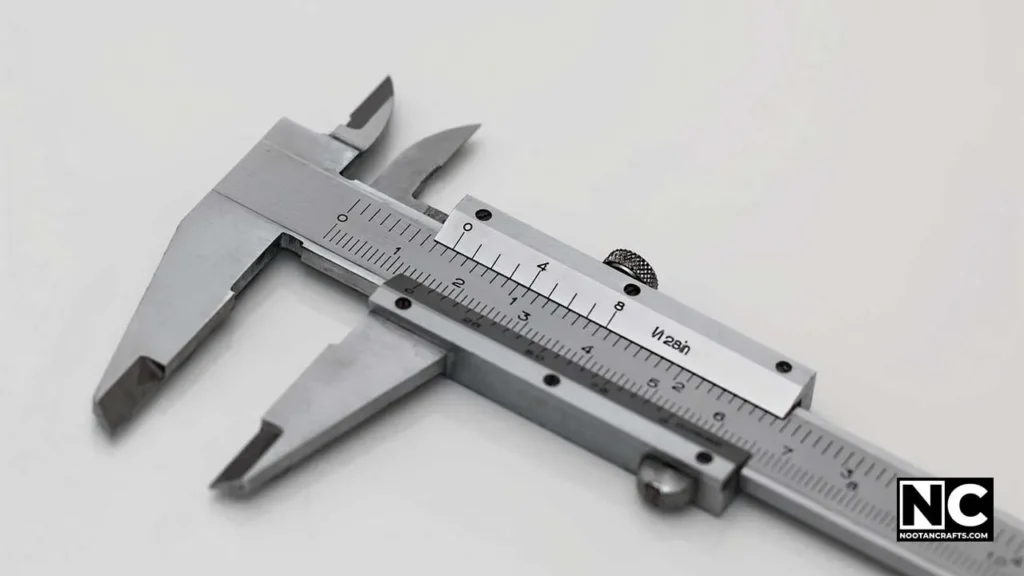
The real reason to choose it is that nothing on it can go flat. A vernier caliper left in a drawer for two years works the moment you pick it up. The cost is that you have to read it, which takes practice — the worked example is here and takes about four minutes to absorb.
3. Mitutoyo 530-101 (Best Built to Last)
Best Built to Last
Last update on 2026-09-23 / Affiliate links / Images from Amazon Product Advertising API
- TypeVernier, manual
- Range0-150 mm (0-6 in)
- Least count0.05 mm
- Notable14-degree angled scale face, raised sliding surfaces
Read this before you assume premium means finer. The 530-101 is a 0.05 mm vernier caliper. That is a coarser least count than the Spurtar above. Almost every guide that lists this caliper calls it “extremely precise” without noticing that, and the older version of this page did the same. What you are buying is hardened stainless steel, sliding surfaces raised so the graduations do not wear away, and a 14-degree angled vernier face that reduces parallax error. Those are durability and readability, not resolution.
Which makes it a strange recommendation until you think about timescale. A 0.05 mm caliper is entirely adequate for wood, and this one will still be reading true in thirty years, with no battery and nothing to service. If you want one caliper for the rest of your working life and you are willing to read a scale, this is it.
4. Mitutoyo 500-196-30 (Best Digital)
Best Digital
Last update on 2026-09-23 / Affiliate links / Images from Amazon Product Advertising API
- TypeDigital, absolute encoder
- Range0-150 mm (0-6 in)
- Resolution0.01 mm (0.0005 in)
- AccuracyAbout ±0.02 mm
The best digital caliper most people will ever handle, and more caliper than woodworking needs. Resolution is 0.01 mm with accuracy around ±0.02 mm — not the 0.001 mm quoted around the internet, which is a micrometer figure and not achievable with any caliper.
Two things justify the price if you also work metal. The absolute encoder means it remembers its origin, so it does not need re-zeroing every time it wakes, and the Advanced Onsite Sensor keeps it reading correctly through dust, oil, and water — the conditions that kill ordinary digital calipers. For wood alone, this is a tool bought for the pleasure of owning it rather than for the measurements.
5. Starrett 3202-6 (Best Dial)
Best Dial
Last update on 2026-09-23 / Affiliate links / Images from Amazon Product Advertising API
- TypeDial
- Range0-150 mm (0-6 in)
- Graduation.001 in (0.025 mm)
- BodyHardened stainless steel
- NotableAdjustable bezel, fitted case
A dial caliper is the answer for anyone who wants a number without a battery and without learning a vernier scale. The needle moves as the jaws move, so you see the reading change — which is how you feel a tapered tenon or a board that is thicker at one end, something a digital readout only tells you after the fact.
By the logic of this page, a .001 in graduation is already twice as fine as wood will hold, so be clear about what the money buys. Starrett publishes it as hardened stainless steel with .001 graduations, and the feature that earns its place on a bench is the adjustable bezel: you can rotate the dial to zero against a setup block or reference piece, then read every other part as plus or minus from it. Comparing parts is what most woodworking measurement actually is.
The honest caveat is that a dial caliper has a rack running its length, and a workshop rack collects dust. Brush it before you close the jaws. It is the one maintenance habit a dial needs and a digital does not.
6. Mitutoyo 505-742J (Best Dial for the Money)
Best Dial for the Money
Last update on 2026-09-23 / Affiliate links / Images from Amazon Product Advertising API
- TypeDial
- Range0-150 mm (0-6 in)
- Graduation.001 in (0.025 mm)
- Dial.1 in per revolution
- Jaw depth40 mm
The same argument as the Starrett for less money, and the spec that matters most for wood is one nobody puts on the front of the box: the jaws are 40 mm deep. That is how far in from the edge of a board you can take a thickness reading, and on a wide panel it is the difference between measuring where you need to and measuring where the tool lets you.
It locks in two places — the bezel and the slide — so a dimension can be carried across the shop without drifting. The dial turns .1 in per revolution, which means on a 6 in caliper the needle goes round sixty times across the range, and you read the inches off the beam and the thousandths off the face. That takes a few minutes to get used to if you’ve only used a screen.
Mitutoyo does not make a fractional dial caliper in this line, or in any other. If you want 64ths, the next pick is the one, and no amount of brand prestige changes that.
7. iGaging 8″ Fractional Dial Caliper (Best for Fractional Work)
Best for Fractional Work
Last update on 2026-09-23 / Affiliate links / Images from Amazon Product Advertising API
- TypeDial, fractional and decimal
- Range0-200 mm (0-8 in)
- Outer dial1/64 in fractions
- Inner dial.01 in decimal
- Accuracy±0.05 mm
This is the one that does something none of the others do. The outer scale reads in 64ths, so when your plan says 5/16 in the caliper says 5/16 in, and the conversion that usually happens in your head at the bench does not happen at all. A woodworker in a Fine Woodworking thread on caliper choice makes exactly this complaint about digital readouts in 32nds and 64ths, and another in the same thread recommends the iGaging fractional by name. Two people arriving at the same answer from different directions is worth more than any single review.
Be clear-eyed about the trade. At ±0.05 mm, this is the least precise instrument on the list, sitting exactly on the threshold this page argues is the minimum rather than comfortably past it. It is also 8 in rather than the 6 in recommended everywhere else here, which makes it longer to store and heavier in the hand. You are buying a unit system, not a tolerance.
If you want a fractional dial from a premium brand, there is exactly one. Starrett’s 1202F reads 1/64 in on the outer scale and .01 in on the inner, with anti-backlash double pinion control. Mitutoyo does not make one; neither does Fowler. So when the 1202F is out of stock, there is no premium substitute at this size — which is why the iGaging holds this slot rather than standing in for something better.
Five Features That Matter on a Woodworking Caliper
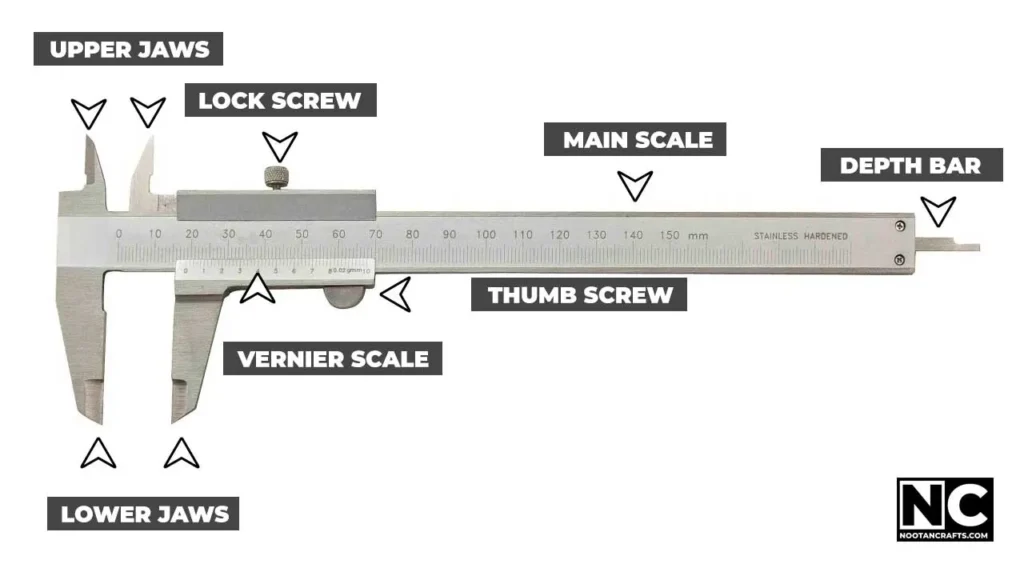
- A depth gauge. The most-used function in woodworking and the one people forget to check for. Mortise depth, groove depth, how far a screw has sunk — all of it comes off the rod at the tail. Not every caliper has one.
- Stainless steel jaws. Not for accuracy, but for corrosion resistance. A caliper that lives in a workshop meets damp air and bare hands, and rust on a jaw face is a measurement error you cannot see.
- A locking screw. Lets you take the caliper off the work before reading it, and lets you carry a dimension from one piece to another without writing anything down. On awkward parts, this is the difference between a measurement and a guess.
- 0-150 mm (0-6 in) range. Enough for dowels, board thickness, tenon shoulders, and joinery. Larger ranges cost more, weigh more, and get used once a year.
- A thumb wheel. Fine control when closing the jaws, which is exactly where over-squeezing happens.
What does not matter: resolution below 0.05 mm, ranges beyond 150 mm, and brand prestige. If you also work metal, the calculation changes completely, and the premium brands start earning their price — the brands worth trusting for precision work.
Dial, Digital or Vernier: Which Caliper Type to Buy
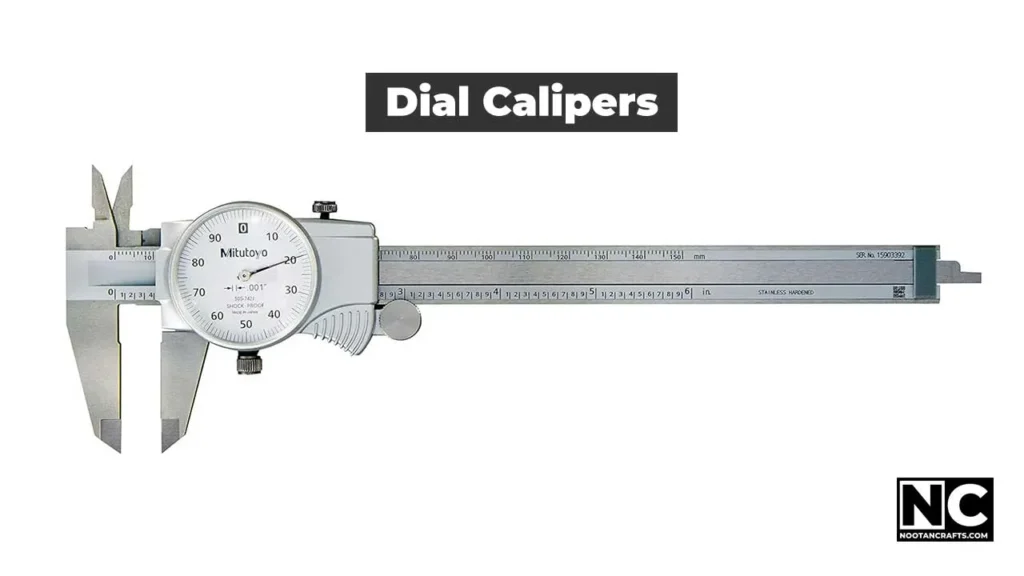
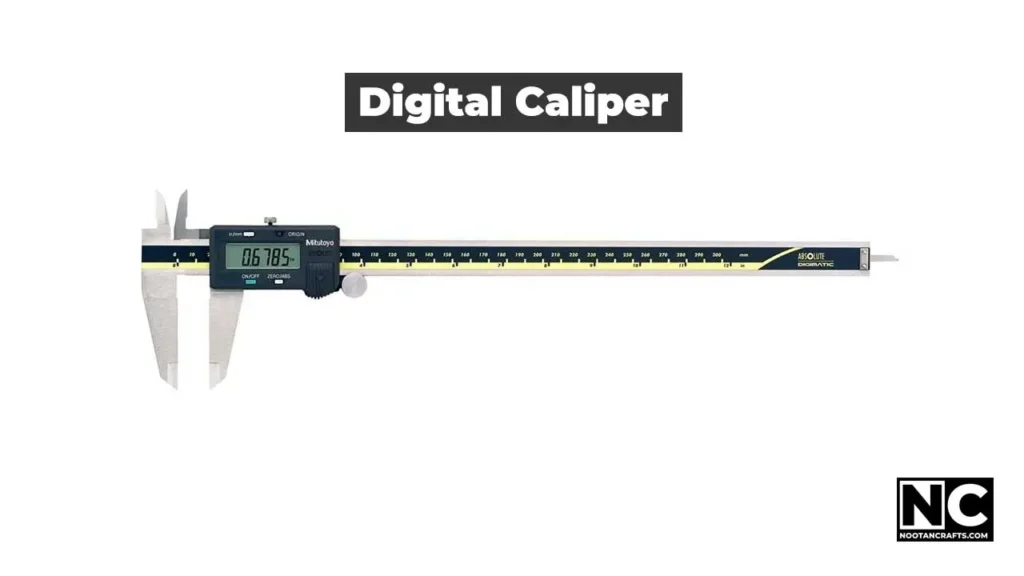
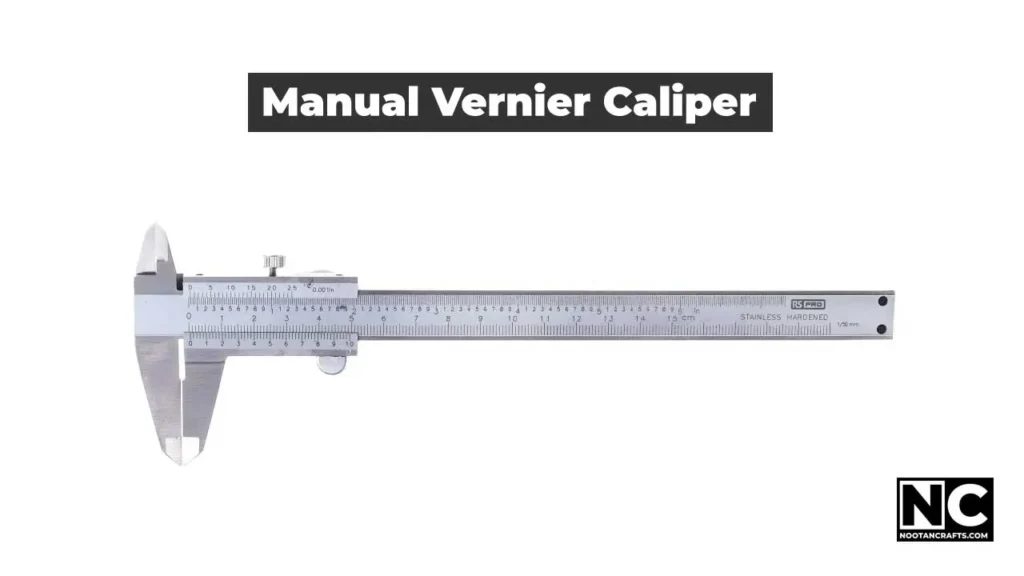
Digital is faster, switches units, and zeroes anywhere along its travel — which is useful when you are comparing one part against another rather than measuring absolutely. It also needs a battery, and it will be flat on the morning you need it.
A vernier caliper is slower to read and cannot fail in a way that still looks like it is working. That last part is worth more than it sounds. A digital caliper with a dying battery can display a stable, wrong number; a vernier scale either aligns or it does not.
A dial sits between them and is the type most woodworkers under-recommend. It gives you a number at a glance like a digital, with no battery like a vernier, and it adds something neither has: a needle that moves while the jaws move, so you feel a taper developing instead of reading two separate numbers and comparing them afterward. The cost is a rack that collects dust and a mechanism that will not survive being dropped on concrete.
| Type | Buy it if | Avoid it if |
|---|---|---|
| Digital | You want a number now, switch between mm and inches often, and will keep spare batteries | The tool sits unused for months at a time |
| Dial | You compare parts more than you measure them, and want no battery | Your bench is buried in dust and the caliper lives on it |
| Vernier | You want one tool for the next thirty years and do not mind reading a scale | Your eyes struggle with fine graduations in workshop light |
| Fractional dial | Your plans, rules and cut lists are all in 64ths | You work in millimeters |
For most woodworkers: buy the digital, and keep a cheap vernier in the drawer as the one that always works. If you own one of these and it has held up —or not —tell me; longevity is the one thing a review written at purchase cannot tell you.
Woodworking Caliper Questions People Actually Ask
How accurate does a caliper need to be for woodworking?
0.05 mm is plenty, and 0.02 mm is comfortably more than enough. Wood expands and contracts with humidity by more than either figure, so precision beyond that is being applied to a material that will not hold still long enough to use it. Spend the difference on the depth gauge and the steel body instead.
Is a dial caliper better than digital for woodworking?
Better in two specific ways and worse in one. The needle moves as the jaws move, so you see a taper or a thickness change developing instead of comparing two numbers after the fact, and there is no battery to go flat between projects. Against that, the rack running the length of the beam collects sawdust and needs brushing before you close the jaws. If your caliper lives in a drawer rather than in the dust, a dial is the better tool.
Should I buy a fractional caliper?
If your plans, your rules and your cut list are all in fractions, yes. The conversion from 0.3125 inch to 5/16 inch is not difficult, it is just one more step between the measurement and the cut, repeated all day. A fractional dial removes it. If you work in millimeters it offers you nothing.
Digital or vernier for a beginner?
Digital, if you want to start measuring today. Vernier, if you want to understand what the tool is doing – reading the scale teaches you something a digital readout hides, and it is why people who learned on vernier can tell when a reading looks wrong.
Are cheap plastic calipers accurate enough?
For occasional checks, yes. The real limitation is not the stated accuracy, it is that plastic jaws flex under hand pressure, so your grip changes the number more than it would on a steel caliper. If you measure often, steel is worth the small extra.
Do digital calipers need calibrating?
They arrive calibrated, but zero them before every session and check them against a known dimension every six months or after any drop. Zeroing only proves the caliper is honest at zero – it says nothing about whether it reads true at 100 mm.
Stainless steel or plastic?
Steel, unless weight or price is the deciding factor. It resists both corrosion and flex, and a workshop supplies plenty of the first and your hand supplies the second.
What size caliper should I buy?
0-150 mm (0-6 in). It covers dowels, board thickness, tenons and joinery, and larger ranges cost and weigh more for a capability most woodworkers use once a year.
Buy the One You Will Actually Pick Up
Buy the NEIKO 01407A and stop reading. It has the depth gauge, the steel body, and the locking screw; it reads finer than any board will hold still, and it costs little enough that losing it to the shop floor is annoying rather than painful.
Spend more only for a reason that is not accuracy: the Starrett 3202-6 or Mitutoyo 505-742J if you want a needle and no battery, the Mitutoyo 530-101 if you want one tool for thirty years, the iGaging fractional if you cut in 64ths. The one thing not to get wrong is buying resolution: a caliper that reads to 0.01 mm on a board that moves 0.15 mm with the weather is answering a question the wood has already changed.