Three things decide what a sheet of plywood actually is, and the price tag tells you about one of them. The veneer grade on each face decides how it looks. The glue decides whether it survives moisture. The core decides whether it holds a screw and stays flat. Almost every disappointing sheet-goods purchase is someone who bought for the first and needed the second.
The grade stamp tells you all three, if you know how to read it. Here is how, plus the one piece of it that nearly every buyer gets backwards.
What’s Inside!
The Letters: Face and Back Veneer Grades
A sheet marked BC has a B-grade face and a C-grade back. The better letter always goes first, and it is the side you show.
| Grade | What the surface looks like | Use it for |
|---|---|---|
| A | Smooth, sanded, repairs neatly made and hard to spot | Anything that gets a clear finish or paint and will be looked at |
| B | Solid surface, minor repairs and small tight knots | Painted work. Under paint, the difference from A largely disappears |
| C | Tight knots up to about 1.5 in (38 mm), some splits, discoloration | Structural work where the face is covered or never seen |
| D | Knots and knotholes up to about 2.5 in (64 mm), unrepaired | Sheathing and hidden structure only |
| X | Not a veneer grade at all – see below | This is the one people misread |
CDX Is Not Exterior Plywood
The X in CDX does not stand for exterior. It marks the panel as Exposure 1, which the APA defines as suitable for uses “not permanently exposed to the weather.” It is built to survive construction delays — rain on a half-built roof, a few weeks open to the sky — not a life outdoors.
The confusion is understandable, because both Exposure 1 and true Exterior panels are made with waterproof glue. That is not what separates them. Two other things do: an Exterior panel must use C-grade or better veneer throughout, where Exposure 1 is allowed D-grade plies, and Exterior panels must meet a higher bond-strength requirement in testing. A D-grade inner ply with a knothole in it lets water into the core no matter how good the adhesive around it is.
If it lives outside, it needs Exterior, not CDX. A garden bench, a shed floor, a planter box. CDX left out in the weather will not fail immediately — it will go uneven and irregular at the surface first, then start to delaminate at the edges, which is exactly slow enough that people conclude “plywood is fine outdoors” and repeat the mistake. (Source: Wiss, Janney, Elstner Associates, on the APA definitions.)
The Core Is What Holds the Screw
Two sheets can carry the same face veneer and behave completely differently, because what is underneath is not the same material. This is the part no grade stamp covers.
| Core | Holds a screw | Stays flat | The trade |
|---|---|---|---|
| Veneer core (real plywood) | Best, especially edge-on | Good, can bow slightly | Voids in cheap sheets show as gaps in a cut edge |
| MDF core | Poor edge-on, fine on the face | Excellent – very flat | Heavy, and swells permanently if it gets wet |
| Particleboard core | Weakest of the three | Good | Cheapest, and the one under most flat-pack furniture |
| Blockboard | Good, if the screw hits a block | Good over long spans | Light and stiff for its weight – long shelves and tabletops |
| Melamine-faced board | Depends entirely on the core beneath | Good | A finish, not a material – see the comparison below |
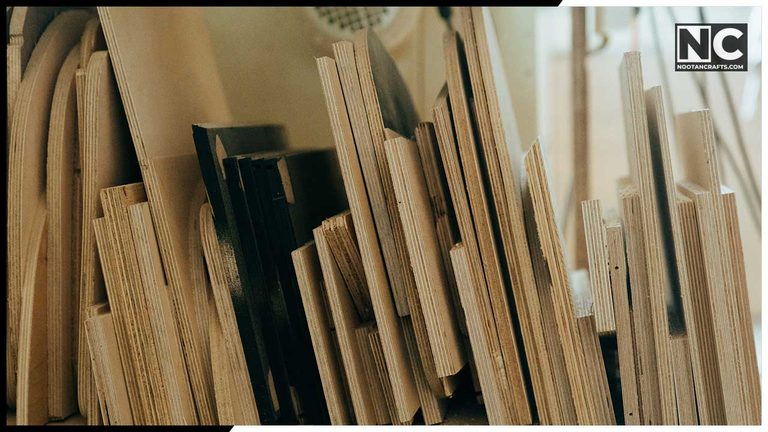
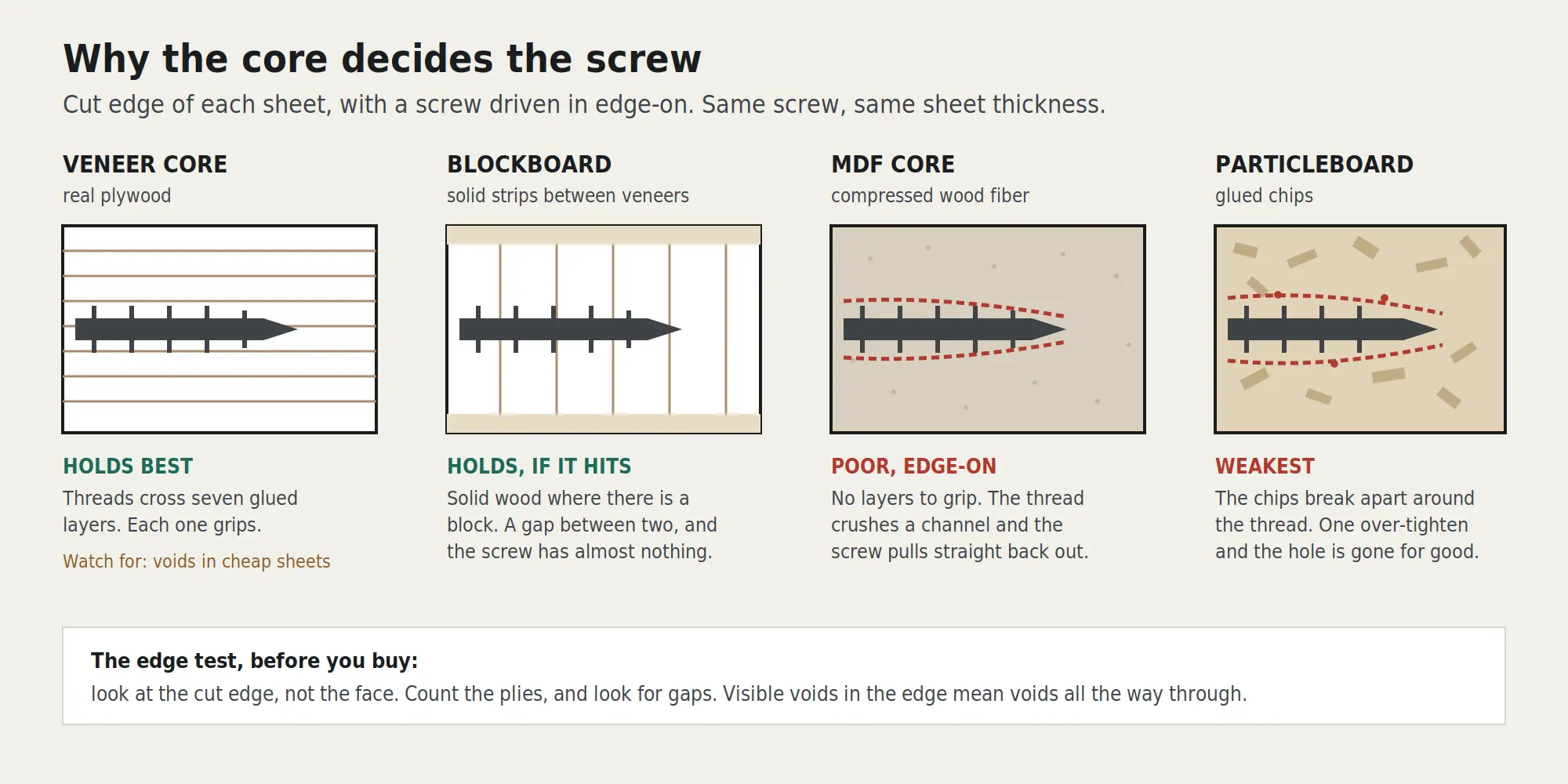
The edge test. When you are standing in front of a stack in a yard, look at the cut edge rather than the face. Count the plies, and look for gaps between them. A sheet with visible voids in the edge has voids all through it, and every one of them is a place a screw will find nothing to bite.
Why the edge is where cores separate. Driven into the face, almost any sheet holds a screw reasonably well — the thread is crossing the layers. Driven into the edge, it is travelling along them, and now the core material is the only thing gripping. Veneer core gives the thread seven glued layers to cross. MDF gives it compressed fiber that crushes into a smooth channel, so the screw pulls back out under load. Particleboard gives it chips that break apart around the thread, and one over-tighten strips the hole permanently. This is why flat-pack furniture uses cam locks and dowels rather than screws into the panel edge.
Which Sheet for Which Job
| The job | Buy | Why |
|---|---|---|
| Painted cabinets and built-ins | BC or B-grade veneer core | Under paint you are buying the core, not the face |
| Anything with a clear finish | A-grade face, hardwood veneer | The face is the whole point and cannot be fixed later |
| Shelving that must not sag | Blockboard or 3/4 in (18 mm) veneer core | Stiffness over the span is what matters, not surface |
| Wardrobe and cabinet interiors | Melamine-faced board | Finished on both sides straight off the saw, wipes clean |
| Anything permanently outdoors | Exterior grade, or marine | Not CDX, for the reason above |
| Roof and wall sheathing | CDX | Exactly what Exposure 1 was designed for |
| A jig, a template, a router pattern | MDF | Flat, no grain, cuts to a crisp edge. It is not furniture |
If you are buying in India
The letter grades above are the North American system. India uses IS marks instead, and they describe the glue rather than the face: MR (moisture resistant) is the interior grade, BWR (boiling water resistant) steps up to kitchens and bathrooms, and BWP or marine grade, covered by IS 710, is the outdoor one. The mapping is not exact, but MR is roughly Interior, BWR roughly Exposure 1, and BWP roughly Exterior. Buy the IS mark, not the brand sticker — the mark is what is being certified.
Cutting Any of This Produces Dust You Should Not Breathe
Sheet material dust is finer than sawdust and it carries the adhesive with it
Cutting solid wood makes chips you can see falling. Cutting MDF, particleboard or plywood makes a fine airborne dust that stays in the air long after the saw stops, and it contains whatever resin was used to bond the sheet together. Wood dust itself is classified as a carcinogen, and the engineered boards add formaldehyde-based binders on top of that. A dust mask worn for the cut and taken off in a room still full of dust has done very little.
- Cut outdoors or with extraction wherever you can. A shop vacuum at the saw removes far more than opening a window does.
- An N95 or better, worn until the air has cleared – not just while the saw is running.
- MDF is the worst of them for dust fineness. Routing and sanding it produce more airborne dust than sawing it.
- Do not sweep it up dry. Sweeping puts settled dust straight back into the air. Vacuum it.
- Support the sheet fully before cutting. A 8 x 4 ft (2440 x 1220 mm) sheet that drops mid-cut binds the blade, and a bound circular saw kicks back hard.
Where to Go From Here
Structural or non-structural?
This is the same question the grade stamp answers, asked a different way — and the difference is the adhesive and the certification, not the wood species. A non-structural sheet can look identical and carry load perfectly well right up until the glue line lets go, which is why the failure is sudden rather than gradual. Structural vs non-structural plywood.
Plywood or melamine board?
Not really a fair comparison, because melamine is a surface and plywood is a structure — a melamine-faced sheet has a core underneath that is usually particleboard. Melamine wins on cost and on arriving already finished. Plywood wins on load, on screw holding, and on what happens when water reaches an unsealed edge. Plywood vs melamine.
Cutting sheets without chipping the face
Sheet goods chip because the tooth exits through a brittle surface with nothing supporting it — which is why a scoring cut fixes it and a better blade alone often does not. Good face down on a circular saw, good face up on a table saw, and score the line first on melamine. Wood splits for a related reason when you screw into it: the thread wedges the fibers apart, so the pilot hole is sized to the screw’s shank, not its thread.
Finishing and protecting
Plywood edges drink finish and stain unevenly across the face, because the veneer’s grain runs in alternating directions. If the surface came up rough after the first coat, that is the water in the finish lifting the grain rather than a mistake: smoothing wood after staining. For anything going outside, the sheet grade only buys you the substrate — the coating is the other half: treating wood for outdoor use.
Seeing it used
If you want the decisions above in a finished piece rather than in the abstract, the desk build uses blockboard for the top and MDF where flatness matters, with a full cut list and every dimension: the DIY L-shaped desk.
Common Questions
What thickness of plywood should I use for shelves?
3/4 in (18 mm) for anything spanning more than about 30 in (750 mm) with weight on it, and even then support it or add a front edge strip. 1/2 in (12 mm) sags over any useful span once books go on it. Sag is a function of span far more than of thickness — halving the span helps more than doubling the thickness.
Is marine plywood worth the extra money?
Only if it is actually going to get wet repeatedly. Marine grade buys you void-free inner plies and a fully waterproof bond, and it is priced accordingly. For a painted cabinet in a dry room you are paying for properties the piece will never use. For a boat, a bathroom vanity or anything outdoors, it is the right sheet.
Why does my plywood keep bowing?
Usually storage. A sheet stored leaning against a wall takes a curve and keeps it, and a sheet finished on one face only will cup toward the unfinished side as it takes up moisture unevenly. Store flat, and finish both faces even when only one shows.
Can I use MDF instead of plywood to save money?
For jigs, templates, painted panels and anything that stays dry and flat, yes. Not for shelves that carry weight, not where screws go into the edge, and never anywhere it might get wet — MDF that swells does not dry back, it stays swollen.
What does the number of plies tell me?
More plies at the same thickness means thinner individual veneers, which generally means a flatter, more stable sheet that resists warping better. It is one of the more reliable quality signals you can check by eye at the yard, and it costs nothing to count.