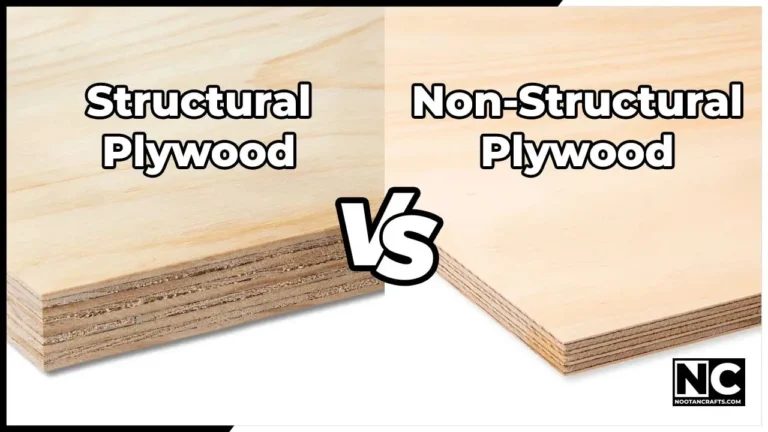
Two sheets of plywood are leaning against the rack. One has a stamp on the face. The other doesn’t. They’re the same thickness, and the unstamped one actually looks cleaner. The stamped one is the structural sheet, and nothing about how they look would have told you that.
Here’s the part most articles get wrong. In the United States, a plywood panel carries two separate ratings: one for strength, one for moisture. “Structural” and “non-structural” describe the strength rating. Whether the panel survives getting wet is a different rating, printed right next to it. You pick both, and picking one correctly does not cover the other.
What’s Inside!
- 1 – Quick Verdict
- 2 – The Two Ratings Every US Panel Carries
- 3 – What Structural Plywood Means
- 4 – What Non-Structural Plywood Means
- 5 – How to Read the Stamp
- 6 – When to Use Structural Plywood
- 7 – When to Use Non-Structural Plywood
- 8 – Cutting Plywood Without Tearout
- 9 – Common Questions
- 10 – Choosing Between Them
Quick Verdict
| What you’re building | Ask for | Why |
|---|---|---|
| Roof deck under shingles | Rated Sheathing, Exposure 1 | Carries the load; gets covered before the weather is permanent |
| Subfloor | Rated Sheathing, Exposure 1 | Takes furniture and foot traffic, then lives under a finished floor |
| Wall sheathing behind siding | Rated Sheathing, Exposure 1 | Bracing strength is the whole job, and siding keeps the weather off |
| Open soffit, shed, anything left uncovered | Rated Sheathing, Exterior | Strength and permanent weather exposure at the same time |
| Kitchen or bathroom cabinet carcass | Sanded A-B or A-C, Exposure 1 | No structural load. You’re paying for a clean face and a glue line that shrugs off humidity |
| Bookshelf, desk, built-in | Sanded A-B, Exposure 1 | Smooth face takes a finish; strength was never the constraint |
| Interior paneling | Sanded, Exposure 1 | Decorative only, no load |
| Outdoor furniture, planter boxes | Sanded A-C, Exterior | Looks matter and the rain never stops |
Two questions, asked separately: will this panel carry weight, and will it stay wet? The first answer picks the panel grade. The second picks the bond class. Answering only one of them is how people end up with the wrong sheet.
The Two Ratings Every US Panel Carries
Most explanations of this topic say structural plywood has weather-resistant glue and non-structural has interior glue that falls apart when damp. That is not how American plywood is graded, and following it will cost you money in both directions.
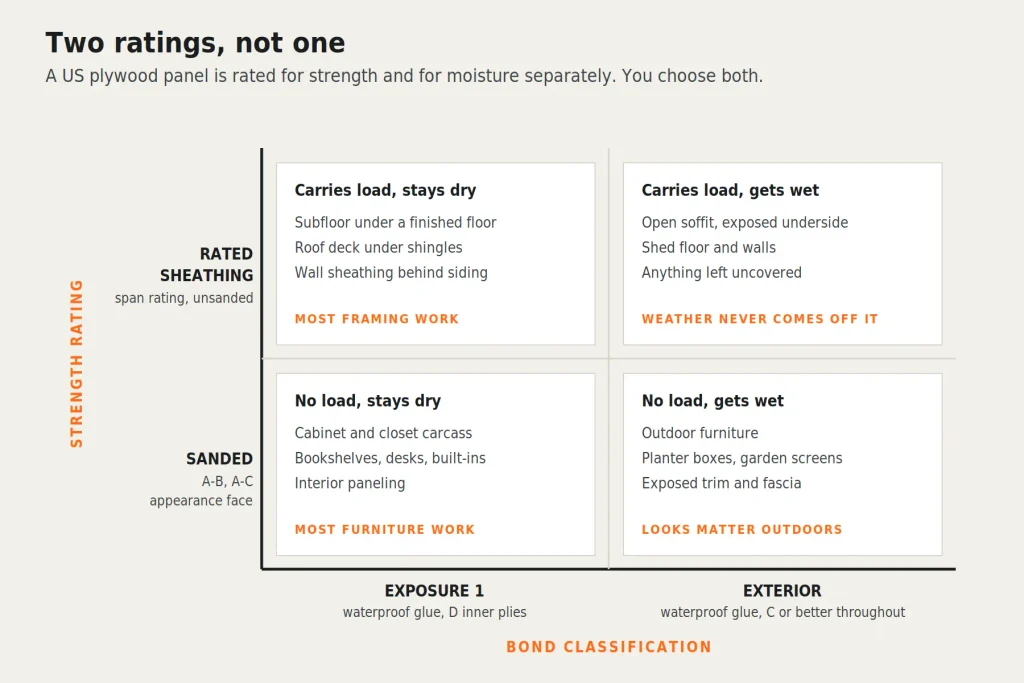
- Strength ratingRated Sheathing carries a span rating and is left unsanded. Sanded panels (A-B, A-C) are graded on appearance and carry no span rating
- Bond classificationExposure 1 or Exterior. Both use fully waterproof glue
- They move independentlyYou can buy a structural panel that isn’t rated for permanent weather, and a decorative panel that is
The part that surprises people: Exposure 1 glue is waterproof too. The difference between the two bond classes is not interior glue versus exterior glue. Exterior panels have to pass a more demanding bond test, and they require C-grade veneer or better on every ply. Exposure 1 permits D-grade veneer in the inner plies. As the Wiss, Janney, Elstner technical primer puts it, Exterior plywood must show “better wood failure percentages than Exposure 1 plywood, indicating a stronger adhesive bond between the plies.”
So Exposure 1 is built to survive the months a house sits open during construction, then spend its life protected. Exterior is built to stay out in the weather permanently. Neither one is “the interior glue.”
What Structural Plywood Means
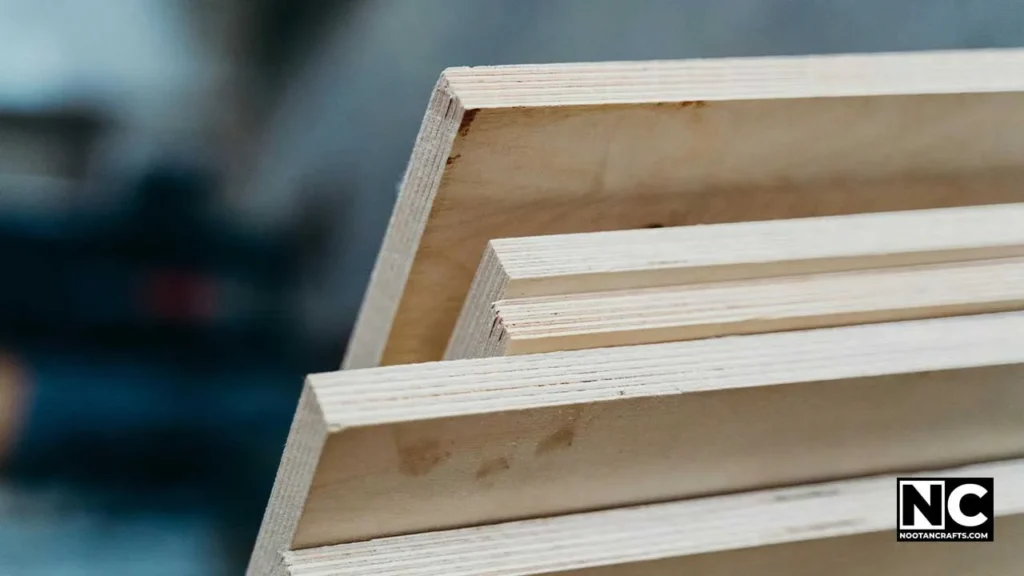
Structural plywood is a panel manufactured and stamped to carry load. In an American lumberyard you’ll see it as APA RATED SHEATHING. It’s built the same way as any plywood, with veneers glued cross-grain, but it’s tested and rated for how far it can span between supports.
- StandardPS 1 for plywood, PS 2 for performance-rated panels, printed on the stamp
- Span ratingTwo numbers like 32/16. Roof support spacing first, subfloor spacing second, both in inches
- Sturd-I-FloorA single number (16, 20, 24, 32, 48) for single-layer floor panels, giving maximum joist spacing
- Structural IA stricter grade with restricted veneers and Group 1 species in the critical plies, for higher shear strength
- SurfaceUnsanded. It is not meant to be seen
A span rating of 32/16 means the panel can span 32 inches between roof supports, or 16 inches between floor joists. You don’t pick the highest number available — you pick the one that matches the framing you actually have.
Structural I is the grade to know about if an engineer is involved. It’s specified when the panel becomes part of the building’s lateral-force-resisting system, which is the technical way of saying the walls and floors are relying on those sheets to resist wind and seismic load. If a drawing calls for Structural I, an ordinary rated panel is not a substitute.
What Non-Structural Plywood Means
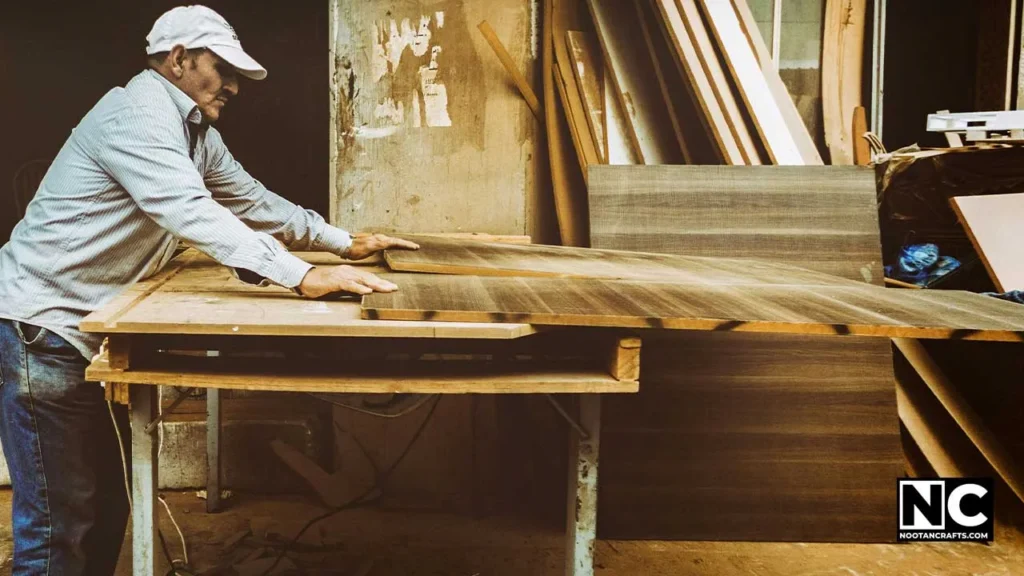
Non-structural plywood is sold on its face, not its span. These are the sanded panels — named by their two faces, like A-B or A-C. They carry no span rating because they were never tested for one.
- Graded onThe quality of the face veneers, front and back
- SurfaceSanded smooth and ready for finish
- Span ratingNone. Support spacing is your problem, not the panel’s
- Bond classStill either Exposure 1 or Exterior — you choose
- CostLower for the same thickness, and the money goes into the face
For indoor furniture this is the better buy. You get a wood veneer face that takes a finish cleanly, and you’re not paying for span capacity that a bookshelf will never use. Put one in a floor or a roof and you have no idea what it can hold, because nobody tested it.
How to Read the Stamp
The stamp settles the question in about four seconds, and it is the only thing in the store that will. Six items appear on an APA trademark:
| On the stamp | What it tells you |
|---|---|
| Panel grade | RATED SHEATHING, or a veneer pair like A-C. This is the structural answer |
| Span rating | 32/16 and similar. Present on rated panels, absent on sanded ones |
| Bond classification | Exposure 1 or Exterior. This is the moisture answer |
| Thickness | In decimal inches, which is the real thickness rather than the nominal one |
| Product standard | PS 1, PS 2, or APA PRP-108 |
| Mill number | Identifies who made it, for traceability |
Veneer grades, in one line each. A is smooth and paintable with neat repairs. B is solid, with plugs and tight knots allowed. C permits tight knots up to about 1.5 inches and some knotholes, and is the minimum for any Exterior panel. D allows the biggest knotholes and is never permitted on an Exterior face.
When to Use Structural Plywood
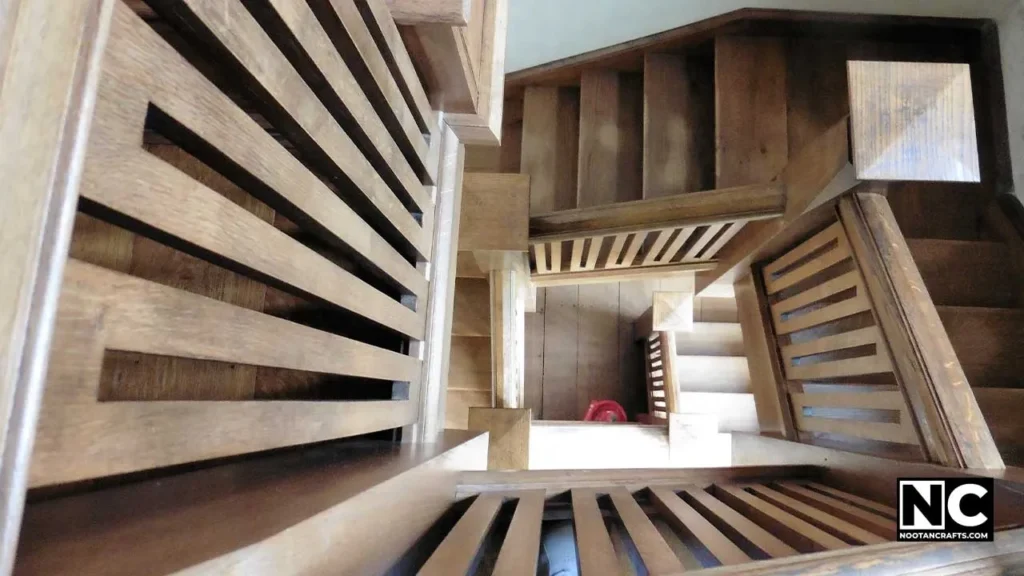
Anything holding weight, and anything a building code inspector will look at.
- Roof decking — carries shingles, insulation, snow load, and whoever is walking on it. Match the span rating to your rafter spacing.
- Subfloor — supports furniture and traffic, and has to stay flat while the house settles. Sturd-I-Floor panels do it in a single layer.
- Wall sheathing — hidden, but bracing the whole wall against wind. Structural I if the engineer calls for it.
- Sheds and outbuildings — load and permanent weather together, so this is where you want Exterior bond rather than Exposure 1.
- Workbench tops and heavy shelving — not code work, but real load. A rated panel is the cheap way to get a top that won’t sag.
Plywood in the wrong place fails at the glue line, all at once
A solid board sags first and gives you warning. Plywood doesn’t. When a glue line lets go, the plies separate and the sheet loses most of its stiffness in one go. That is the failure behind collapsed shelving and soft spots in floors.
- Never substitute a sanded panel for rated sheathing in framing, flooring, or roofing. It has no span rating because it was never tested. You are guessing with a load over your head.
- Read the stamp, not the sheet. A clean sanded panel looks stronger than a rough rated one. Appearance tells you nothing about what it can hold.
- Exposure 1 is not permanent weather protection. It is rated for construction delays, not for a life outdoors. If the panel will never be covered, buy Exterior.
- Cutting any plywood releases formaldehyde-bonded dust. Respirator on, cut outdoors or with extraction running. This applies to every grade, not just the structural ones.
- An unstamped sheet is an unknown sheet. It may be fine. You have no way to find out, and no recourse if it isn’t.
When to Use Non-Structural Plywood
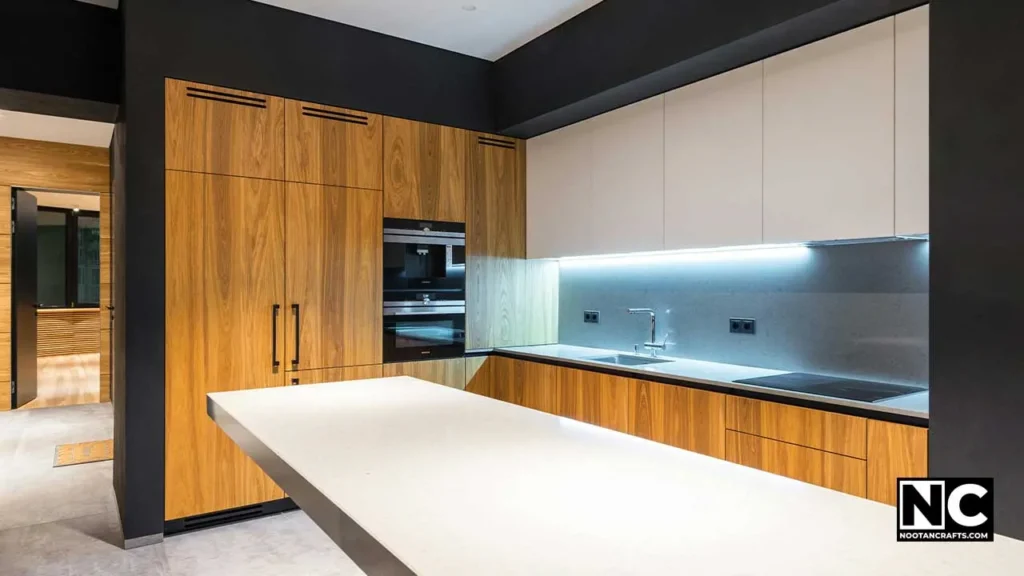
Anywhere the surface is the point and the load is light.
- Furniture — bookshelves, cabinets, desks. Take the saving and spend it on a better face veneer, which is the part anyone will see.
- Cabinet carcasses, kitchen and bathroom included — sanded panel, Exposure 1 bond. You want the waterproof glue for the humidity, not the span rating.
- Interior paneling — no load whatsoever, so this is purely a question of which face you like.
- Outdoor furniture and planters — sanded A-C with an Exterior bond. Decorative, but permanently wet.
- Jigs, templates, and shop fixtures — flat and smooth matters, strength doesn’t.
If you’re weighing plywood against a laminate board rather than against another plywood grade, that’s a different comparison — see plywood vs melamine.
Cutting Plywood Without Tearout
Buying the right panel and then splintering the face on the first cut is a common way to waste the money you just spent. The blade matters more than the saw does, and more teeth is not automatically better.
Pneumatic Addict ran four blades through 3/4-inch red oak plywood and published the results. The 18-tooth framing blade caused heavy splintering. The 24-tooth still chipped the edges. The 60-tooth finish blade cut with no tearout at all. The 140-tooth blade went the other way: it bound in the cut, burned the edge, and slowed to a crawl, because that many teeth can’t clear the chips. Sixty teeth on a 7-1/4 inch blade is the working answer.
- Face down on a circular sawThe teeth exit through the top, so tearout lands on the face you hid
- Face up on a table sawOpposite direction of cut, opposite rule
- Score the line firstA utility knife cut through the top veneer stops the splinter before it starts
- Back the cutA sacrificial board underneath supports the fibers as the blade leaves
Moisture is the other thing worth checking before you build. Panels stored outdoors at a yard can come in wetter than you’d like, and a cabinet assembled from damp plywood moves as it dries.
Common Questions
Is Exposure 1 plywood waterproof?
The glue is. The panel isn’t. Exposure 1 uses a fully waterproof adhesive, which is why it survives a house standing open through a wet winter. What it doesn’t have is C-or-better veneer throughout, and it isn’t rated for a permanent life in the weather. For that, buy Exterior.
How do I tell structural from non-structural in the store?
Look for a span rating on the stamp — two numbers with a slash, like 32/16. If it’s there, the panel is rated to carry load. If the stamp names veneer grades instead, like A-C, it’s a sanded appearance panel. No stamp at all means treat it as non-structural.
What does 32/16 mean?
Maximum support spacing in inches: 32 for roof framing, 16 for floor joists. It’s a rating for that specific panel at that thickness, so a thicker sheet of the same grade will carry a different pair of numbers.
Can I use rated sheathing for furniture?
Yes, and for a workbench or garage shelving it’s a sensible choice. The trade-off is the face: it’s unsanded, often has knots and patches, and won’t take a clear finish well. Paint it, laminate it, or accept the look.
What is Structural I and do I need it?
It’s a stricter grade with restricted veneers and stronger species in the critical plies, giving higher shear strength. You need it when a structural engineer specifies it, usually for shear walls and diaphragms. For a shed or a workbench, you don’t.
What about F14 and F17 grades?
Those are Australian and New Zealand stress grades, common on formwork plywood there. They don’t appear on panels sold in the US, so if you’re shopping in an American lumberyard you can ignore them and look for the span rating instead.
Is structural plywood the same as marine plywood?
No. Marine plywood is a separate specification with no core voids and high-grade veneers throughout, built for boats and constant submersion. Exterior-bond structural plywood handles rain and damp; it isn’t meant to sit in water.
Choosing Between Them
Ask the two questions separately and the answer falls out. Will it carry weight? If yes, you want rated sheathing with a span rating that matches your framing. Will it stay wet? If yes, you want Exterior rather than Exposure 1. A kitchen cabinet answers no to the first and no to the second, so a sanded Exposure 1 panel is right and the structural sheet would be a waste of money with a worse face. A shed wall answers yes to both.
Then read the stamp before it goes in the cart. That is the whole method, and it takes four seconds.