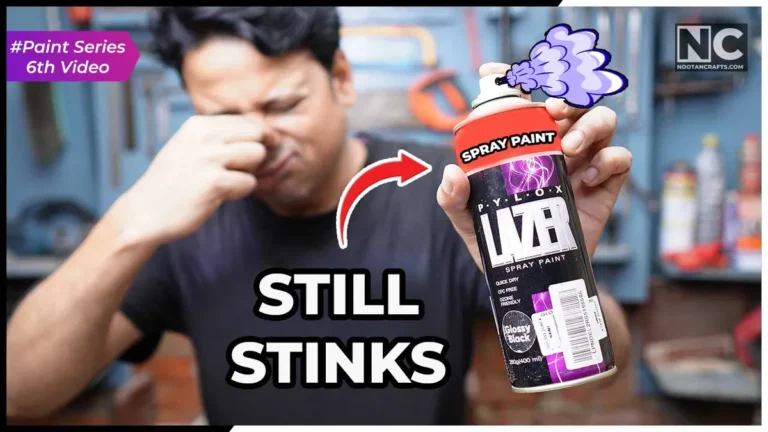
Get rid of spray paint smell by cross-ventilating the room — windows open on opposite sides plus a fan pushing air out, not just a ceiling fan stirring it in place — and backing that up with activated charcoal or baking soda set near the painted surface to absorb the fumes rather than just cover them. Vinegar and lemon bowls only mask the smell; they don’t remove the VOCs actually causing it.
What’s Inside!
Room or Object?
Before any of the methods below, answer this one question, because it changes everything. Most people searching for this sprayed a thing, not a room — a chair, a shelf, a set of planters — and then brought it indoors to dry.
If you painted an object, move the object. Put it in the garage, on a covered porch, or under a tarp outside, and the problem walks out of the house with it. Every trick below is a way of dealing with fumes you couldn’t remove at the source. Moving the source is faster than all of them combined and costs nothing.
If you sprayed the room itself — walls, trim, built-in cabinets — then the source is staying put, and the rest of this page is the job.
| Method | Removes or masks? | Worth doing? |
|---|---|---|
| Move the object outside | Removes the source | First choice, if it’s an object. Nothing else comes close |
| Cross-ventilation with a fan | Removes | The main method. Everything else supports this one |
| Activated charcoal | Removes, by adsorption | Yes. Slow but real, and it works overnight while you’re not there |
| Baking soda | Removes, weakly | Mild version of charcoal. Fine if it’s what you have |
| Box fan with a carbon filter | Removes | Yes, and it’s cheap. Use thick granular carbon, not a thin coated sheet |
| Air purifier, HEPA only | Neither | No. Physically cannot touch VOCs — see below |
| Vinegar or lemon bowls | Masks | Only alongside ventilation. It’s perfume, not a fix |
| Scented candles, air freshener | Masks, and adds fumes | No. An open flame near solvent vapor is also a bad idea |
The smell fading doesn’t mean the VOCs are gone
Spray paint fumes are volatile organic compounds. The EPA lists eye and respiratory irritation, headaches, dizziness and visual disorders among their effects, and notes that elevated indoor concentrations “can persist in the air long after the activity is completed.” Your nose adapts to a constant smell and stops registering it, which is not the same as the air clearing.
- Don’t sleep in a room sprayed within the last 48 hours if the smell is still noticeable when you walk back in from outside. Walking in from fresh air is the only honest test your nose can give you.
- Keep children out until it’s clear. They breathe faster relative to body size, and they spend more time near the floor, where solvent vapor settles.
- Move birds out of the house entirely. Birds have respiratory systems far more sensitive than ours and are harmed by fumes at levels people barely notice. Cats and dogs should be kept out of the room.
- If you’re pregnant, asthmatic, or have a lung condition, let someone else handle the room until it’s aired out, and ask your doctor rather than this article.
- No open flame while it still smells. Solvent vapor is flammable, so no candles, and mind pilot lights on gas appliances.
How to Get Rid of Spray Paint Smell — My Video
Why the Smell Sticks Around
Spray paint carries VOCs as the solvent that delivers the pigment, and those solvents are supposed to evaporate off once the paint’s on the surface. Three things slow that evaporation down: a closed room with nowhere for the fumes to go, no real airflow, and high humidity, which keeps the solvent from evaporating at a normal rate. None of those are about the paint being defective — they’re about the room not letting the paint finish off-gassing.
Which is why the smell and the drying time are the same problem seen from two sides. A room that clears fumes quickly is also a room the paint cures quickly in, and the conditions that fix one fix the other — the same ones covered in making spray paint dry faster.
Getting Rid of the Smell, Method by Method
1. Ventilate properly — the method that actually works
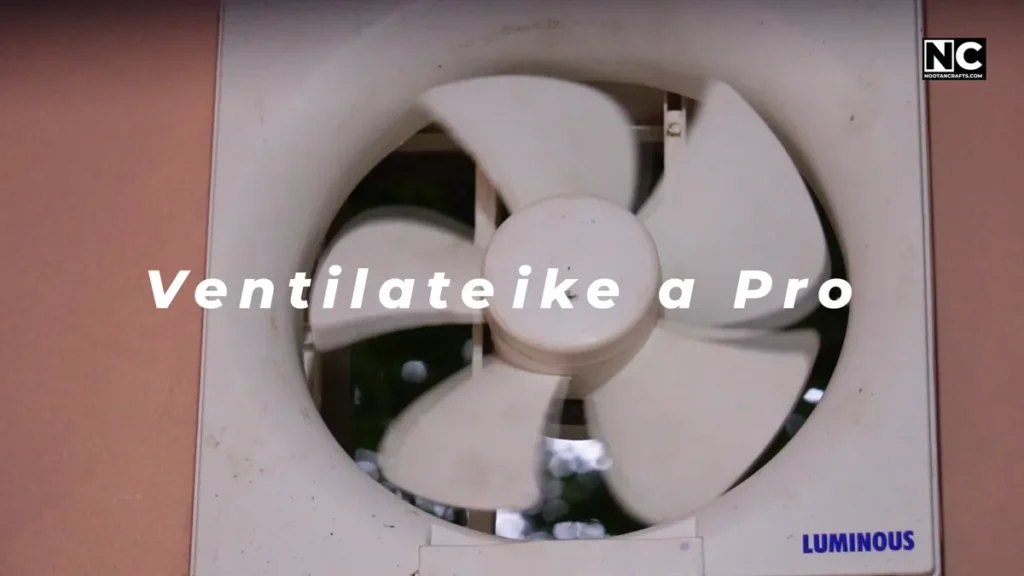
Open windows on opposite sides of the room so air has somewhere to go — one open window with a fan pointed out, and another cracked elsewhere for air to pull in. A ceiling fan alone just recirculates the same air and won’t move the VOCs out of the room.
- Pick the exit window — ideally the one nearest the painted surface, and on the downwind side of the house.
- Put a box fan in it, facing out. Blowing air out beats blowing air in, because it pulls fresh air through the whole room behind it rather than pushing fumes into the next room.
- Open a second window on the far side, a few inches is enough. Without an inlet the fan is fighting the house.
- Shut the door to the rest of the house, so the replacement air comes from outdoors instead of from your hallway.
- Leave it running for hours, not minutes. Overnight if the weather allows it. This is the step people cut short.
2. Activated charcoal or baking soda
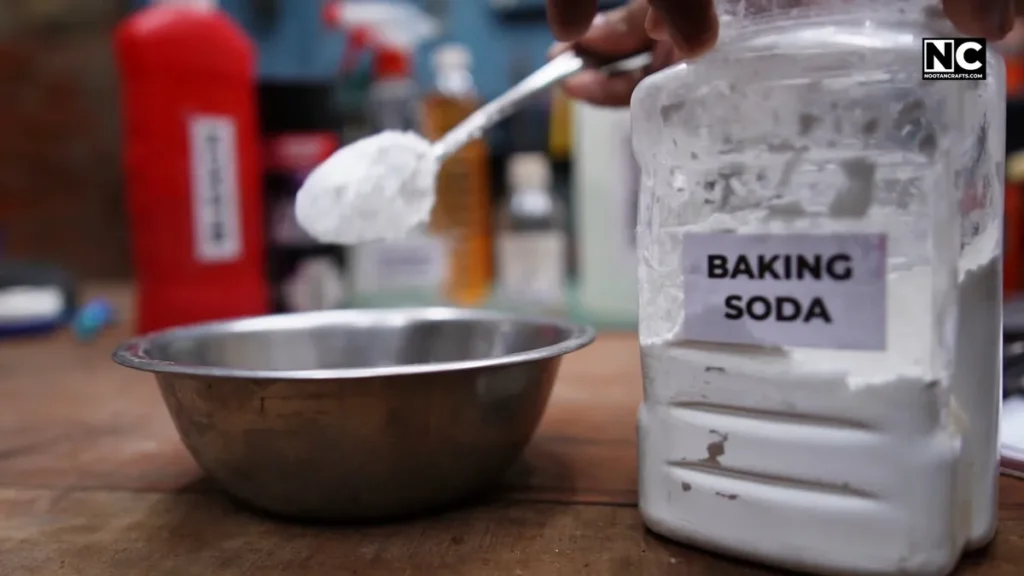
Both actually absorb VOCs rather than mask them. Set a few open bowls around the room, closest to the painted surface, and leave them for a full day. Activated charcoal is far and away the better of the two — it’s manufactured to be extraordinarily porous, and a single gram carries thousands of square feet of internal surface for molecules to stick to. Baking soda is the mild household stand-in.
3. A box fan with a carbon filter taped to it
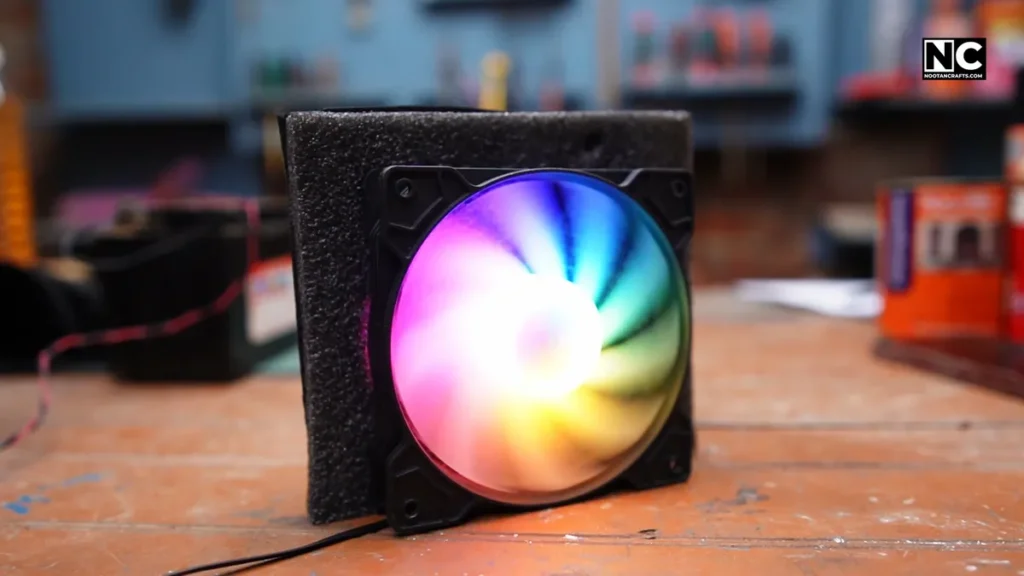
Tape an activated-carbon air filter to the intake side of a box or computer fan and run it for a few hours. It pulls room air through the filter and traps VOC molecules the same way a proper air scrubber would, for a fraction of the cost.
Thickness is what makes this work. A thin carbon-coated sheet holds well under half a pound of carbon and saturates in an afternoon. A proper granular carbon bed — a couple of inches deep, several pounds of it — lasts. If you’re taping a filter to a fan, spend the small extra on the thick one; the thin one gives you the satisfying feeling of having done something and very little else.
4. Vinegar or lemon bowls — masking only

These cover the smell rather than remove it — closer to perfume than a fix. Use them alongside real ventilation, not instead of it, and expect to replace them every few hours.
Why Your Air Purifier May Not Be Helping
This is the most common wasted purchase in the whole problem. Someone buys a well-reviewed HEPA purifier, runs it for two days, and the room still smells exactly the same. The purifier isn’t faulty. It is doing precisely nothing about this, and it never could.
- HEPA is a meshIt physically strains particles out of the air. Rated at 0.3 microns
- VOCs are gas moleculesAround a thousandth of a micron — roughly a thousand times smaller than what HEPA is built to catch
- The gap is physics, not qualityNo grade of HEPA, no amount of airflow, and no premium model changes this
- Carbon works differentlyAdsorption, not straining. Gas molecules stick to the carbon’s surface instead of being caught in a net
Catching a VOC with HEPA media is like trying to catch sand with a fishing net.activated carbon it contains. Many machines advertise a carbon stage that turns out to be a thin coated sheet. For a real VOC problem you want pounds of granular carbon, not grams.
Carbon wears out silently. Every pore that grabs a molecule is used up. A saturated filter stops working, and can even release what it captured back into the room — with no visual warning, because unlike a dusty HEPA filter it looks the same on the last day as the first. Replace it on schedule, not on appearance.
What I’d buy for this job


Last update on 2026-10-25 / Affiliate links / Images from Amazon Product Advertising API
Still Smells After Three Days?
A smell that won’t quit usually comes down to a few things: the room stayed sealed, the windows weren’t open long enough to move air, the paint went on during high humidity, or the coat was thick enough to need extra time to cure. None of those mean anything’s wrong with the paint — they mean the room needs more airflow time than you gave it.
Two others catch people out. A thick coat holds solvent under a dried skin, and it comes out slowly for days — one heavy pass can smell longer than three light ones that used more paint in total. And the smell can come back on the first warm day. Heat drives out solvent still trapped in the film, so a room that seemed fine in cool weather can smell again when the sun hits that wall. That’s normal; it’s milder each time, and the answer is the same: open the windows.
Spray Paint Smell Questions People Actually Ask
How long does spray paint smell last?
Anywhere from a few hours to a few days, depending on ventilation, humidity, and the paint type — thin coats in a well-ventilated room clear fastest. A sealed room with a thick coat can hold a smell for a week or more.
Will an air purifier help?
Only if it has a substantial activated carbon stage. HEPA filtration alone catches particles, and VOCs are gas molecules about a thousand times smaller than HEPA is designed to capture, so it does nothing for the smell. Check the carbon weight before buying.
Does heat make the smell go away faster?
Warmth helps the paint cure and drives solvent out of the film faster, but airflow is what actually removes the fumes from the room. Heat without airflow just concentrates them.
Does vinegar remove paint smell?
No — it masks it. For actual removal, use ventilation first, then activated charcoal or a carbon filter.
Is the smell of spray paint actually harmful?
The VOCs behind it can cause eye and respiratory irritation, headaches and dizziness, which is why the EPA’s advice on these products is to maximize ventilation. Avoid sleeping in a room that still smells strongly, and keep children and pets out until it clears.
Why did the smell come back after a week?
Warm weather. Heat pulls out solvent still trapped under the surface of the film, especially where the coat went on thick. It’s weaker each time it happens and it does stop.
Can I paint indoors in winter with the windows shut?
It’s the worst case for both smell and drying — no air exchange and low temperature together. If you have no choice, spray the thinnest coats you can, run a carbon-filter fan, and open up for short bursts rather than not at all.
The smell isn’t really the problem — the trapped VOCs behind it are. Move the object outside if you can, ventilate properly if you can’t, add charcoal or a carbon-filter fan if the room needs help, and give it real time rather than a scented workaround.