Buy the spade bit if the hole is shallow, rough and cheap to make. Buy the auger if the hole is deep, clean, or in something you cannot pull the bit back out of easily. The difference is not size or price — it is that an auger pulls itself through the wood and clears its own waste, and a spade bit does neither.
That single mechanical difference decides every other comparison on this page.
| Spade bit | Auger bit | |
|---|---|---|
| How it starts | Small center spur | Threaded screw point that bites and pulls |
| Waste clearing | None – the flat blade pushes chips ahead of it | Deep single flute augers chips back out continuously |
| Best depth | Shallow. Up to roughly the board’s thickness | Deep. Through beams, posts, several boards at once |
| Hole quality | Rough walls, splintered exit | Clean walls, much cleaner exit |
| Feed pressure | You supply all of it | Almost none – the screw point does the work |
| Cost | Cheap, often sold in sets | Several times the price each |
| Drill it needs | Any drill, high speed | Torque at low speed. Can stall a small cordless |
What’s Inside!
The Spade Bit
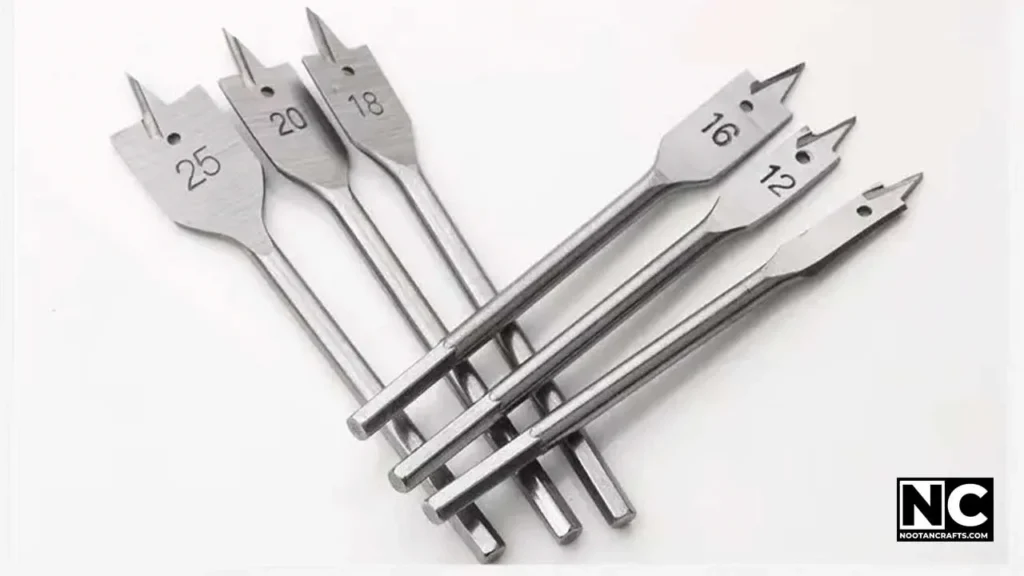
A flat paddle of steel with a point in the middle and a cutting edge across each side. It scrapes material away rather than slicing it, which is why the walls come out rough and why it needs to run fast — around 1,000 to 2,000 rpm for most sizes.
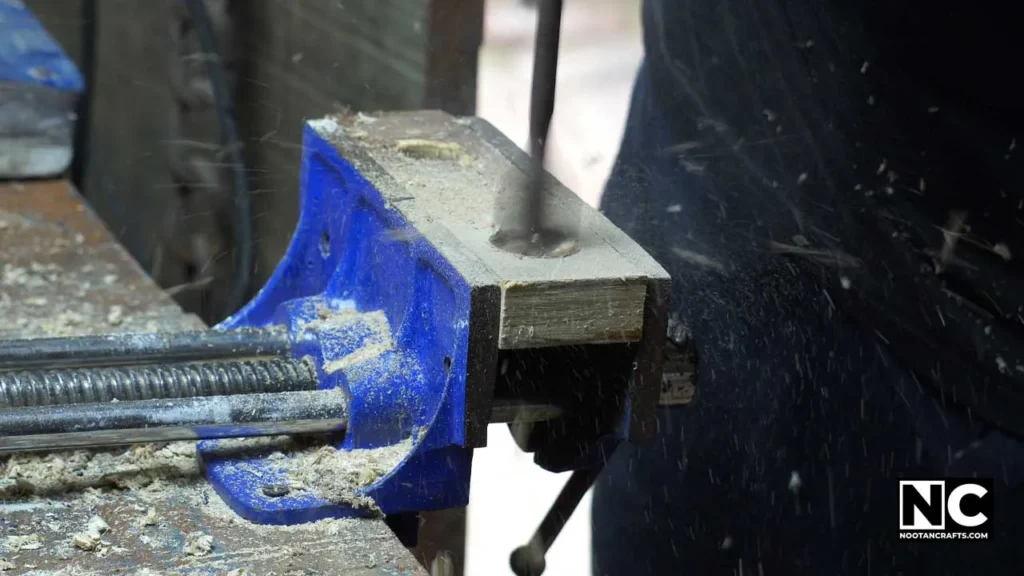
What it is very good at is being cheap and disposable. A spade bit that hits a nail is a small annoyance; an auger that hits a nail is a real one. For running cable through studs, making a rough clearance hole, or any job where nobody will ever see the inside of the hole, it is the correct choice and not a compromise.
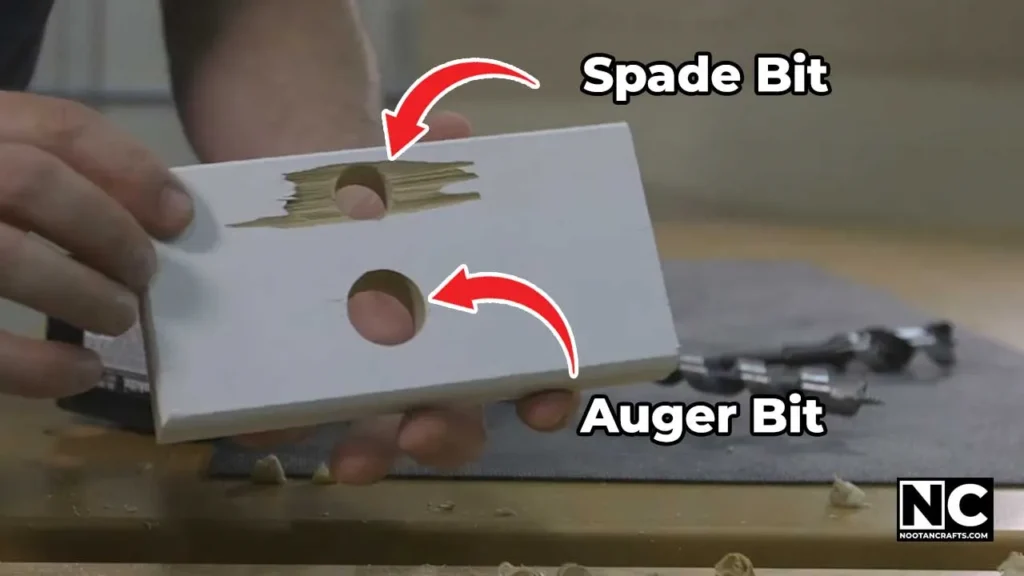
The exit is where spade bits embarrass you. Because the blade pushes rather than slices, it blows a ragged crater out of the far side of the board. Two fixes: clamp a sacrificial scrap behind the workpiece so the fibers are supported, or stop as soon as the center point breaks through, flip the board, and finish the hole from the other side using that small hole as the center.
The tool for this job


Last update on 2026-10-25 / Affiliate links / Images from Amazon Product Advertising API
The Auger Bit
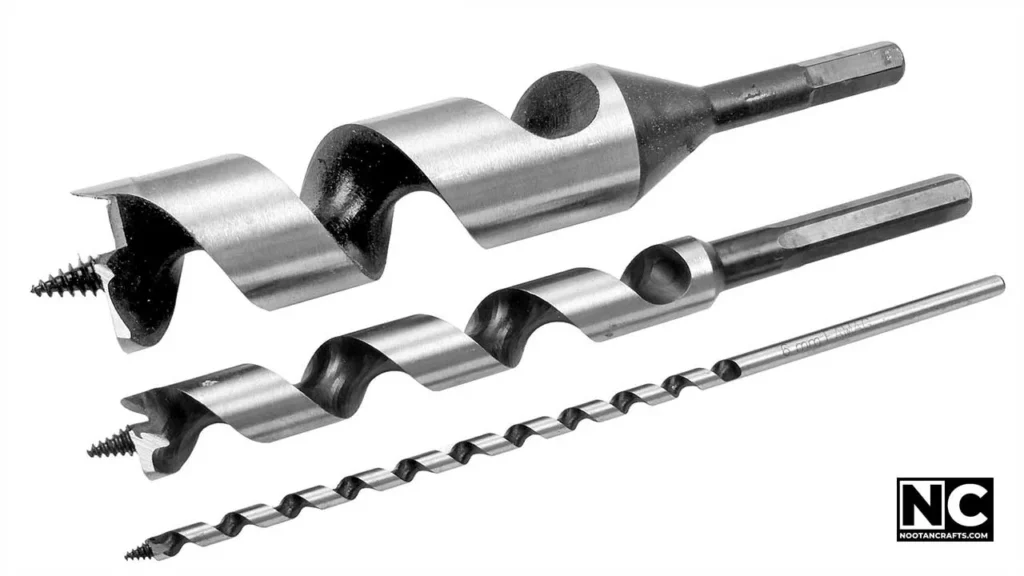
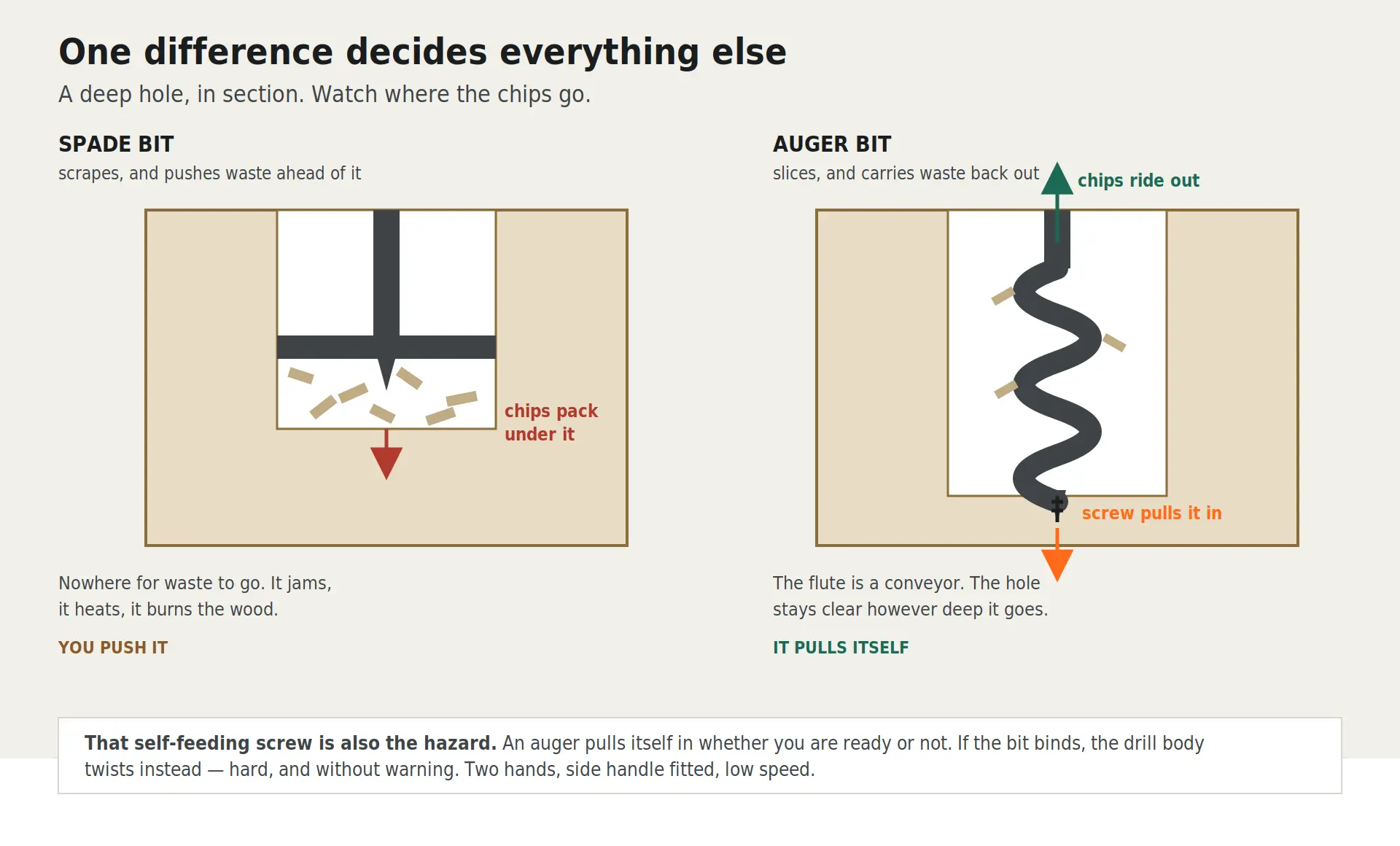
A deep helical flute with a threaded screw point at the tip. The screw bites into the wood and draws the bit forward at a fixed rate, so you are not pushing — you are just holding the drill and letting it feed itself. The flute then carries every chip back out of the hole behind it.
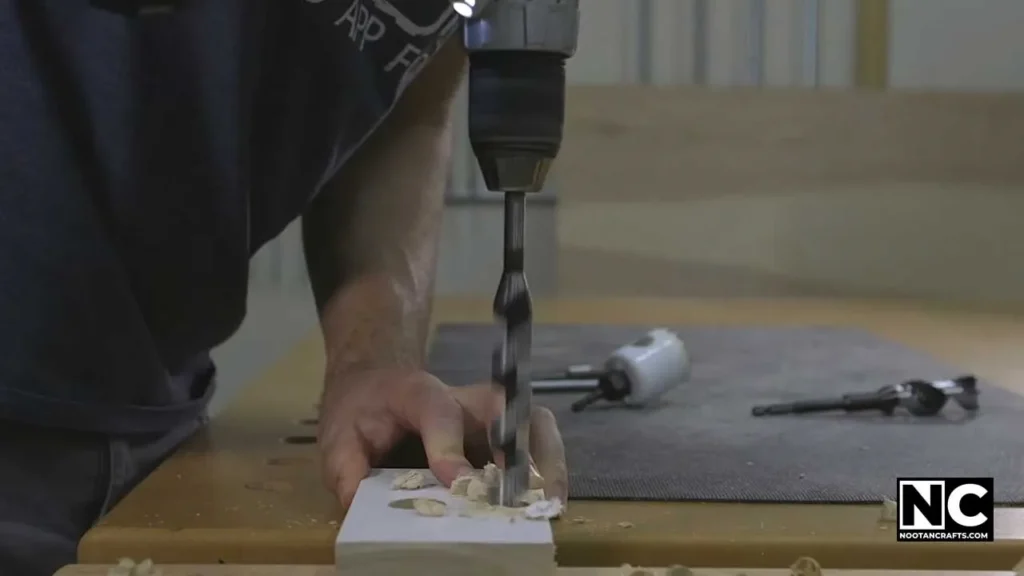
That self-clearing action is what makes deep holes possible. A spade bit in a 6 in (150 mm) deep hole packs the hole with chips, which jams it, which heats it, which burns the wood. An auger simply keeps going – the same self-clearing principle a deep straight hole depends on.
The self-feeding screw is also the hazard. An auger pulls itself in whether or not you are ready, so if the bit binds, the drill body twists instead — hard, and without warning. Two hands, the side handle fitted if the drill has one, and low speed. This is one of the few wood bits that can wrench a drill out of your grip.
The tool for this job

Last update on 2026-10-25 / Affiliate links / Images from Amazon Product Advertising API
Where Each One Wins
| The job | Use | Why |
|---|---|---|
| Cable through studs | Spade | Rough is fine, and hitting a nail costs nothing |
| Through a beam or a fence post | Auger | Depth. A spade bit will pack and burn long before it gets through |
| A hole you will see – furniture, a shelf | Auger | Clean walls and a clean exit |
| Twenty rough holes in scrap | Spade | Fast, cheap, and no reason to spend more |
| Green or wet timber | Auger | Wet chips clog a spade bit almost immediately |
| Reclaimed wood with hidden fixings | Spade | It is the one you can afford to sacrifice |
| Working overhead or one-handed | Spade | An auger’s self-feed is hard to control from an awkward position |
| Hardwood | Auger | The screw point does the feeding you would otherwise have to supply |
The Cases People Get Wrong
- Running an auger fast. It is not a twist bit. High speed with a self-feeding point overloads the flute and burns the wood. Low gear, steady.
- Using an auger in a small cordless drill. A large auger in hardwood needs more torque than a compact drill has. It stalls, then it twists.
- Expecting a spade bit to go deep. Its limit is roughly the board’s thickness, and past that it is fighting its own waste.
- Blaming the bit for a torn exit. A spade bit will always tear on exit unless the fibers behind it are supported. Scrap behind, or finish from the other side.
- Using either in metal or masonry. Both are wood bits. Metal wants HSS or cobalt, masonry wants carbide.
- Not clamping. Both bits grab, and an auger grabs hard. A workpiece that spins with the bit is the injury in this job.
Best drill bits


Last update on 2026-10-25 / Affiliate links / Images from Amazon Product Advertising API
Common Questions
Which bit gives a more precise hole?
The auger, clearly. Its screw point starts exactly where you put it and its flutes leave clean walls, where a spade bit scrapes and can drift. For a hole that has to be right, or that anyone will see, use the auger. Neither is as precise as a Forstner bit, which is the tool when the hole must be flat-bottomed and exact.
Can spade bits handle hardwood?
Yes, but they need real feed pressure and they blunt faster than in softwood. If you are drilling hardwood repeatedly, the auger’s self-feeding point is doing work you would otherwise be doing with your shoulder.
How do auger bits clear shavings?
The deep helical flute acts as a screw conveyor – it carries chips up and out continuously as the bit advances. That is the whole reason augers work at depths where a spade bit packs solid and starts burning.
Are auger bits worth the cost?
If you drill deep holes, clean holes, or a lot of holes, yes – the difference is not marginal. If your drilling is occasional and rough, a set of spade bits for the price of one auger is the better buy, and you will not miss anything.
Can I use a spade bit at an angle?
Poorly. Its small center spur has very little to grip with, so it skates on a slope. An auger’s threaded point bites and holds far better. Either way, an angled hole wants a guide rather than a steady hand – see drilling at 45 degrees.
Why is my spade bit burning the wood?
Chips packed in the hole, a blunt edge, or too little feed pressure so it is rubbing rather than cutting. Withdraw it regularly to clear waste, and if it still burns, the edges need a few strokes with a file – spade bits are easy to sharpen, which is another quiet advantage.
Own a set of spade bits, and buy augers one at a time in the sizes you actually keep reaching for. That is the answer for almost every workshop.