The first day I owned a drill, my friend Ranjiv leaned on it until the bit snapped and the broken end cut his hand. Ten years later, I have broken dozens of my own, almost always in steel and almost always the thin ones, and the lesson has never changed: pressure and speed are what break bits, and the only way to get both right is to know what the metal wants.
Buy a cobalt set if you are buying one thing. Cobalt holds its hardness at the temperature where plain HSS has already gone soft, which is the whole argument. Then match the bit to the metal: HSS for aluminum, brass, copper, zinc and mild steel; cobalt for stainless, cast iron and hardened steel; carbide-tipped for tool steel, where cobalt starts losing.
The part almost nobody publishes is the speed. Stainless wants roughly a sixth of the surface speed aluminum does, and running it at aluminum speed is how you ruin a good bit in one hole. The full RPM table is below, along with the hardness chart and seven bits worth owning.
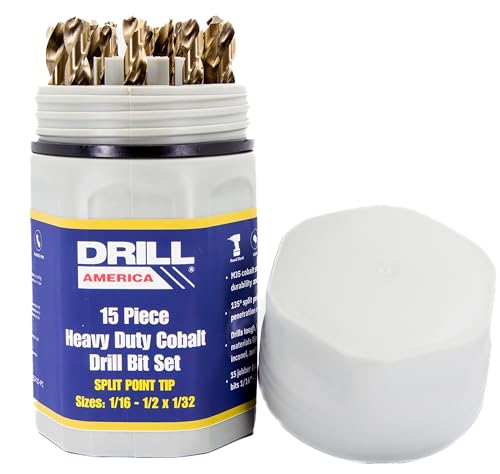
Top Pick — Drill America Cobalt Set

Last update on 2026-10-25 / Affiliate links / Images from Amazon Product Advertising API
Ten years ago my friend Ranjiv leaned on my new drill until the bit broke and cut him
We were drilling a stainless steel pipe with an ordinary bit, at full speed, dry, with nothing clamping the pipe down. Every one of those was a mistake, and together they are the standard recipe for a snapped bit:
- Wrong bit for the metal. An HSS bit against stainless work-hardens the surface. Once that happens the bit is rubbing, not cutting, and the heat climbs fast.
- Too much pressure. Force is what actually breaks the bit, and thin bits go first because they have the least material to resist the twist. If it needs leaning on, the bit is dull or wrong — pushing harder never fixes either.
- Too much speed, no lubrication. Heat destroys the cutting edge. A blunt edge needs more force, which brings you back to the line above.
- Unclamped workpiece. A pipe that rolls as the bit bites will jam it sideways. Side load is what turns a stuck bit into a broken one.
- No pilot hole. A large bit starting cold on a curved surface wanders, then catches.
Wear safety glasses. A snapping bit throws hardened steel fragments at the speed of the chuck. Clamp the work, start with a pilot hole, run slow, and stop the moment the bit stops producing chips.
What’s Inside!
- 1 – What Makes a Drill Bit Good for Metal
- 2 – Drill Speed for Metal: RPM by Material and Bit Size
- 3 – Drill Bits for Metal Compared
- 4 – Seven Drill Bits for Metal, Reviewed
- 4.1 – 1. Drill America Cobalt Set (Best Overall)
- 4.2 – 2. Bosch CO14B Cobalt Set (Best Value)
- 4.3 – 3. Norseman Magnum Super Premium (Best for Stainless)
- 4.4 – 4. Chicago-Latrobe 157 Series (Best for Aluminum and Soft Metals)
- 4.5 – 5. DeWalt DWA1790IR Step Bit Set (Best for Sheet Metal)
- 4.6 – 6. Milwaukee Hole Dozer Bi-Metal Set (Best for Large Holes)
- 4.7 – 7. Drill America Carbide-Tipped Die Drill (Best for What Cobalt Won't Cut)
- 5 – Which Bit for Which Metal
- 6 – The Hard Metals, and What They Do to Bits
- 7 – How to Drill Metal Without Breaking Bits
- 8 – Which Drill Bits Should You Buy?
- 9 – Drill Bit Questions People Actually Ask
- 10 – The One Thing Not to Get Wrong
What Makes a Drill Bit Good for Metal
- MaterialHSS for soft metals, cobalt (M35/M42) for hard, carbide for hardest
- CoatingBlack oxide resists rust; titanium nitride adds surface hardness
- Tip angle135° split point self-centers; 118° is the general-purpose grind
- LengthJobber for reach, screw-machine (short) for stiffness
- ShankReduced shank fits a 13 mm chuck on larger bits
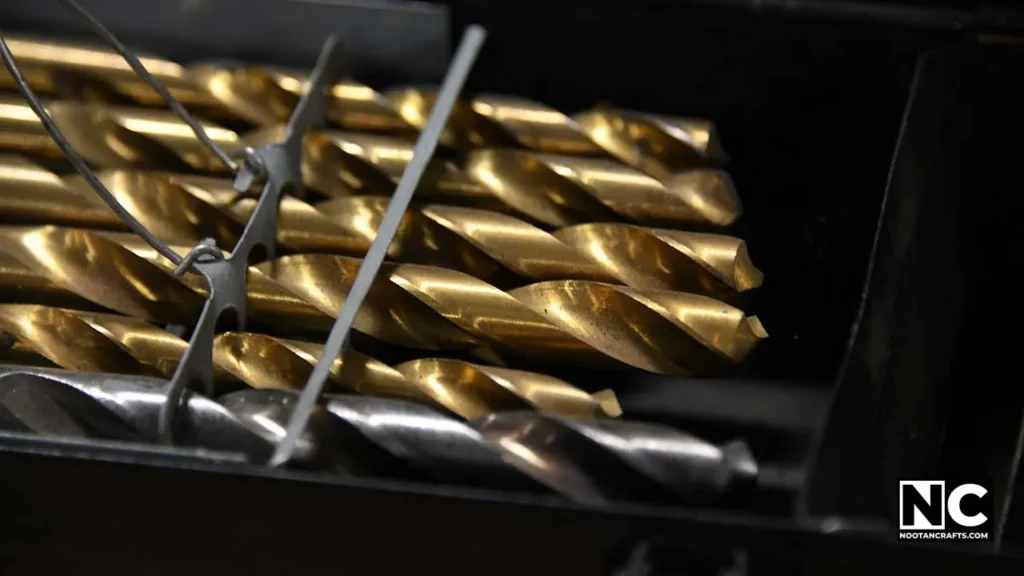
Cobalt is alloyed through; titanium is only a skin
One distinction worth getting right, because the marketing blurs it: a titanium-coated bit is an HSS bit with a thin hard surface layer. Sharpen it, and the coating is gone. A cobalt bit has cobalt alloyed through the whole bit, so it survives resharpening. For repeated work on stainless, that difference decides which one is still usable in a year.
Do not put a titanium-coated bit in aluminum
This is where this guide differs from most others – Titanium nitride is widely recommended for aluminum and soft metals. It should not be, because aluminum bonds to the coating and tears it off the bit. For soft metals, the recommendation is plain uncoated HSS at a 118° point—cheaper, and it lasts longer for the one job the coated bit is sold for.
Coatings solve a problem aluminum does not have. A coating buys surface hardness and heat resistance, which matter in steel and stainless. Aluminum is soft and sticky; it welds itself to the flutes. A slick, plain, well-cleared bit beats a hard-coated one there every time.
Short bits break less than long ones
Nearly every bit I have snapped was a small-diameter jobber-length bit. Length is why. A drill bit in a hand drill is a slender column being twisted, and the longer and thinner it is, the less force it takes to deflect and then break it. Screw-machine bits—sold as short-length or stub—have the same diameter but roughly half the flute length, which makes them far stiffer for the same money.
The trade is reach. A short bit cannot drill deeper than its flutes, so anything thicker than an inch or two still needs jobber length. For sheet, bar, angle, and plate — which is most of what a home workshop drills — short bits are the ones that survive a beginner’s grip.
Drill Speed for Metal: RPM by Material and Bit Size
This is the table the other guides leave out, and it is the one that saves bits. Cutting tools are specified in surface feet per minute, not RPM, because the correct speed depends on the bit’s diameter as well as the metal. Norseman publishes the SFM figures for HSS drills along with the conversion: RPM = (3.8197 ÷ drill diameter in inches) × SFM.
| Material | SFM (HSS) | 1/8 in | 1/4 in | 3/8 in | 1/2 in |
|---|---|---|---|---|---|
| Aluminum and alloys | 200–300 | 6110–9170 | 3060–4580 | 2040–3060 | 1530–2290 |
| Brass and bronze | 150–300 | 4580–9170 | 2290–4580 | 1530–3060 | 1150–2290 |
| Cast iron, soft | 75–125 | 2290–3820 | 1150–1910 | 760–1270 | 570–950 |
| Mild steel | 80–110 | 2440–3360 | 1220–1680 | 810–1120 | 610–840 |
| Medium-carbon steel | 70–80 | 2140–2440 | 1070–1220 | 710–810 | 530–610 |
| Tool steel | 50–60 | 1530–1830 | 760–920 | 510–610 | 380–460 |
| Stainless steel | 30–50 | 920–1530 | 460–760 | 310–510 | 230–380 |
Stainless wants 30–50 SFM against aluminum’s 200–300 — six times slower. A 1/4 in bit should turn about 600 rpm in stainless and 4,000 in aluminum. Most cordless drills sit near the top of that range by default, which is why a bit that sails through aluminum dies in one stainless hole.
Two things to read alongside the numbers. The table is for high-speed steel; cobalt keeps its hardness at higher temperatures, and Drill America puts the gain at up to 30 percent greater speed than plain HSS for its aerospace-standard cobalt drills. Treat that as a ceiling rather than a target — the top of any range still shortens a bit’s life. And a drill with no speed dial gives you one lever: trigger control. Feather it, and judge by the chips rather than the tachometer.
The chip test beats any number. Steady curling chips mean the speed and pressure are right. Dust, or a bit that turns straw-colored and then blue, means too fast. Nothing coming out at all means you are rubbing rather than cutting, and in stainless that is the moment the surface hardens, and the bit is finished.
Drill Bits for Metal Compared





Last update on 2026-10-25 / Affiliate links / Images from Amazon Product Advertising API
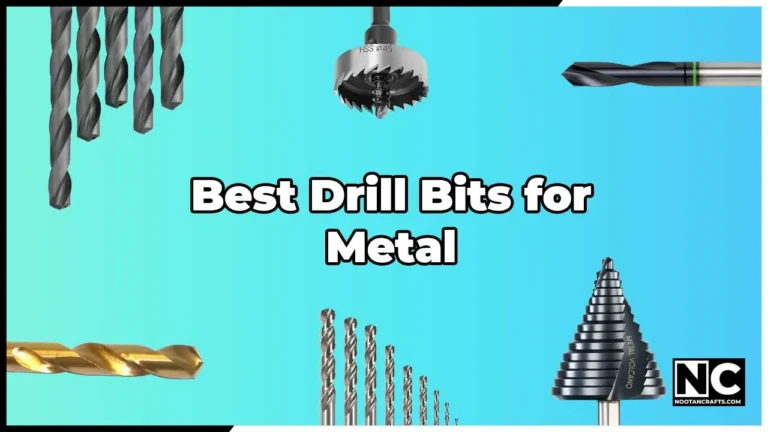
Listed in review order. The last three aren’t twist bits at all—a step bit, a hole saw set, and a single carbide-tipped bit—because past a certain diameter or hardness, a twist bit is the wrong tool, not just a worse one.
Seven Drill Bits for Metal, Reviewed
1. Drill America Cobalt Set (Best Overall)
Best Overall
Last update on 2026-10-25 / Affiliate links / Images from Amazon Product Advertising API
- MaterialM35, 5% cobalt
- Pieces15, 1/16 in to 1/2 in by 32nds
- Point135° split point, jobber length
- StandardNational Aerospace Standard 907
- SeriesDrill America DWDCO
If you are buying one set and you want to stop replacing bits, buy cobalt, and Drill America is the industrial-supply brand that sells it without a consumer markup. The point of cobalt is not that it is harder when cold — it is that it stays hard when hot, which is exactly the condition a hand drill creates in stainless. Drill America builds these to National Aerospace Standard 907, which is a real specification rather than a marketing phrase, and states the practical consequence plainly: the higher red hardness permits speeds up to 30 percent greater than plain high-speed steel.
It also rewards sharpening. A coated bit is finished the day you touch it to a grinder, because the coating was the whole product. A cobalt bit is the same material all the way through, so a resharpened one performs like new. Over a few years, that is the difference between buying one set and buying four.
Two honest caveats. Cobalt is the wrong tool for soft metal — it is more brittle than plain HSS and costs several times as much, and neither buys you anything in aluminum or brass. And these are jobber length, so the small sizes are as breakable as any other jobber bit; the stiffness argument made earlier in this guide still applies. Keep the cobalt set for the hard jobs, and it will last.
Where it wins
- Holds hardness at cutting temperature, unlike plain HSS
- Sharpenable without destroying what you paid for
- Built to National Aerospace Standard 907
- Rated for stainless, titanium and Inconel, not just steel
Where it doesn’t
- More brittle than HSS — it chips if you let it chatter
- Wasted on aluminum, brass and copper
- Jobber length — the thin sizes still snap under pressure
- M35 is 5% cobalt; the Bosch below runs a higher grade
2. Bosch CO14B Cobalt Set (Best Value)
Best Value
Last update on 2026-10-25 / Affiliate links / Images from Amazon Product Advertising API
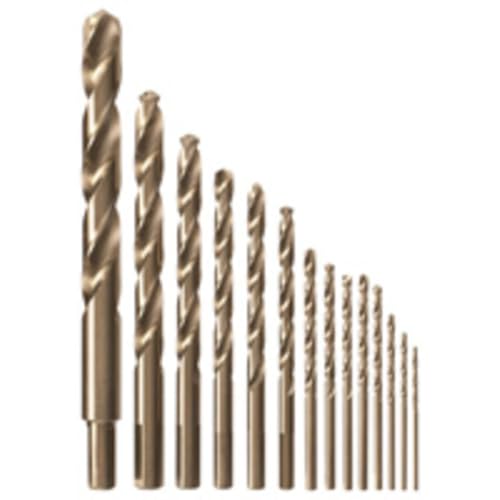
- MaterialM42 cobalt
- Pieces14, with case
- ShankThree-flat, will not spin in the chuck
- Rated forStainless, cast iron, titanium, light-gauge metal
M42 carries a higher cobalt percentage than the more common M35, which buys more heat resistance at the cost of a little toughness. Fourteen pieces rather than twenty-nine is the right call for most people: the sizes between the common ones get used once a decade, and a smaller set of good bits beats a large set you are afraid to blunt.
Bosch is my default brand for general work and has been for years, on the straightforward basis that the price-to-durability balance has never let me down on aluminum through mild steel. The three-flat shank is the detail worth having: a round shank slips in a keyless chuck under load, and a slipping bit is a bit being polished rather than turned.
Pro Tool Reviews arrived at the same pick from a different direction, naming this set their best value pick among metal drill bits. Where it runs out is size: the set stops well short of the diameters a hole saw covers, and for anything past 1/2 in you are into a different tool entirely.
Where it wins
- M42 runs hotter before it softens than M35
- Three-flat shank stops chuck slip under load
- Fourteen useful sizes rather than padding
- Independently picked as a value leader
Where it doesn’t
- Higher cobalt means slightly more brittle
- Small set — gaps between sizes
- Still cobalt, so still overkill on soft metals
- Nothing here for holes above 1/2 in
3. Norseman Magnum Super Premium (Best for Stainless)
Best for Stainless
Last update on 2026-10-25 / Affiliate links / Images from Amazon Product Advertising API
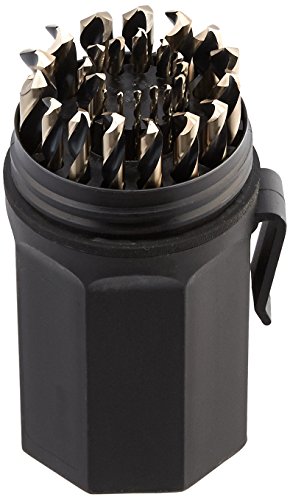
- SeriesUltra Dex Type 240-UB, Magnum Super Premium
- Point135° split point
- Pieces29, jobber length
- Made inUnited States
Norseman is one of the few drill brands still actually made in America—union-made in Missouri—and that matters more than patriotism here, because most heritage American names no longer match what the badge suggests. Cleveland, Greenfield and Chicago-Latrobe have all changed hands, so a familiar old name on a box is not evidence of anything.
The technical argument for this set in stainless is the web. Norseman’s position is that the thin-web Magnum geometry penetrates better than cobalt in stainless because a thinner web means less material is pushed aside at the center of the cut and therefore less of the pressure that causes work hardening. That is a manufacturer’s claim about its own product and should be read as one — but the mechanism is real, and it is the same reason split points outperform conventional grinds on hard material.
The 135° split point lets it start without a punch mark on flat stock. Against it: these are jobber length, which is the geometry most prone to snapping in small sizes, and it is a 29-piece set at a premium price, so a beginner will break expensive bits learning feel.
Where it wins
- Still US-made, unlike most heritage names
- Thin web reduces the pressure that work-hardens stainless
- 135° split point self-centers without a punch
- Full 29-piece coverage in 64ths
Where it doesn’t
- The stainless claim comes from the maker, not a third party
- Jobber length — the small sizes still snap if you lean
- Premium price for a first set
- HSS, not cobalt, so heat discipline matters more
4. Chicago-Latrobe 157 Series (Best for Aluminum and Soft Metals)
Best for Aluminum and Soft Metals

Last update on 2026-10-25 / Affiliate links / Images from Amazon Product Advertising API
- MaterialHigh-speed steel, uncoated
- Point118° conventional
- LengthShort (screw machine)
- Range1/16 in to 1/2 in by 64ths, 29 pieces
Two deliberate choices here, and both run against what most roundups recommend. The first is that these are uncoated. That is the point: aluminum bonds to a titanium nitride surface and pulls it off, so the coating you paid extra for becomes the reason the bit fails. Plain HSS has nothing to lose.
The second is length. These are short-length bits, roughly half the flute of a jobber bit at the same diameter, which makes them several times stiffer in the sizes that break most. If you have snapped 1/8 in bits — and most people have — this geometry is the fix, not a steadier hand.
The 118° conventional point is the right grind for soft metal: it is less aggressive than a 135° split point, which matters when the material is grabby and wants to pull the bit through. One honest note on provenance — Chicago-Latrobe is an old American name that is no longer American-owned, so buy this set on its specifications rather than its heritage.
Where it wins
- Uncoated, so aluminum has nothing to tear off
- Short length resists the bending that snaps thin bits
- 118° point suits soft, grabby metals
- Full 29-size coverage at HSS prices
Where it doesn’t
- Short flutes cannot drill deep — thick stock needs jobber bits
- Plain HSS will not cope with stainless or hardened steel
- No coating means no rust protection; keep them oiled
- American name, foreign ownership
5. DeWalt DWA1790IR Step Bit Set (Best for Sheet Metal)
Best for Sheet Metal
Last update on 2026-10-25 / Affiliate links / Images from Amazon Product Advertising API
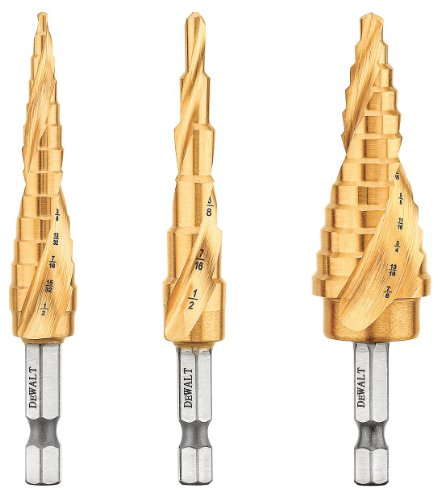
- CoatingTitanium nitride
- Pieces3, covering 31 hole sizes
- Range1/8 in to 7/8 in
- Shank1/4 in hex, impact rated
A twist bit punching through thin sheet grabs, tears, and leaves a triangular hole because the two cutting lips break through at different moments and nothing supports the metal behind. A step bit cuts a circle at a time, with the cone behind it holding the sheet flat. On anything under about 3 mm, it is not a better tool; it is the correct one.
Three bits covering thirty-one sizes is the practical appeal: one tool in the chuck gets you through a run of different holes in an electrical box or a panel without stopping to change bits. The hex shank means it also runs in an impact driver, which is useful on sheet metal where torque matters more than speed.
The caveat is heat. A step bit cuts on a wide edge, so it generates heat faster than a twist bit of the same diameter — run it slow and keep it wet. Unlike the twist bits above, this is the one place the titanium coating earns its keep, because sheet steel isn’t aluminum and the coating isn’t being torn off by the material.
Where it wins
- Clean round holes in thin sheet, no tearing
- 31 sizes from three bits, no bit changes mid-job
- Impact-rated hex shank
- Self-deburring as the next step passes through
Where it doesn’t
- Heats faster than a twist bit — slow speed and oil are not optional
- Useless in thick stock
- Expensive per hole size if you only need one
- Stops at 7/8 in
6. Milwaukee Hole Dozer Bi-Metal Set (Best for Large Holes)
Best for Large Holes
Last update on 2026-10-25 / Affiliate links / Images from Amazon Product Advertising API
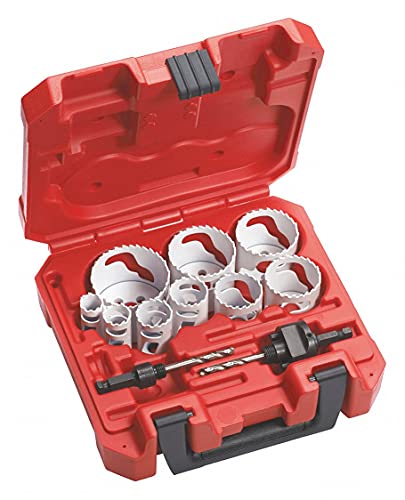
- Model49-22-4025
- MaterialBi-metal
- Range3/4 in to 2-1/2 in
- Pieces13, with arbors and pilot bit
Past about 1/2 in, a twist bit stops being sensible: the material it has to remove goes up with the square of the diameter, and a hand drill does not have the torque. A hole saw removes only a ring, which is why a 2 in hole saw asks less of the drill than a 1/2 in twist bit does. This is the general-purpose bi-metal set rather than the carbide one, which is the right choice for steel, wood, and plastic rather than abrasive materials.
Bi-metal means an HSS cutting edge welded to a tougher steel body — hard where it cuts, flexible where it would otherwise crack. The 3/4 in to 2-1/2 in spread covers conduit, pipe fittings and electrical boxes, which is the overwhelming majority of large holes anyone drills in metal.
Clamp it, always. A hole saw has far more cutting edge in contact than a twist bit, so it grabs harder. An unclamped workpiece will spin with it — this is the bit type most likely to wrench a piece out of your hand, and the one where wrists get hurt.
Where it wins
- Cuts a ring, not a disc — far less load on the drill
- Bi-metal edge is hard where it cuts, tough where it flexes
- 3/4 to 2-1/2 in covers conduit and box work
- Arbors and pilot bit included
Where it doesn’t
- Grabs hard; an unclamped piece becomes a weapon
- Bi-metal, not carbide — wrong for abrasive material
- Slow going in anything thick
- Slugs jam in the cup and need prying out
7. Drill America Carbide-Tipped Die Drill (Best for What Cobalt Won’t Cut)
Best for What Cobalt Won’t Cut
Last update on 2026-10-25 / Affiliate links / Images from Amazon Product Advertising API
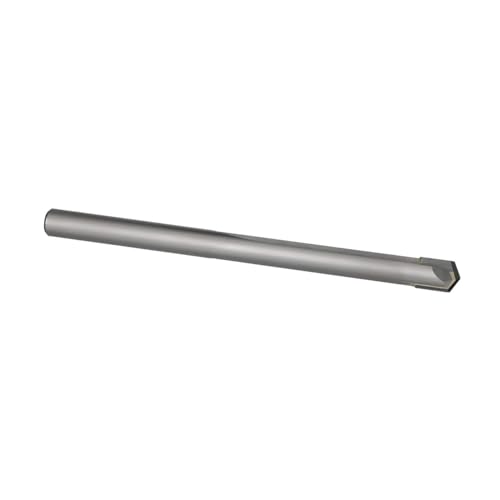
- TipCarbide
- SeriesDrill America D/ADIE
- Sold asSingle bit, one size
- ForTool steel, hardened steel, die work
Above roughly 60 HRC, cobalt stops being the answer. Tool steel and properly hardened steel need carbide, and buying it as a single bit in the size you need is both cheaper and more honest than a set — you will use one size, once, for a specific job.
Carbide is harder than anything else here and more brittle than all of it. It does not bend before it breaks; it chips. That makes setup rigidity more important than the bit itself: a drill press or a solidly clamped piece, low speed, steady feed, no chatter, no side load. In a hand drill on an unsupported workpiece, carbide will fail faster than the cobalt bit it replaced.
Before you buy carbide, check whether you can avoid the problem. A hardened bolt or a broken tap is often better attacked by annealing the spot with heat and letting it cool slowly, which softens it enough for cobalt. For a hardened workpiece you cannot heat, carbide in a rigid setup is the DIY answer, and a machine shop with EDM is the professional one.
Where it wins
- Cuts material cobalt cannot touch
- One bit, one size — no paying for a set
- Industrial series rather than an unbranded listing
- Holds an edge at temperatures that destroy HSS
Where it doesn’t
- Brittle — chips rather than bends
- Needs a rigid setup; poor in a handheld drill
- Expensive per bit
- Overkill for anything softer than tool steel
Which Bit for Which Metal
Hardness is measured on two different scales, and they are not interchangeable. Rockwell C (HRC) is used for hardened steels; Brinell (BHN) is used for softer metals and castings. Comparing 65 HRC against 250 BHN directly tells you nothing, so the last column gives the practical answer instead.
| Metal | Hardness | Use this bit | How hard to drill |
|---|---|---|---|
| Aluminum | 40–60 BHN | Uncoated HSS, or step bit for sheet | Easy — but gummy, clear chips often |
| Copper | 35–100 BHN | Uncoated HSS | Easy — soft and grabby |
| Brass | 60–120 BHN | HSS | Easy |
| Zinc | 90–130 BHN | HSS | Easy |
| Mild steel | 120–180 BHN | HSS, cobalt for volume work | Moderate |
| Bronze | 150–250 BHN | HSS or cobalt | Moderate |
| Cast iron | 170–250 BHN | HSS or cobalt | Moderate — brittle, ease off on breakthrough |
| Titanium | 35–45 HRC | Cobalt or carbide-tipped | Hard — work-hardens, never let the bit rub |
| Stainless steel | 50–60 HRC | Cobalt, or a thin-web split point | Hard — work-hardens fastest of all |
| Hardened steel | 60–65 HRC | Cobalt or carbide-tipped | Very hard |
| Tool steel | 60–65 HRC | Carbide-tipped | Very hard — cobalt will struggle |
The one rule underneath all of it: the bit must be harder than the workpiece. That’s the whole reason cobalt exists — it holds its hardness at temperatures where plain HSS has already gone soft.
The Hard Metals, and What They Do to Bits
The table above gives the pick. These four are worth a note because they fail in specific ways.
Hardened Steel, 60 to 65 HRC
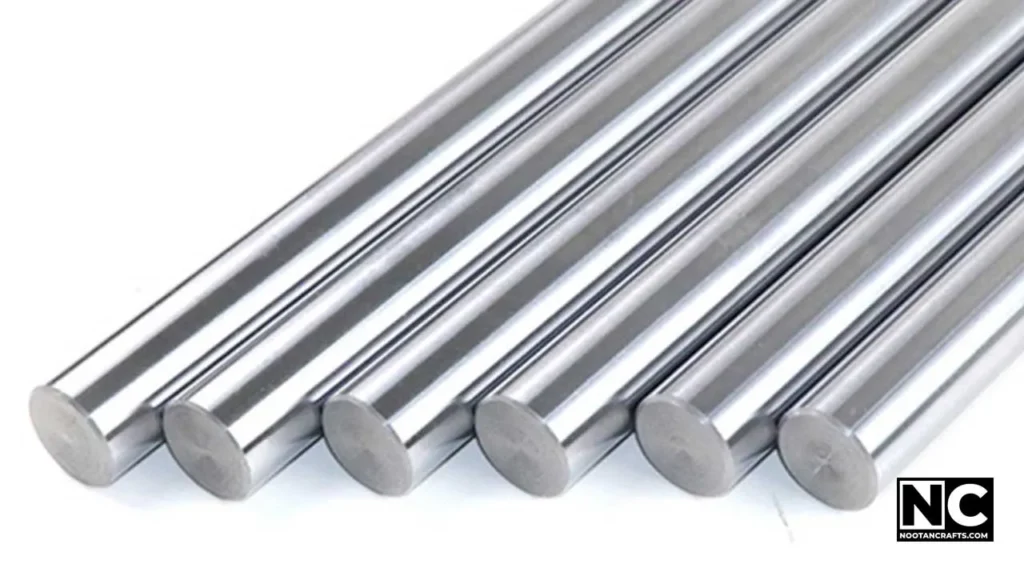
High carbon content plus chromium, molybdenum or vanadium. Very hard, and brittle with it. Cobalt or carbide-tipped, low speed, constant lubrication. If the bit stops making chips, stop — it’s rubbing, and rubbing is how you lose both the bit and the temper of the surface.
Stainless Steel, 50 to 60 HRC
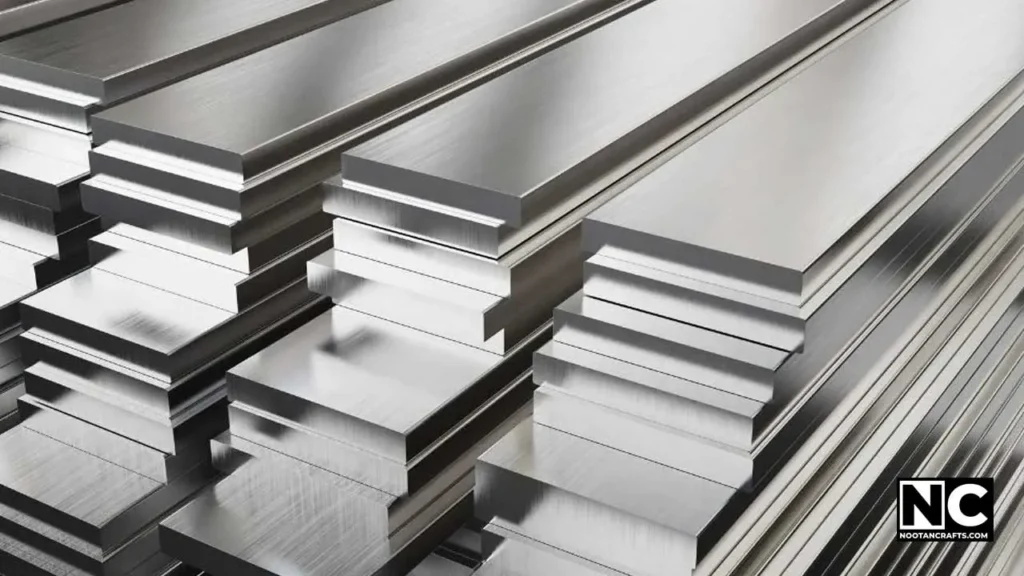
The metal that punishes hesitation. Stainless work-hardens where it is rubbed rather than cut, so a bit that skates for two seconds creates a surface harder than itself. Run it at the bottom of the speed table, feed it firmly enough to keep making chips, and never let it spin without cutting.
Cast Iron, 170 to 250 BHN
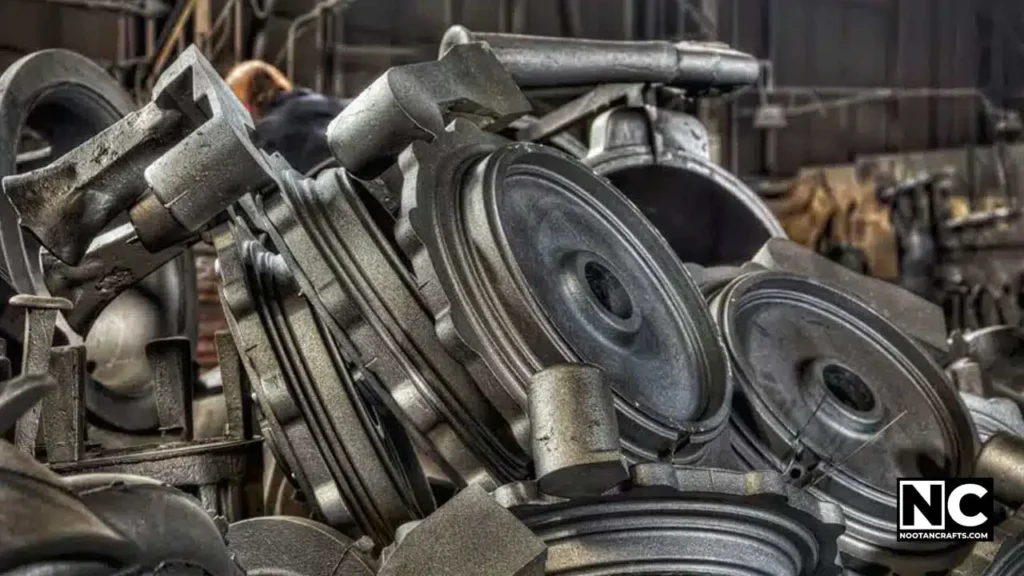
Not especially hard, but brittle, and the only metal here you drill dry. Cast iron produces graphite dust that turns to abrasive paste if you add oil. Ease off hard at breakthrough — the exit edge chips out rather than deforming.
Titanium and Tool Steel, 35 to 65 HRC
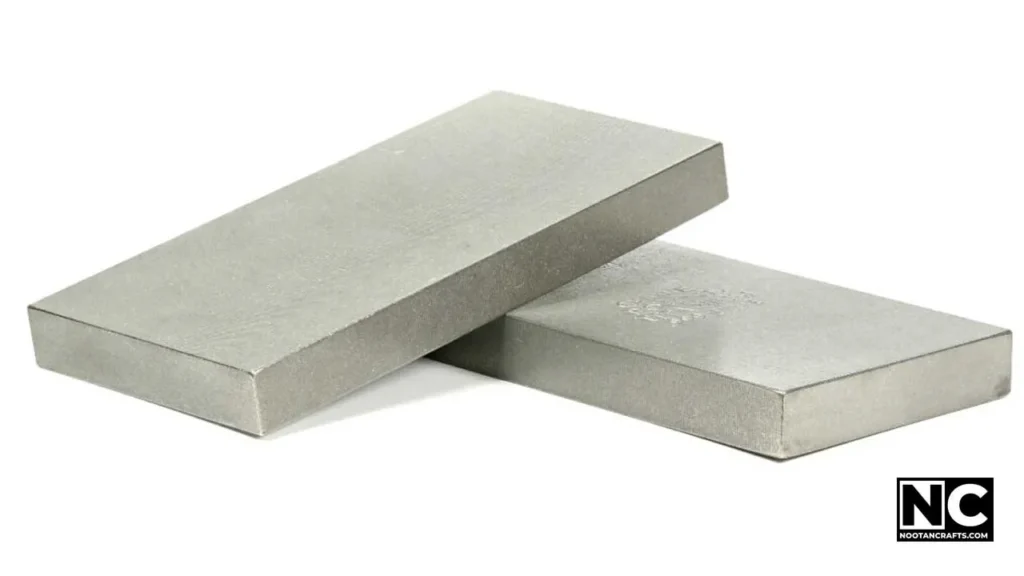
Titanium work-hardens like stainless and holds heat badly, so it needs cobalt at low speed with constant coolant. Tool steel is simply harder than cobalt can handle reliably, which is the one job on this page that really needs carbide.
The Soft Metals: Aluminum, Brass, Copper, Zinc, Bronze
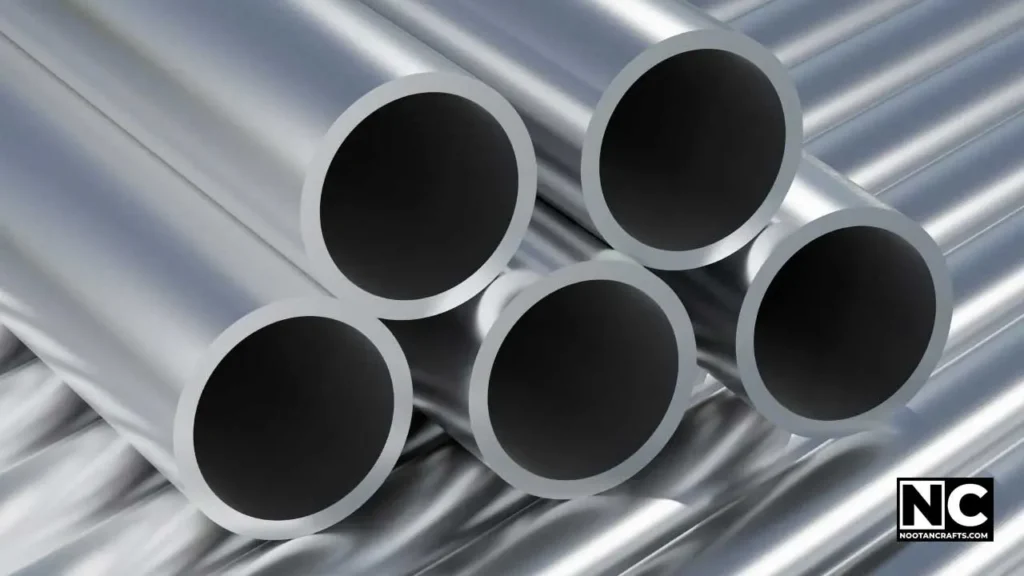
Easy to cut and easy to make a mess of. Aluminum is gummy and packs the flutes, so withdraw the bit to clear chips rather than pushing through a blocked hole. Copper and brass grab at breakthrough and can pull the bit in; ease off in the last millimeter. None of these need cobalt, and none of them want a coated bit.
How to Drill Metal Without Breaking Bits
Most of this page is about choosing. This part is about the feel, and it is where the bits actually get broken. If you are working without a drill press, the hand drill method goes into more detail.
- Clamp the workpieceA vise or clamps, every time. A piece that moves is how bits jam and snap — and how you end up chasing a spinning offcut across the bench, which I have done.
- Mark and punch the centerA center punch dimple stops the bit wandering on the first contact. On curved stock like pipe this isn’t optional.
- Drill a pilot holeFor anything above roughly 6 mm, start with a small bit. The large bit then has a center to follow and far less material to remove.
- Set the speed from the tableBigger bit and harder metal both mean lower speed. If the drill has no dial, feather the trigger and judge by the chips rather than the sound.
- Find the pressure by the chips, not the effortThis is the part that only comes with practice. Too little pressure and the bit rubs instead of cutting, which blunts it fast and work-hardens stainless. Too much and it snaps, especially in the thin sizes. Steady curling chips mean you have it right; adjust until you see them.
- LubricateA few drops of cutting oil cuts friction and carries heat away. Soapy water or engine oil will do at a push. Cast iron is the exception — drill it dry.
- Cool between holesOn a run of holes, pause every few. I snapped a perfectly good cobalt bit in a length of angle steel purely from impatience, and replacing it mid-project cost more time than the pauses would have.
- Ease off at breakthroughThe bit grabs as it exits. Reduce pressure in the last millimeter, especially on brittle cast iron and thin sheet.
Which Drill Bits Should You Buy?
| If you’re doing this | Buy this | Why |
|---|---|---|
| Buying one set for everything | Drill America cobalt | Holds hardness when hot, and resharpens without losing what you paid for. |
| Same idea, smaller budget | Bosch CO14B | M42 cobalt in the sizes you actually use, with a shank that won’t slip. |
| Stainless, repeatedly | Norseman Magnum | Thin web and a split point reduce the rubbing that work-hardens stainless. |
| Aluminum, brass, copper | Chicago-Latrobe 157 | Uncoated so nothing tears off, and short so the thin sizes survive. |
| Thin sheet and panels | DeWalt DWA1790IR | Cuts a clean round hole where a twist bit tears a triangle. |
| Holes bigger than 1/2 in | Milwaukee Hole Dozer | Removes a ring instead of a disc, so a hand drill can actually turn it. |
| Tool steel or hardened steel | Drill America carbide-tipped | The only thing here that cuts above 60 HRC — in a rigid setup, not a wobbling hand drill. |
Drill Bit Questions People Actually Ask
Can I use wood drill bits on metal?
No. Wood bits use a sharp lead point and a shallower angle designed to pull into soft fiber. On metal that point dulls almost immediately and the bit will wander before it cuts. Use HSS at minimum.
What speed should I drill metal at?
It depends on both the metal and the bit diameter, which is why the table above gives RPM rather than a single number. As a rough anchor: a 1/4 inch bit wants around 600 rpm in stainless, around 1,400 in mild steel, and can run past 3,000 in aluminum. If your drill has no speed control, feather the trigger and watch the chips — steady curls mean the speed is right, dust or a bit turning straw-colored means it is too fast.
What’s the difference between cobalt and titanium bits?
A titanium bit is HSS with a hard coating on the surface. A cobalt bit has cobalt alloyed through the entire bit. The coating wears off — and disappears completely if you sharpen it — while cobalt keeps its properties all the way through. For repeated hard-metal work, cobalt is the one that lasts.
Are titanium-coated bits good for aluminum?
No, and this is one of the most repeated bad recommendations in the category. Aluminum bonds to a titanium nitride surface and pulls the coating off the bit, so the feature you paid extra for is the first thing the metal destroys. For aluminum and other soft metals, plain uncoated HSS at a 118 degree point is both cheaper and longer-lasting.
Why do my thin drill bits keep breaking?
Because a long thin bit is a slender column being twisted, and it takes very little side load or excess pressure to deflect it past the point of no return. Three fixes, in order of effect: use short-length (screw machine) bits instead of jobber length in the small sizes, always start in a punched dimple so the bit cannot wander, and back off the pressure until the bit is producing chips rather than being forced.
Why does my bit stop cutting partway into stainless?
Work hardening. Stainless hardens where it’s been rubbed rather than cut, so the moment the bit skates the surface becomes harder than the bit. Once it happens you need a fresh sharp bit and a firmer, steadier feed — pushing the same bit harder makes it worse.
Do I really need cutting oil?
For anything harder than aluminum, yes. It cuts friction and carries heat out of the cut, which is what preserves the edge. Cast iron is the exception — it produces graphite dust that turns to paste with oil, so drill it dry.
Can I sharpen metal drill bits?
Yes, and it’s worth doing with cobalt and plain HSS. It is not worth doing with titanium-coated bits — sharpening removes the coating that made them worth buying, leaving an ordinary HSS bit.
The One Thing Not to Get Wrong
Match the bit to the hardness: uncoated HSS for soft metals, cobalt for stainless and hardened steel, carbide-tipped for tool steel. Then set the speed from the table rather than from the trigger, and let the chips tell you whether the pressure is right. Nearly every broken bit I have owned, including the one that cut my friend, came from getting one of those two wrong and pushing harder to compensate.