I’ve used both in the same house. The bed with storage underneath is high-grade plywood because it carries weight every night. The shoe rack is melamine, because it doesn’t — and the smooth white finish meant no painting at all.
Use plywood when the piece carries weight, gets wet, or needs to last — shelving, flooring, bed frames, anything outdoors. Use melamine when it doesn’t, and you want a clean finish cheaply — cupboard interiors, drawer boxes, light storage. Plywood is layered wood veneer, and it’s structural. Melamine is a resin-coated surface on particleboard or MDF, and it isn’t.
The one that catches people out: plywood handles moisture better than melamine, not worse. Melamine looks sealed, but the board underneath swells the moment water gets past the edge.
What’s Inside!
Quick Verdict
| What you’re building | Use | Why |
|---|---|---|
| Shelving that holds real weight | Plywood | Melamine sags and the edges chip under load |
| Bed frame or bench | Plywood | Cross-grain layers resist flexing and creaking |
| Bathroom or outdoor | Marine or structural plywood | Melamine swells once moisture reaches the core |
| Kitchen cabinet carcass | Plywood (moisture-resistant grade) | Under-sink leaks destroy particleboard |
| Cabinet doors and visible panels | Melamine | Pre-finished, no painting, no sanding |
| Drawer boxes and cupboard interiors | Melamine | Low stress, wipes clean, cheapest option |
| Anything you’ll stain or refinish later | Plywood | Melamine can’t be sanded or refinished at all |
| Curved or shaped work | Flexible plywood | Melamine cracks rather than bends |
The practical answer for most home projects: plywood for the carcass and anything load-bearing, melamine for the doors and interior panels. Most decent flat-pack furniture is built exactly that way, and for good reason.
What Is Plywood?
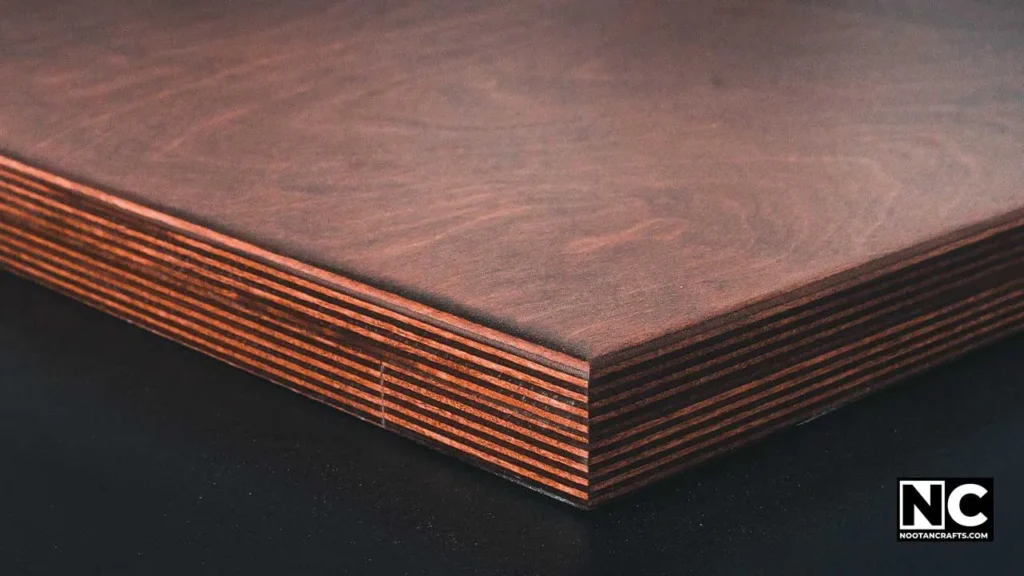
Plywood is made by gluing thin layers of wood veneer together, with each layer’s grain running perpendicular to the one below it. That cross-grain structure is the whole trick — it’s why plywood resists warping and cracking, and why it stays stiff across its width instead of only along the grain like solid timber.
Everything on the market falls into two camps — structural and non-structural plywood. Load-bearing or exposed to weather means structural. Indoor and decorative means non-structural, and it costs less.
Plywood Types, and What Each Is Actually For
| Type | Category | Use it for |
|---|---|---|
| Softwood | Structural | Construction, subfloors, sheathing |
| Marine | Structural | Boats, outdoor furniture, wet areas |
| Laminated veneer lumber (LVL) | Structural | Beams and framing that carry load |
| Fire-retardant | Structural | Where building regulations require it |
| Hardwood | Non-structural | Furniture and cabinetry with a visible face |
| Tropical | Non-structural | Decorative furniture, mixed hardwood core |
| Moisture-resistant (MR) | Non-structural | Indoor furniture in humid rooms |
| Flexible | Non-structural | Curved panels and shaped work |
What Is Melamine?
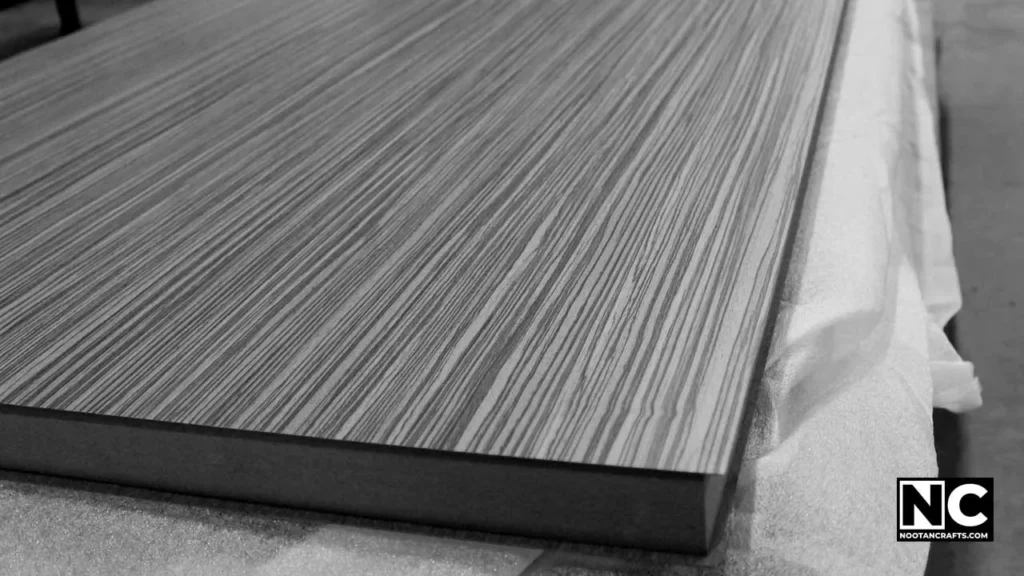
Melamine isn’t wood at all. It’s a thermally fused laminate bonded onto a core of MDF or particleboard. What you’re buying is a finished surface plus a cheap substrate.
That surface is the real draw — scratch-resistant, wipes clean with a damp cloth, and it arrives finished so there’s no painting or sanding. The limitation is the core underneath. It won’t take load the way plywood does, it chips at the edges, and once it’s damaged you can’t repair it. There’s no sanding melamine back and refinishing it; the coating is the whole finish.
You will see it sold under several names. Melamine, TFL or thermally fused laminate all mean the same thing: the resin paper is fused directly onto the board under heat and pressure. HPL, or high pressure laminate, is a different product — the laminate is made as a separate sheet first and then glued down. HPL is thicker and tougher and costs more, and it is what kitchen worktops usually use. If a quoted price looks too good, check which one you are being sold.
The Core Matters More Than the Surface
Two boards can have an identical white surface and behave completely differently, because the board underneath is not the same.
| Core | How it behaves | Buy it for |
|---|---|---|
| Particleboard core | Lightest and cheapest. Coarse chips inside, so screws strip easily and edges crumble if you work them | Cupboard interiors, backs, drawer bottoms, anything that never takes a fastener under load |
| MDF core | Denser and heavier. Fine even fibers, so it machines cleanly, holds a screw far better and the cut edge is smooth | Doors, visible panels, anything hinged or screwed |
Tell them apart at a cut edge and by weight. Particleboard shows chips and flakes you can see; MDF looks like dense brown cardboard. A full sheet of MDF-cored board is noticeably heavier. If you are hanging a door on it, pay for the MDF core.
Edge Banding Is Not Decoration
Every cut you make opens the core. The laminate is only on the faces, so a fresh cut is bare particleboard or MDF, and that is where water gets in and where the board starts to crumble.
Iron-on edge banding is the usual fix and it takes a few minutes. Cut it slightly over-length, run a household iron along it on a medium setting, press it down with a block of wood while the glue is still hot, then trim the overhang with a sharp blade held flat against the face. In a damp room, run a bead of silicone along the bottom edge of any panel that sits on the floor as well.
The dust is the hazard, not the blade
- Wear a mask, not just glasses. Both materials are bonded with formaldehyde-based adhesives. Cutting releases that into fine dust, and MDF-cored melamine produces some of the finest dust of any sheet material — it stays airborne long after the saw stops.
- Cut outdoors or with extraction. A workshop with the door shut and no dust collection is the worst case. Open the space up or run a vacuum at the blade.
- Melamine chips on the exit side. Use a fine-tooth blade (60+ teeth), score the cut line first, and support the underside. A standard rip blade will tear the laminate badly.
- Seal cut edges on melamine. The exposed core is where water gets in. Edge banding isn’t cosmetic — it’s what stops the board swelling.
Plywood vs Melamine: The Differences That Matter
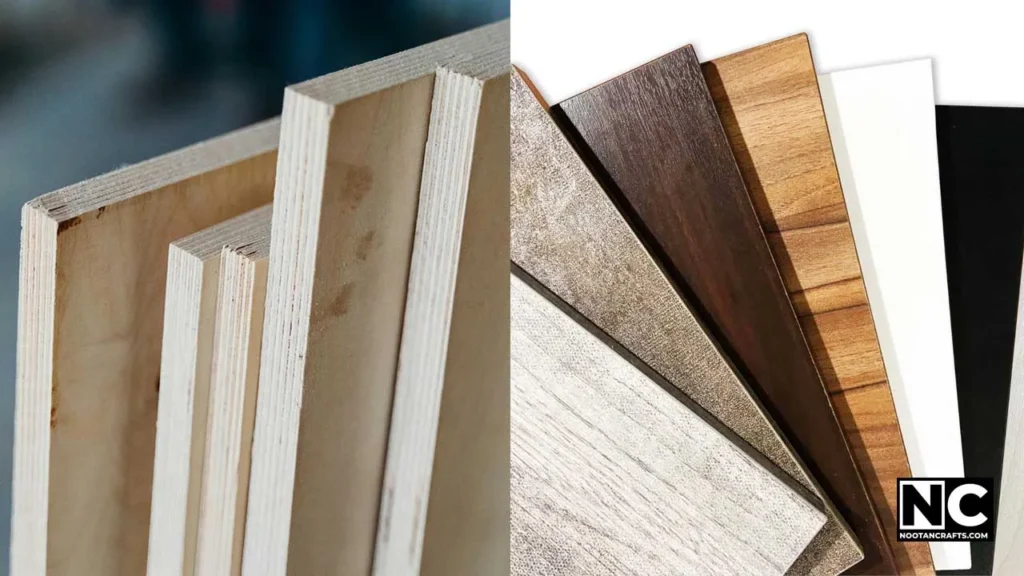
| Feature | Plywood | Melamine |
|---|---|---|
| Material | Layers of wood veneer glued cross-grain | Resin laminate over MDF or particleboard |
| Strength | Strong, suitable for structural use | Weak in bending, non-structural only |
| Finish | Needs paint, stain, or veneer | Arrives pre-finished |
| Moisture | Moderate to high, depending on grade | Surface resists it, core swells once breached |
| Cost | Higher | Lower |
| Cutting | Forgiving, standard blades work | Chips easily, needs a fine-tooth blade |
| Repairable | Yes, sand and refinish | No, damage is permanent |
| Look | Natural grain, customizable | Flat modern color, many finishes |
Will It Sag? Span and Thickness
This is the question behind most of this comparison, so here are the numbers. They are for 3/4 in (18 to 19 mm) board carrying a normal load of books, with no support between the ends.
| Material | Span it will take | Notes |
|---|---|---|
| Solid maple | 36 to 42 in (900 to 1070 mm) | Stiffest of the lot, and the most expensive |
| Hardwood plywood | 32 to 36 in (810 to 900 mm) | The sensible choice for a real bookshelf |
| Pine | 24 to 30 in (610 to 760 mm) | Solid wood, but soft, so it sags sooner than plywood |
| Melamine over particleboard or MDF | Keep it short, and add a support | Shelving guides advise against these cores for heavy loads at any span. The reason is below |
Here is the honest reason melamine has no number in that table. The woodworking limit for a shelf is about 1/32 in of sag per foot of span, roughly 1/384 of the length. The particleboard and MDF standards themselves permit slightly more than 1/8 in of deflection over a 36 in span, which is several times looser. So a melamine shelf can be perfectly within its own specification and still look bent to you. It is not faulty. You are holding it to a stricter standard than the board was built to meet.
The second problem is creep. Wood and plywood spring back when the load comes off. A particleboard or MDF core keeps bending slowly under a steady weight and never comes back. That is why a melamine shelf looks fine for a year and then has a permanent curve in it, and why taking the books off does not fix it.
- Thickness beats everything. Stiffness climbs very steeply with depth, so going from 18 mm to 25 mm does far more than any other single change.
- A front lip roughly doubles the stiffness. Glue a 1.5 in (38 mm) strip of solid hardwood on edge along the front of the shelf. It is the cheapest fix there is, and it hides the cut edge at the same time.
- One support in the middle is worth more than doubling the thickness. Halving the span is the biggest lever you have, and it costs one bracket.
- The load matters as much as the board. Books are the worst domestic load there is. The same shelf that bends under paperbacks will hold folded towels for a lifetime.
When to Choose Plywood
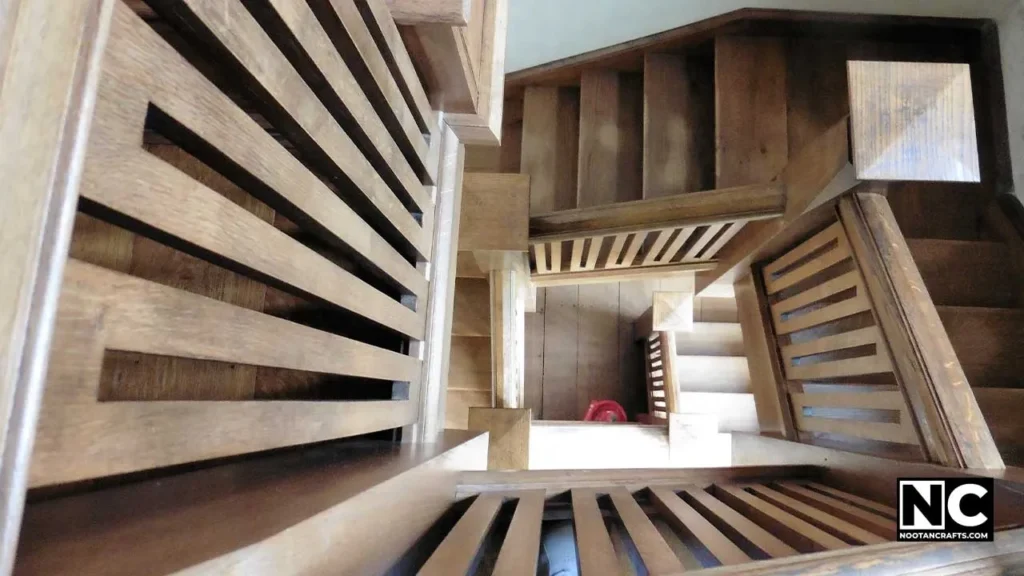
Anything that carries weight or gets wet. Flooring, shelving, heavy-duty furniture, bathroom units, outdoor work.
I built a custom bed with storage underneath using high-grade plywood. Friends said it was overkill. Years later it still doesn’t creak or flex — an adult can jump on it. For anything under real stress, plywood earns the extra cost, and the cost difference is a one-off while the sagging is permanent.
When to Choose Melamine
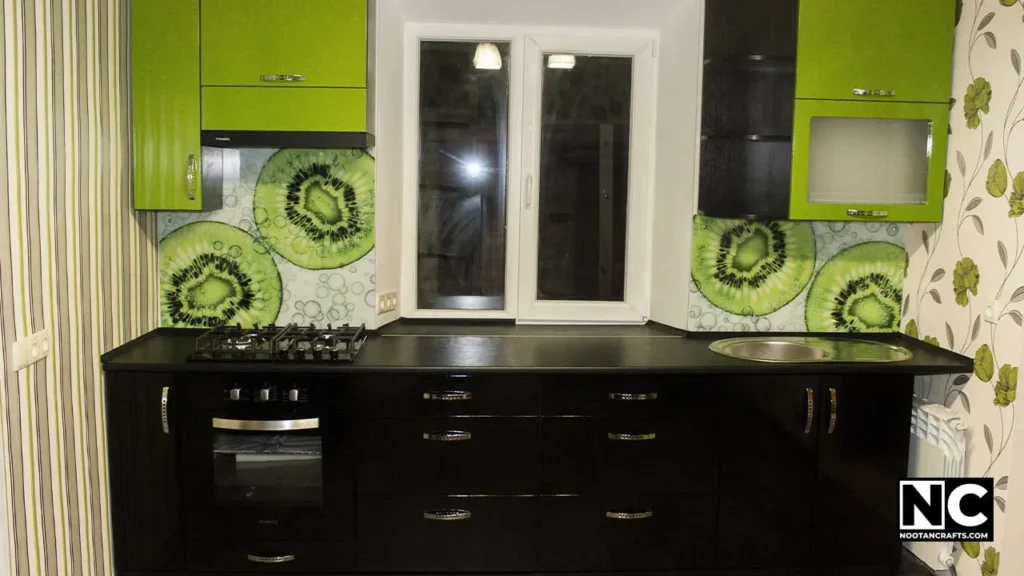
Budget, low-stress, and you want it finished without extra work. Drawers, cupboard interiors, storage units, anything where the surface matters more than the strength.
I built a shoe rack out of melamine. It didn’t need to be heavy-duty, so I saved money by skipping plywood, and the smooth white finish matched the look I wanted with no painting at all. That’s melamine doing exactly what it’s good at.
Environmental Impact

Plywood comes from natural wood, which is renewable but means felling trees. FSC-certified plywood comes from managed forests if that matters to you.
Melamine often uses recycled wood particles, so its raw-material footprint is lower. But it’s chemically manufactured and contains formaldehyde, which is a health consideration indoors and toxic to aquatic life if disposed of badly. Neither material is clearly greener — it depends which trade-off you care about.
Common Questions
Can melamine be painted?
Not easily. The laminated surface is designed not to hold anything, which is what makes it wipe clean. A bonding primer can work, but adhesion stays unreliable and it chips at the edges. If you want a painted finish, start with plywood or MDF instead.
Is plywood stronger than melamine?
Considerably. Plywood’s cross-grain layers resist bending in both directions; melamine’s particleboard core sags under sustained load. For any shelf longer than about 600 mm carrying weight, this is the deciding factor.
Can I use plywood in the kitchen?
Yes, and moisture-resistant grade is the better choice for cabinet carcasses — particularly under the sink, where a slow leak will destroy a particleboard core but only stain plywood.
Which is better for outdoor projects?
Plywood, specifically structural or marine grade. Melamine is not suitable outdoors at all — the core absorbs moisture through any cut edge or screw hole and swells permanently.
Is melamine safe for furniture?
Yes, it’s used throughout commercial cabinetry. Some boards release low levels of formaldehyde, so ventilate enclosed spaces like wardrobes for the first few weeks, and look for low-emission grades if you’re sensitive.
Why does my melamine chip when I cut it?
The blade is tearing the laminate as it exits. Use a fine-tooth blade (60 teeth or more), score the cut line with a knife first, apply masking tape over the cut, and support the underside. Cutting face-down on a circular saw also helps, since the teeth enter through the good face.
What thickness should I use?
18 mm (3/4 in) is the default for cabinet carcasses and shelving in both materials. Go to 25 mm for a shelf that has to span more than about 800 mm or carry books. 12 mm is fine for drawer bottoms, cabinet backs and anything that only has to keep dust out. Thickness buys stiffness faster than anything else you can change.
Is MDF-core melamine better than particleboard-core?
For anything that takes a screw or a hinge, yes. MDF is denser and finer, so it holds fasteners far better and the cut edge comes out smooth rather than crumbly. Particleboard core is lighter and cheaper and it is fine for backs, interiors and drawer bottoms. Check a cut edge in the shop: visible chips mean particleboard, dense brown fiber means MDF.
Can a swollen melamine panel be dried out and saved?
No. The core is wood fiber compressed under heat and glue, and water lets those fibers spring back. They stay swollen after it dries, so the panel is permanently thicker and weaker at that spot. That is the real difference here: plywood that gets wet usually dries and carries on, while a melamine panel that gets wet is finished.
Can you screw directly into melamine?
Only with a pilot hole. The particleboard core splits easily and screws strip if overtightened. Use coarse-thread confirmat or particleboard screws, and never drive into an edge without drilling first.
Choosing Between Them
Ask what the piece has to survive. Weight, moisture, or years of use means plywood. A clean finish on a low-stress panel means melamine. Most real projects use both — plywood where it’s working, melamine where it’s showing — and that’s usually the right answer rather than a compromise.