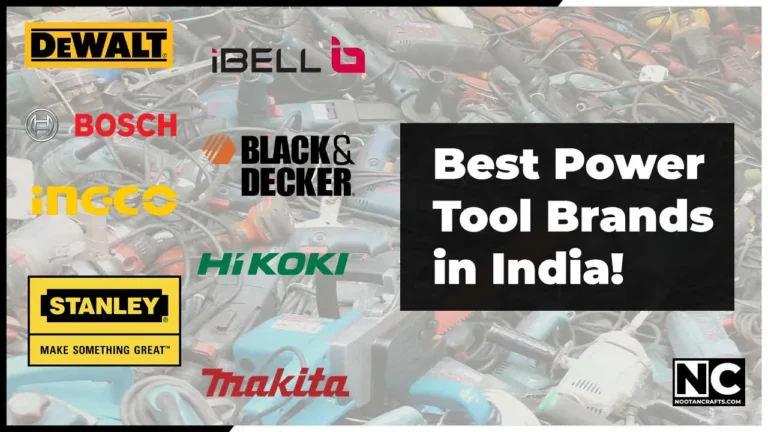
I own tools from four of the brands on this page — Bosch, INGCO, Black+Decker and iBell — so this is a ranking of what actually survived my workshop rather than a list of logos.
If you want one brand that will still be working in ten years, buy Bosch. If you want the most tool for the money, buy INGCO. Everything else here is a variation on those two positions.
The thing nobody tells you when you’re buying your first power tool in India: the brand matters far less than whether you can get a carbon brush for it in two years. That single question separates the eight brands below more cleanly than any spec sheet does.
What’s Inside!
- 1 – Quick Verdict
- 2 – The Eight Brands Compared
- 3 – 1. Bosch: Buy It Once
- 4 – 2. DeWalt: Built for Sites, Not Sheds
- 5 – 3. Makita: The One You Can Hold All Day
- 6 – 4. Black+Decker: Honest About Being Light Duty
- 7 – 5. Stanley: Better at Hand Tools Than Power Tools
- 8 – 6. HiKOKI: Hitachi Under a New Name
- 9 – 7. INGCO: The Best Value on This Page
- 10 – 8. iBell: Covers What the Others Skip
- 11 – Which Brand Fits Where You Are
- 12 – Where This Goes Wrong
- 13 – How the Indian Market Got Here
- 14 – Power Tool Brand Questions People Actually Ask
- 15 – Buy Bosch Once, or INGCO Three Times
Quick Verdict
| What you’re doing | Buy | Why |
|---|---|---|
| Buying one drill for the house | Bosch | Spares and service are available almost everywhere in India, which is what decides a tool’s real lifespan |
| First tools, tight budget | INGCO | Usable performance at a price that lets you buy three tools instead of one |
| Occasional weekend jobs | Black+Decker | Built for light duty and priced for it — accept that heavy use shortens its life |
| Daily site work | DeWalt or HiKOKI | Both are built for continuous duty cycles that will kill a DIY-grade tool |
| Long sessions, fine work | Makita | Best balance of control and comfort — the difference shows after the second hour, not the second minute |
| Welding, tile work, odd jobs | iBell | Covers categories the premium brands price out of reach for a home workshop |
| Hand tools and measuring | Stanley | Still strongest where it started; the power tools are decent rather than exceptional |
The rule that covers most first purchases: buy the cheap tool for the job you’ll do twice, and the expensive one for the job you’ll do every week. A budget grinder that dies after a year of light use cost you almost nothing. The same grinder dying mid-job on a paid project costs you the job.
The Eight Brands Compared
| Brand | Origin | Price tier | Built for | Service in India |
|---|---|---|---|---|
| Bosch | Germany | Premium | Everything, well | Widest authorized network |
| DeWalt | USA | Premium | Site abuse | Good in metros |
| Makita | Japan | Premium | Precision and long sessions | Good in metros |
| HiKOKI | Japan | Premium | Heavy drilling and breaking | Dealer-led, patchy outside cities |
| Black+Decker | USA | Mid | Light household work | Widely stocked, easy to replace |
| Stanley | USA | Mid | Hand tools first, power tools second | Widely stocked |
| INGCO | China | Budget | Value per rupee | Dealer replacement, not repair |
| iBell | India | Budget | Welders, tile cutters, odd categories | Direct and dealer, India-focused |
Read the last column first. Two brands can be identical on the box and years apart in practice, because one has a dealer twenty minutes away who stocks brushes and the other doesn’t. That is the single most useful filter in this market.
A cheap tool is safe; a cheap accessory is not
Brand choice affects how long a tool lasts. It has almost nothing to do with whether it hurts you. The failures that actually injure people in a home workshop come from the consumables — an abrasive disc rated below the grinder’s no-load speed, a blunt drill bit forced through steel until it snaps, a power cord run under the work. Buy the budget grinder if you like, but never the budget disc.
- Match the disc’s rpm stamp to the grinder’s plate, every time you fit one. A disc rated under the tool’s free speed can burst.
- Check grounding on budget corded tools. Cheap power cords and molded plugs are where corner-cutting shows up first.
- Keep the guard on — it is not optional equipment, whichever brand is stamped on the body.
- Face shield over safety glasses, not instead of them, for anything with a spinning disc.
1. Bosch: Buy It Once
- Strongest atDrills, rotary hammers, angle grinders, measuring tools
- Price tierPremium, with a cheaper green DIY range alongside the blue professional line
- Real advantageSpares and authorized service reach further into small-town India than any rival
- Watch forCounterfeits — buy from an authorized dealer or a trusted seller
I own two Bosch drills. One of them is past ten years old and still runs true — no bearing rumble, no chuck slop. That is the whole argument for the brand, and it isn’t about the motor being magic. It’s that the tool was built to be repaired, and there is somewhere to repair it.
The jigsaw is the one I’d point a beginner at. Blade changes are tool-free, the base plate stays where you set it, and it tracks a line without the wandering that makes people give up on jigsaws entirely.
Know the two ranges. Bosch sells a green DIY line and a blue professional line in India. They share a name and very little else — duty cycle, bearings, and serviceability all differ. If a Bosch price looks surprisingly low, check which line you’re looking at.
Bosch was also first to the electric rotary hammer, which is why their hammer drills still feel like the reference point everyone else is measured against. If you’re weighing one against a plain drill, the difference matters more than the badge does — see types of drill machines.
2. DeWalt: Built for Sites, Not Sheds
- Strongest atHeavy-duty drills, chop saws, cordless platforms
- Price tierPremium
- Real advantageTolerates being dropped, left in dust, and run all day
- Watch forBattery ecosystem lock-in — the first cordless tool decides the next five
DeWalt is engineered for a duty cycle a home workshop never reaches. That’s worth saying plainly, because it cuts both ways: if you use a drill twice a month, you are paying for robustness you’ll never consume, and a mid-tier tool will serve you just as well for a third of the money.
Where it earns its price is continuous work — a day of chop-sawing, a week of framing. The cordless line is the strongest part of the range, and the batteries are the real purchase. Pick a voltage platform once and stay on it; buying across brands is how people end up with four chargers and no spare cells.
DeWalt started in 1924 with a radial arm saw its founder called the Wonder-Worker, configurable nine ways. The brand has been selling versatility under load ever since.
3. Makita: The One You Can Hold All Day
- Strongest atCordless drills, angle grinders, jigsaws, planers
- Price tierPremium
- Real advantageBalance and vibration control on long sessions
- Watch forService outside metros is thinner than Bosch’s
Makita’s advantage is one you can’t see in a listing: where the weight sits in your hand. On a ten-minute job it makes no difference. On a two-hour session of grinding or sanding, the tool that stays balanced is the one you finish the job with, and the one that doesn’t is why your wrist aches the next morning.
That’s why Makita is the natural step up for someone who has outgrown a starter kit but isn’t buying for a site crew. You’re paying for control rather than raw power.
The company began in 1915 repairing motors and lighting equipment and didn’t build its own power tool — an electric planer — until 1958. Four decades of fixing other people’s motors is a reasonable explanation for the engineering culture.
4. Black+Decker: Honest About Being Light Duty
- Strongest atBasic drills, sanders, heat guns, household kits
- Price tierMid
- Real advantageLow barrier to starting — easy to buy, easy to use
- Watch forSustained heavy work; this range is not built for it
I’ve run two Black+Decker angle grinders and a hot air gun through years of projects. One of the grinders eventually gave out under heavy use — and I don’t hold that against it. It was doing work a light-duty tool isn’t rated for, at a price where replacing it cost less than a service visit on a premium machine.
That’s the correct way to think about this brand. It is a good first grinder and a bad only grinder. If you find yourself using one every week, you’ve outgrown it, and the next purchase should be a tier up.
The heat gun has been the quiet winner of the three — stripping paint, softening adhesive, shrinking sleeving. It’s the tool I’d have bought years earlier if I’d known how often it comes out.
Black+Decker patented the first portable electric drill with a pistol grip and trigger switch in 1917. Every drill you have ever held is a descendant of that shape.
5. Stanley: Better at Hand Tools Than Power Tools
- Strongest atTape measures, hand tools, marble cutters, entry drills
- Price tierMid
- Real advantageAvailability — stocked in hardware shops that carry nothing else on this list
- Watch forPower tools are competent, not class-leading
Stanley’s reputation was built on hand tools, and that’s still where the brand is strongest. The power tool range is a reasonable middle option — priced between the budget brands and the premium ones, without decisively beating either.
Where it makes real sense is availability. In a lot of Indian towns, the local hardware shop stocks Stanley and nothing else from this list. A tool you can buy today and replace locally beats a better tool you have to order and wait for.
6. HiKOKI: Hitachi Under a New Name
- Strongest atRotary hammers, demolition hammers, heavy drills
- Price tierPremium
- Real advantageConcrete and breaking work, where it is first-rank
- Watch forDealer-led service — check what’s near you before buying
If you search for Hitachi power tools and find nothing, this is why: the power tool business was rebranded to HiKOKI in 2018 when it separated from Hitachi’s wider group. Same tools, same factories, different badge.
The range is narrower than Bosch’s and aimed squarely at heavy work — masonry drilling, breaking, demolition. For that specific job it’s as good as anything sold in India. For a general household kit, the breadth isn’t there, and the service network is more dealer-dependent, which matters more than the specification does.
7. INGCO: The Best Value on This Page
- Strongest atCircular saws, chop saws, clamps, cordless drills
- Price tierBudget
- Real advantageBuys you a whole workshop for the price of two premium tools
- Watch forReplacement rather than repair — treat it as a consumable, not an heirloom
This is the brand I’ve leaned on hardest. My INGCO kit runs to F-clamps, a 7-inch circular saw, and a chop saw, and none of it has been babied. The circular saw built a full-size cupboard, a shoe rack, and a double bed — all work that needed straight, repeatable cuts, not just power.
The chop saw went through a large metal railing project and held its accuracy. At that price I expected it to be adequate and it was better than adequate.
The honest caveat: budget tools are bought to be replaced, not serviced. Plan on getting a few good years out of them rather than a decade, and don’t put one at the center of work you’re being paid for. Within those limits, INGCO is the most sensible money on this list.
8. iBell: Covers What the Others Skip
- Strongest atArc welding machines, tile cutters, blowers, drills
- Price tierBudget
- Real advantageSells categories the premium brands price out of a home workshop
- Watch forFit and finish is a clear step below the Japanese and German brands
iBell’s real service is range. A hobby welder in India can’t reasonably buy a premium arc welding machine, so the choice isn’t iBell versus Bosch — it’s iBell versus not welding at all.
I ran roughly 250 electrodes through my iBell arc welder on that same railing job. It isn’t as refined as a premium machine — the duty cycle is what it is, and you learn to let it rest — but it struck an arc every time and finished the work. The tile cutter and leaf blower have had the same story: unglamorous, still going.
Which Brand Fits Where You Are
Skill level is a worse guide than frequency. How often the tool comes out of the cupboard decides more than how good you are with it.
| How often you’ll use it | Spend | Brands |
|---|---|---|
| A few times a year | As little as possible | INGCO, Black+Decker, iBell |
| Most weekends | Mid, on the tools you reach for most | Bosch green line, Stanley, Makita for the main tool |
| Several days a week | Premium, and stay on one battery platform | Bosch blue, Makita, DeWalt |
| Daily, paid work | Premium, plus a spare of whatever stops the job | DeWalt, HiKOKI, Bosch blue |

One correction to the usual advice: don’t buy a premium kit up front. Buy budget across several tools, find out which two you actually use, and replace those with the good versions. Almost everyone discovers their real workshop is three tools and a pile of things they bought once.
The exception is cordless. Batteries are where the money quietly goes, so if you know you’re heading that way, pick a platform early and buy into it deliberately — the difference between corded and cordless is more about how you work than what you spend.
Where This Goes Wrong
- Buying on brand instead of on service. A premium tool with no dealer within reach is a disposable tool with a long warranty card.
- Mixing cordless platforms. Three brands means three chargers, three battery types, and no spare when one dies mid-job.
- Saving on consumables. A premium grinder with a cheap disc is more dangerous than a budget grinder with a good one.
- Confusing the DIY and professional ranges of the same brand. The badge is identical; the duty cycle isn’t.
- Buying the kit instead of the tool. Bundled cases are mostly filled with accessories you’d never choose separately.
How the Indian Market Got Here
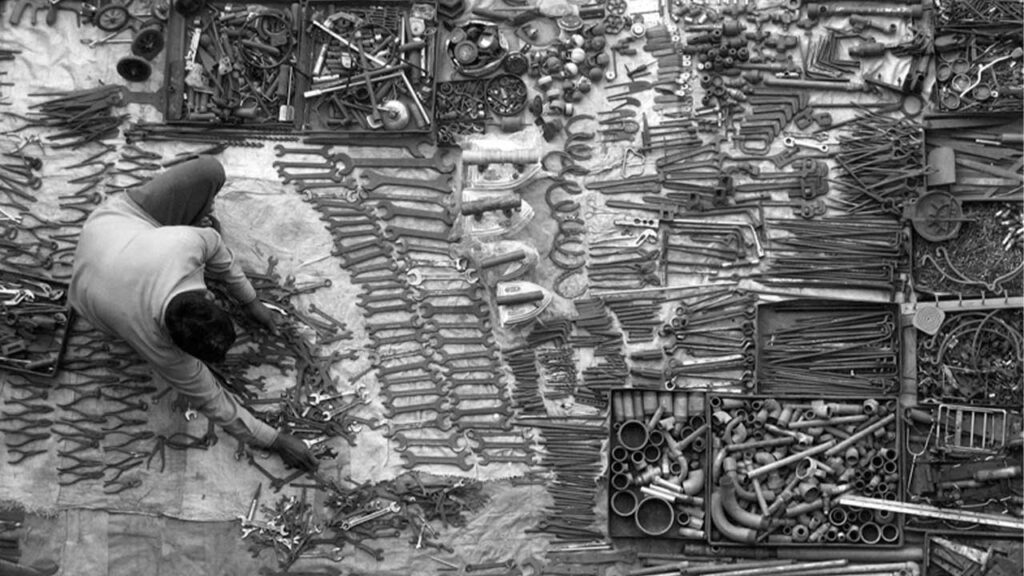
Two things changed at once: tools got cheap enough to buy on a whim, and DIY stopped being something you learned from a person and became something you learned from a screen. That combination is why a budget brand like INGCO could arrive and take real share from names that had been here for decades.
It also explains the gap this list is trying to close. Plenty of people now own power tools with nobody to tell them which ones are worth keeping.
Power Tool Brand Questions People Actually Ask
Which is the best power tool brand in India overall?
Bosch, for most people. Not because the tools are dramatically better than Makita’s or DeWalt’s, but because parts and service reach further across India than any competitor’s. A tool you can get repaired lasts longer than a tool you can’t.
Is INGCO good, or is it just cheap?
Good value, not just cheap. My circular saw and chop saw have handled furniture builds and a metal railing job without complaint. The limitation is repairability — budget tools get replaced rather than serviced, so plan for a few good years rather than a decade.
Which brand is best for a complete beginner?
Black+Decker or INGCO. Both are cheap enough that a mistake costs little, and simple enough that nothing about the tool gets in your way while you’re learning. Upgrade only the ones you find yourself using every week.
Is Hitachi still available in India?
Yes, under the HiKOKI name. The power tool business was rebranded in 2018 when it split from Hitachi’s wider group. Same tools, different badge — an old Hitachi tool is not orphaned.
Are Indian brands like iBell worth buying?
For categories where the premium brands are unaffordable — arc welders, tile cutters — yes, clearly. For a drill or a grinder, where you have real choice, the fit and finish is a visible step below the imports.
Corded or cordless for a home workshop?
Corded, for your first tools. It’s cheaper per watt, there’s no battery to age out, and nothing dies halfway through a cut. Go cordless when the cable itself is the problem — working up a ladder, or away from a socket.
How do I avoid fake Bosch and Makita tools?
Buy from authorized dealers or established sellers, and be suspicious of a premium tool priced near a budget one. Counterfeits copy the casing convincingly; what they don’t copy is the internals or the warranty.
Buy Bosch Once, or INGCO Three Times
Those are the two coherent strategies, and both work. What doesn’t work is spending premium money on a brand with no service near you, or buying a budget tool for work you depend on. Decide how often the tool will run before you decide whose name is on it — and before you switch anything on, check the disc rating against the plate.


This blog just made my search for power tool dealers so much easier. Thank you!