A cheap hardware-shop clamp held my bike’s radiator hose for a few months, then started weeping. The clamp had not loosened. The slots pressed into its band had chewed their way into the rubber underneath, and I ended up buying a new hose as well as a proper clamp — which cost more than buying the right one in the first place.
Two things on the packet decide whether that happens to you, and neither of them is the price: the material grade and whether the band is slotted or solid. Get those right and almost any clamp works. Get them wrong and the clamp either rusts into a lump you cannot undo, or quietly cuts the hose it is holding.
Beyond that, the type is decided by two questions: does the joint get hot, and how much pressure is behind it? Worm gear for general low-pressure work, spring and constant-tension for anything that heats and cools, ear clamps for a permanent crimped seal on small hose, T-bolt for high pressure and silicone, and V-band for flanged exhaust joints you need to open again.
What’s Inside!
- 1 – Quick Verdict
- 2 – Hose Clamp Material Grades: W1 to W5
- 3 – Slotted, Non-Perforated or Lined: The Band Decides the Hose
- 4 – Hose Clamp Torque: How Tight Is Tight
- 5 – How Many Types of Hose Clamps Are There?
- 6 – The Six Types Compared
- 7 – Hose Clamp Types and the Best Pick for Each
- 8 – The Clamps Worth Knowing But Probably Not Buying
- 9 – Sizing and Fitting
- 10 – Which Ones a Car Actually Uses
- 11 – Getting a Seized Clamp Off
- 12 – Recommended Accessories
- 13 – Where This Goes Wrong
- 14 – What a Hose Clamp Is Actually Doing
- 15 – Which Hose Clamp Should You Buy?
- 16 – Hose Clamp Questions People Actually Ask
- 17 – Read the Grade and the Band, Not the Price
Quick Verdict
| The job | Use | Why |
|---|---|---|
| Garden hose, workshop air line, low-pressure water | Worm gear | Cheap, adjustable, reusable, and enough clamping force for the job |
| Radiator and coolant hoses | Spring or constant-tension | They keep tension as the hose expands hot and shrinks cold; a fixed clamp goes loose |
| Silicone and soft rubber hose | Non-perforated worm gear or T-bolt | A slotted band cuts into soft hose; a solid or lined band spreads the load |
| Turbo and boost pipework | T-bolt | Far higher clamping force, and it will not release under boost |
| Exhaust and turbo housing joints | V-band | Even seal all the way round, and it comes apart cleanly for service |
| Small hose in an appliance, permanent | Ear clamp | Crimps once, sits low profile, cannot vibrate loose |
| Anything outdoors or near salt | W4 or W5 stainless | Grade decides how long it lasts far more than type does |
| Brake lines | None of them | See the safety note below — this is not a hose-clamp job at all |
Brake lines and high-pressure fuel are not hose-clamp applications
Brakes. A hydraulic brake system runs at pressures many times anything a hose clamp is built for, and it uses purpose-made flexible hoses with crimped ends into threaded flare fittings. There is no correct way to secure a brake line with a hose clamp. If a brake hose is leaking, it gets replaced as an assembly. A clamped repair on a brake line can hold in the driveway and let go under emergency braking, which is the one moment it matters.
Fuel. A modern fuel injection system runs at pressures well above a carburettor feed, and an ordinary slotted worm gear clamp is not the right fastener for it. Use the constant-tension or crimped clamp the manufacturer specifies. A fuel leak onto a hot exhaust is a fire, not a puddle.
- Never reuse an ear clamp. It seals by being deformed once. A re-crimped clamp does not hold the same force.
- Never over-tighten a slotted worm clamp. The slots bite into the hose wall and cut it; the leak you get afterwards is one you made.
- Depressurize before you loosen anything. Cooling systems are pressurized and hot coolant scalds; fuel lines hold pressure long after the engine stops.
- Match the metal to the environment. A plated steel clamp on a marine or outdoor joint rusts through and fails without warning; that is what stainless is for.
Hose Clamp Material Grades: W1 to W5
This is the table that would have saved me a hose, and almost nobody writing about clamp types prints it. Clamps are classified by what the band, the housing and the screw are each made from, and the grades are not interchangeable. A clamp sold as “stainless” can still have a mild steel screw in it.
| Grade | Band | Housing | Screw | Rated for |
|---|---|---|---|---|
| W1 | Mild steel, zinc plated | Mild steel, zinc plated | Mild steel, zinc plated | Dry indoor use only |
| W2 | AISI 430 stainless | AISI 430 stainless | Zinc-plated mild steel | Automotive, plumbing, irrigation |
| W3 | AISI 430 stainless | AISI 430 stainless | AISI 430 stainless | Outdoors, above-waterline marine |
| W4 | AISI 304 stainless | AISI 304 stainless | AISI 304 stainless | Marine, outdoor, agricultural |
| W5 | AISI 316 stainless | AISI 316 stainless | AISI 316 stainless | Saltwater immersion, offshore |
Grades as published by Uniclamp’s material code reference. The step from W4 to W5 is molybdenum, which is what buys resistance to chloride corrosion — road salt and sea air.
W1 is the grade in most bargain multipacks, and its published rating is dry indoor use. Put it anywhere that gets wet and the teeth corrode until the screw no longer catches them, and the screw head itself rounds off. At that point the clamp cannot be tightened and cannot be undone — it gets cut off. I have a small collection of those, and every one of them was bought on price.
W2 is the one to watch for. The band and housing are stainless, so the clamp looks and is sold as stainless, but the screw is plated mild steel. Outdoors that screw is the first thing to go, and the clamp seizes long before the band shows any sign of trouble.
Slotted, Non-Perforated or Lined: The Band Decides the Hose
The second thing on the packet. An ordinary worm gear band is perforated — the slots the screw engages are punched right through it. That works because the screw thread needs something to grip, and it is fine on a thick-walled garden hose. On soft rubber or silicone it is the failure I opened this article with.
Ideal Tridon, who manufacture both kinds, describe the mechanism in their own words: a perforated band “can dig into your hose and cause holes, cuts, impressions, and other damage when over-tightened”, and a lined clamp’s inner band “prevents any extrusion through the band notches”. Extrusion is the word worth holding on to: the rubber is being squeezed up into the slots, and once it is in there, the edges of the slots do the rest.
- PerforatedSlots punched through — cheapest, fine on thick-walled hose
- Non-perforatedSlots embossed, not punched — smooth inner face, no extrusion path
- LinedPerforated band with a separate inner liner — for the softest hose
- Rolled edgeBand edges rolled over so they cannot score the hose either
How to tell in a listing: look for the words embossed, non-perforated, or lined. If the photo shows daylight through the slots, it is perforated. On silicone, soft rubber, or any hose you would rather not replace twice, that is the wrong band.
Hose Clamp Torque: How Tight Is Tight
“Snug, then a quarter turn” is honest advice and it is what most people will use. But manufacturers publish real figures, and if you own a torque screwdriver there is no reason to guess. Every row below names its source, because there is no single industry number — the figure depends on the clamp, the band width and what is underneath it.
| Clamp | Torque | Source |
|---|---|---|
| Standard worm gear | Max 50 in-lb | Dixon Valve |
| Aero-Seal worm gear | Max 60 in-lb | Dixon Valve |
| Worm gear, 1/2 in band (0.024 in) | 35 in-lb (4 Nm) | RockClamp, SAE J1508 Type F |
| T-bolt on a turbo inlet, 3–4 in | 4–6 ft-lb (48–72 in-lb) | Hose Candy |
| T-bolt on silicone | Stay at 4–5 ft-lb | Hose Candy |
| T-bolt on a plastic inlet | Never exceed 5 ft-lb | Hose Candy |
| Constant-tension | The maker’s figure, not a general one | The spring only works in its designed range |
| Ear clamp | Not applicable — crimped, not torqued | — |
Over-torque is the failure, not under-torque. Hose Candy reports real-world failures at 8 ft-lb on plastic housings — crushed hose, deformed inlets, cracked plastic. A clamp that is slightly loose weeps and warns you. A clamp that has cut the hose fails later, harder, and without notice.
How Many Types of Hose Clamps Are There?
More than any list needs to cover, and the number depends on who is counting. SAE J1508, revised in January 2023, is the standard the motor industry works to, and its scope is specific: it “covers 32 types of clamps most commonly and suitably being used on OEM coolant, fuel, oil, vacuum, and emission systems.”
Three of its designations turn up constantly in supplier catalogues and are worth recognising, because they are how heavy-duty clamps are actually specified:
- Type FStandard worm drive — general automotive and industrial
- Type GHeavy duty — higher pressure, stronger band
- Type MMicro — small diameter hose in tight spaces
The six families below cover essentially every clamp a home workshop, a car or a boat will meet. The rest of the thirty-two are variations on them: different band widths, different housing constructions, different corrosion grades of the same shapes.
The Six Types Compared
| Type | Pressure class | Reusable | Tool needed | Handles heat cycling |
|---|---|---|---|---|
| Worm gear | Low to medium | Yes | Flat screwdriver or 7-8 mm nut driver | No – goes loose |
| Spring | Low to medium | Yes | Hose clamp pliers | Yes |
| Constant-tension | Medium | Yes | Screwdriver or pliers, by design | Yes – actively |
| Ear clamp | Low to medium | No | Crimping pincers | Partly |
| T-bolt | High | Yes | Socket or wrench | Not on its own |
| V-band | High | Yes | Socket or wrench | Yes |
The distinction that matters most: a worm gear clamp holds a fixed circumference. A spring or constant-tension clamp holds a fixed force. On a joint that heats and cools, the hose swells and shrinks under the band, so a fixed-circumference clamp is too tight when hot and too loose when cold. That is why coolant hoses weep at the clamp after a season, and it is not a sign the clamp was fitted badly.
Hose Clamp Types and the Best Pick for Each




Last update on 2026-10-25 / Affiliate links / Images from Amazon Product Advertising API
One pick per type, in the order they appear below. Spring clamps are the deliberate omission — you do not buy those, you keep the ones already on the car and buy the pliers instead.
1. Worm Gear Clamps
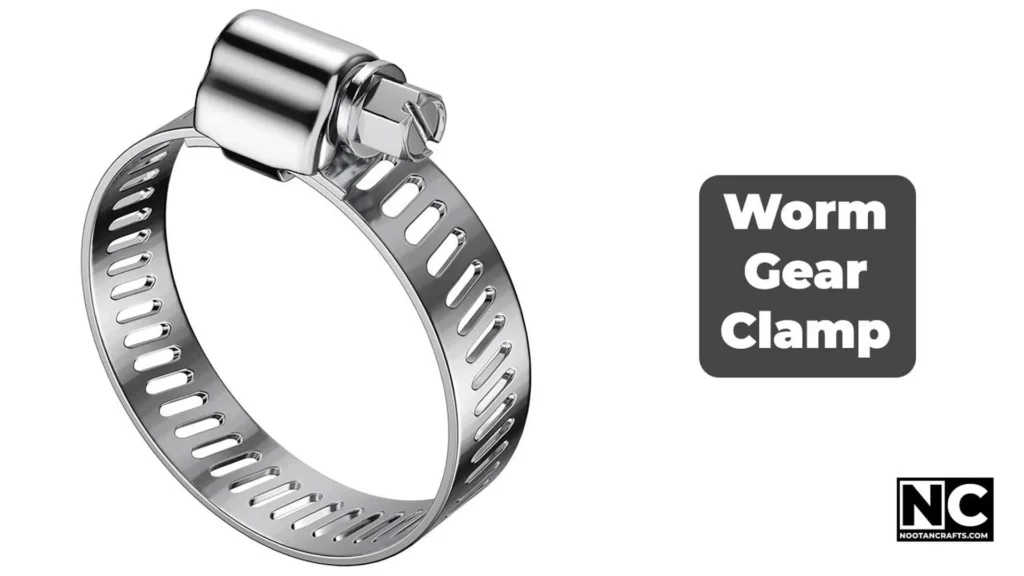
The one everyone owns. A steel band and a screw that engages slots in the band as a worm drive, so a quarter turn of a screwdriver pulls it tighter. Adjustable across a range, reusable, and cheap enough to keep an assortment in a drawer.
- Best forGarden hose, air lines, low-pressure water and drainage
- Band widthsCommonly 8 mm for light duty, 12.7 mm for general use
- SAE typeType F standard, Type G heavy duty, Type M micro
- Weak pointA perforated band cuts soft hose if over-tightened
Two things go wrong with them, and both are avoidable. The first is over-tightening: punched slots are stress risers, and pulled hard onto rubber they emboss it and then cut it. Snug, then a quarter turn, then stop. The second is the housing — on budget clamps the screw housing is spot-welded to the band and tears off before the joint is properly tight.
Best Overall

Last update on 2026-10-25 / Affiliate links / Images from Amazon Product Advertising API
This is the clamp I should have put on that radiator hose. Two specifications matter and this one has both: the band is embossed rather than perforated, so there are no punched slots for rubber to extrude into, and it is 304 stainless throughout, which is W4 — band, housing and screw all the same metal, so nothing seizes first. Eleven sizes from 8 to 60 mm covers most of what turns up.
Buy this on the specification, not the brand name. Nothing about an embossed 304 clamp is proprietary, and a no-name set that states both specs is a better purchase than a familiar name that states neither. What you are avoiding is the W1 multipack: mild steel under a zinc flash, slots punched straight through, and a screw that will be unusable in two winters.
2. Marine and Outdoor Worm Gear Clamps
Same clamp, different metal. Once salt is involved — sea air, road salt, a boat, an irrigation line in a coastal garden —304 stops being enough and the answer is 316, which is W5. The difference is molybdenum, and what it buys is resistance to chloride corrosion specifically.
Best for Marine and Outdoor
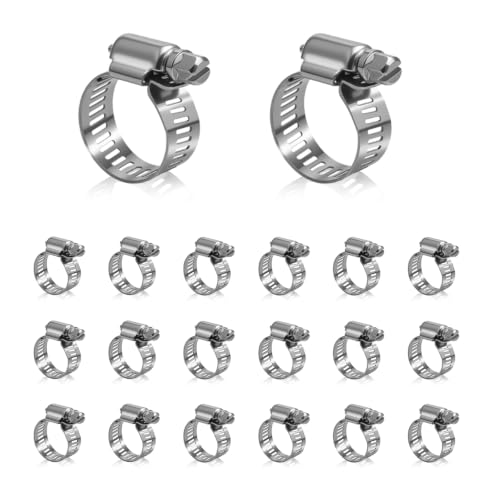
Last update on 2026-10-25 / Affiliate links / Images from Amazon Product Advertising API
- Grade316L stainless — W5
- Range14–27 mm hose outside diameter
- Pack20 clamps, one size band
- Buy it forSalt, immersion, and anything you must undo years later
Check the range before you buy — this one is a single size band covering 14 to 27 mm, and the listing notes it will not fit hose under 1/2 inch outside diameter. That is the normal trade-off with the higher grades: they are sold in narrow size bands rather than assortments, because nobody buys 316 speculatively.
Worth being clear about fuel. Clamps in this grade are often marketed for fuel lines, and 316 is the right metal there. That does not override the safety note above — on a modern injection system, the clamp type is whatever the manufacturer specifies, and a worm gear clamp is not it regardless of how good the stainless is.
3. Spring Clamps
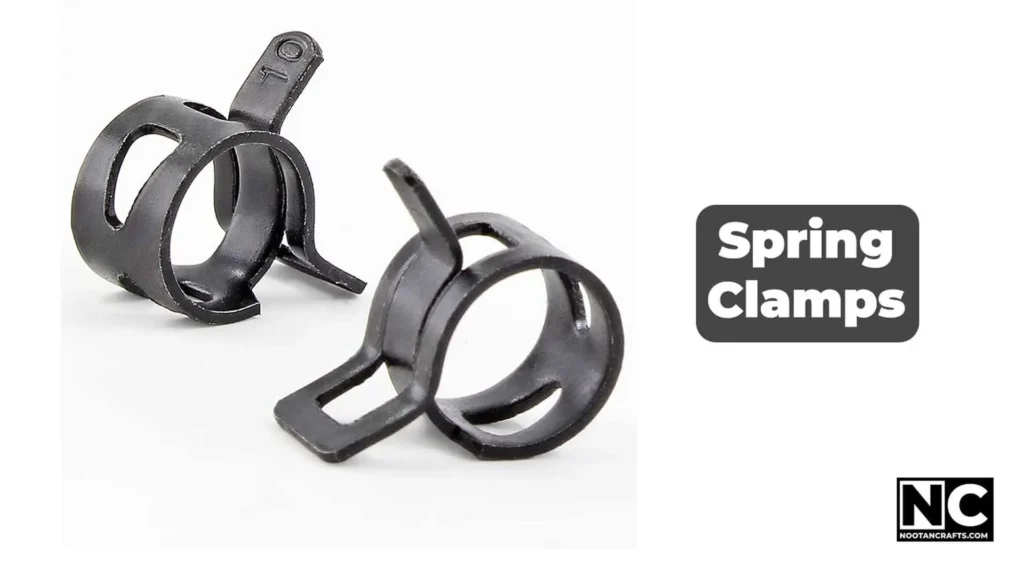
A single band of spring steel that wants to close. You squeeze the two tabs to open it, slide it into place, and let go. There is nothing to adjust and nothing to tighten — the spring supplies a fixed force and keeps supplying it however the hose moves underneath.
- Best forCoolant hoses, heater hoses, anything that heat cycles
- SizingOne clamp fits one narrow diameter – they are not adjustable
- ToolHose clamp pliers; regular pliers will slip and they will fly
- Weak pointYou cannot fine-tune the force, and access is often awkward
This is what car manufacturers fit at the factory, and replacing them with worm gear clamps is one of the most common well-meant mistakes in home car repair. The spring clamp is not the cheap option — it is the correct one for a joint that spends its life expanding and contracting.
No pick here, on purpose. Spring clamps are an original-equipment part sized to one specific hose, and there is no useful assortment to recommend. Keep the ones that came off the car, and spend the money on the pliers instead — those are in the accessories section below.
Use the right pliers. A spring clamp under tension released from ordinary pliers goes across the workshop at speed. Hose clamp pliers hold it captive, and on cars the cable-operated type reaches clamps you cannot otherwise get a hand to.
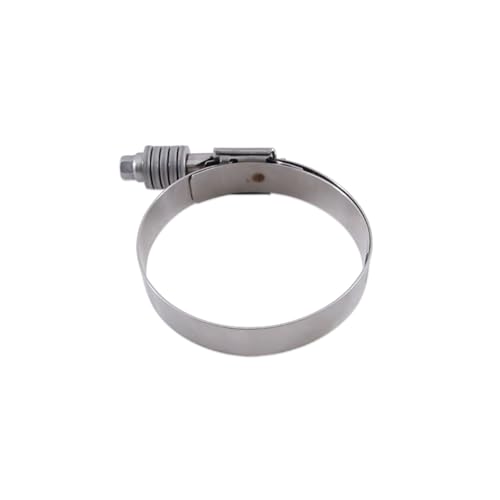
4. Constant-Tension Clamps
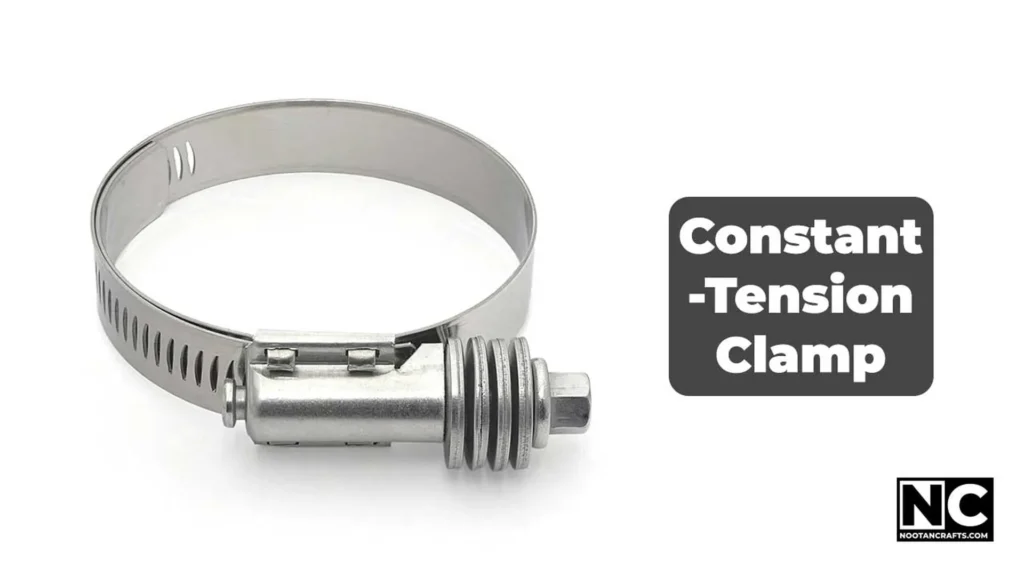
A worm gear or T-bolt clamp with a spring built into it — usually a stack of Belleville washers under the screw head, or a sprung section in the band. You tighten it with a tool like a normal clamp, and the spring then takes up the slack as the hose swells and shrinks.
- Best forCoolant, turbo pipework, anything that cycles hot and cold under pressure
- AdvantageAdjustable like a worm clamp, self-compensating like a spring clamp
- Trade-offSeveral times the price of a plain worm gear clamp
- Fitting noteTighten to the manufacturer’s figure – the spring only works within its designed range
If you are fitting one clamp and you want to fit it once, this is usually the answer. It is also the correct upgrade for a joint that keeps weeping despite being retightened — retightening a fixed clamp treats the symptom, and this fixes the cause.
Best for Coolant
Last update on 2026-10-25 / Affiliate links / Images from Amazon Product Advertising API
Mishimoto build cooling parts for a living, which is the right pedigree for the one clamp on this page whose entire job is surviving heat cycles. This is a worm gear clamp with the spring stack under the screw head, so it fits and adjusts exactly like the clamp it replaces and then behaves like a factory spring clamp afterwards.
Buy by size — this one covers 45 to 66 mm, and constant-tension clamps are sold in bands rather than assortments because the spring is calibrated to a range. Measure the hose on the fitting first. If you are replacing a factory spring clamp and want something you can actually adjust, this is the upgrade that is not also a downgrade.
5. Ear Clamps
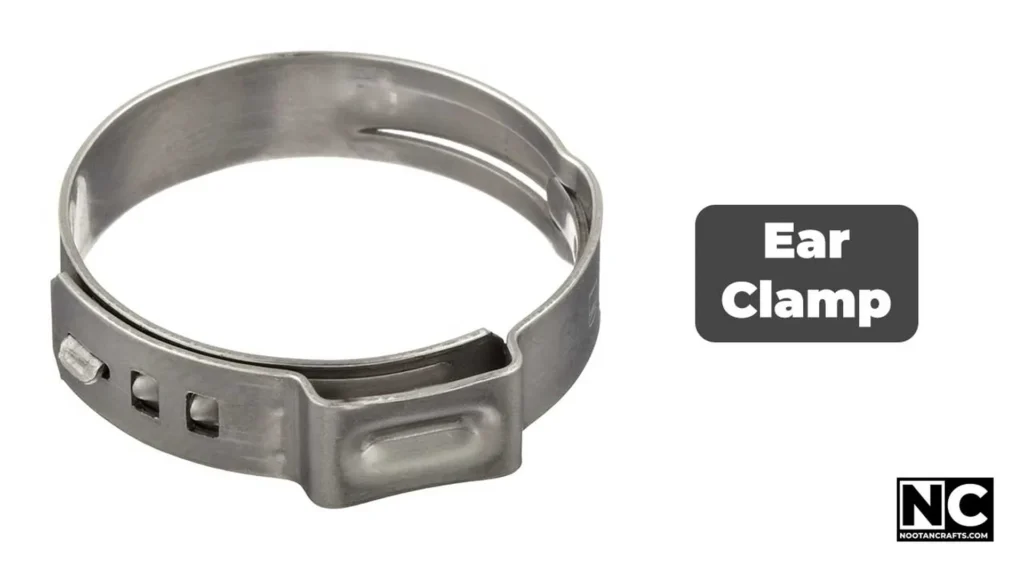
A solid ring with a raised “ear” that you crush closed with pincers. Crushing the ear shortens the circumference and locks it there. One use only.
- Best forSmall-bore hose in appliances, CV boots, drive shafts, medical and food equipment
- ReusableNo – cut it off and fit a new one
- ToolEar clamp pincers, side jaw or front jaw depending on access
- AdvantageEven 360-degree pressure, very low profile, cannot vibrate loose or be tampered with
The band is smooth on the inside, so it seals evenly rather than pinching at a screw housing the way a worm clamp does. That is why they are used where hygiene or a perfect seal matters, and on rotating parts like CV boots where a protruding screw head would be a problem.
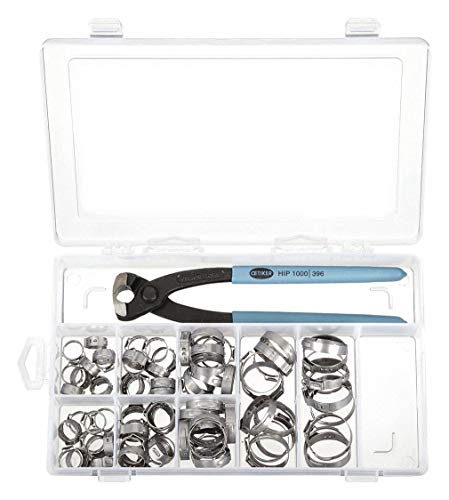
Best for Small-Bore and Permanent Joints
Last update on 2026-10-25 / Affiliate links / Images from Amazon Product Advertising API
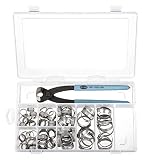
Oetiker invented this clamp and the name is used generically for it, which tells you most of what you need to know. The kit matters more than the clamps: an ear clamp without pincers is unusable, and pincers bought separately often turn out to be the wrong jaw type for the access you have.
The honest caveat is that this is a one-shot fastener. Every time you open that joint you need a new clamp, so buy more than you think and keep the pincers where you can find them. In exchange you get a seal with no screw housing and nothing sticking out, which on a CV boot or a spinning shaft is not a preference but a requirement.
6. T-Bolt Clamps
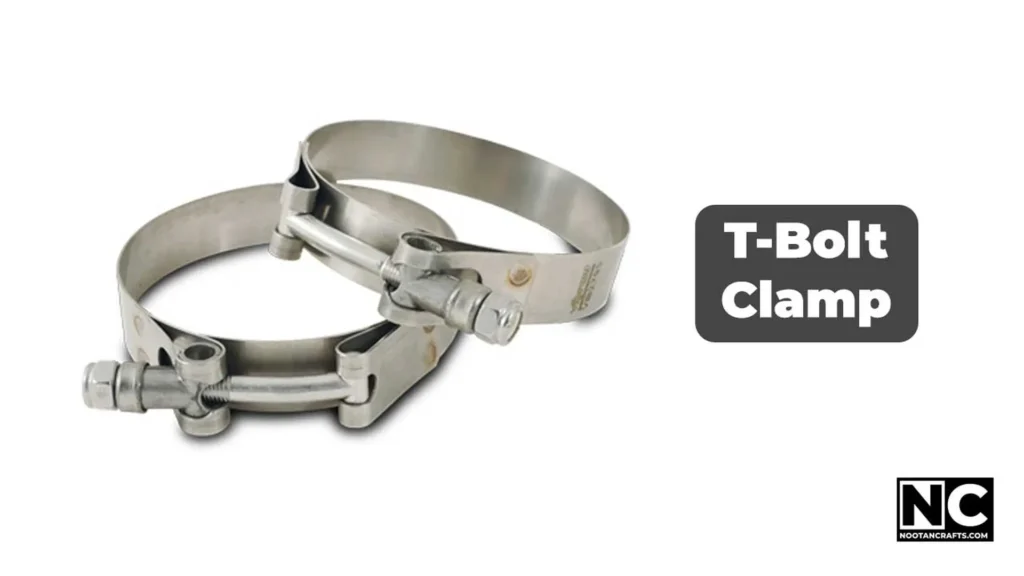
A solid, unslotted band closed by a proper bolt and nut through a T-shaped trunnion. Because you are torquing a bolt rather than driving a screw through pressed slots, it generates far more clamping force — and because the band has no slots, it spreads that force evenly instead of biting.
- Best forTurbo and boost pipework, large industrial hose, silicone hose, marine
- BandSolid, wide, usually stainless
- ToolSocket or wrench — and it can be torqued to a figure
- Trade-offBulkier, needs clearance around the joint, costs more
This is the clamp for silicone hose. Silicone is softer than rubber and a slotted worm band will emboss and eventually cut it, which is why every properly built boost pipe uses T-bolts. On a turbo system a clamp that lets go under boost blows the pipe off, and you find out at full throttle.
Best for Silicone and Boost
Last update on 2026-10-25 / Affiliate links / Images from Amazon Product Advertising API
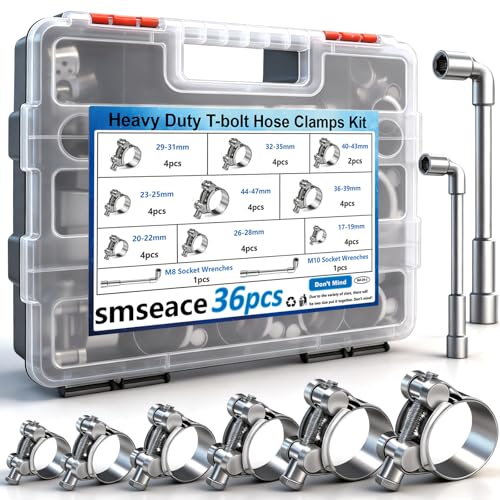
T-bolts are normally sold one diameter at a time, which makes them awkward to buy before you have measured. A nine-size assortment from 17 to 47 mm solves that, and the reason to prefer this one specifically is that the M8 and M10 wrenches are in the box. A T-bolt takes a socket or a spanner, not a screwdriver, and finding that out with the hose already on the car is a wasted evening.
Torque matters more here than on any other clamp on the page, because a bolt will happily generate enough force to crush what is underneath it. On silicone stay at the low end. On a plastic inlet do not exceed 5 ft-lb. And note that this set tops out at 47 mm — the published torque ranges for 3 and 4 inch clamps do not transfer directly to these smaller bands, so err downwards.
7. V-Band Clamps
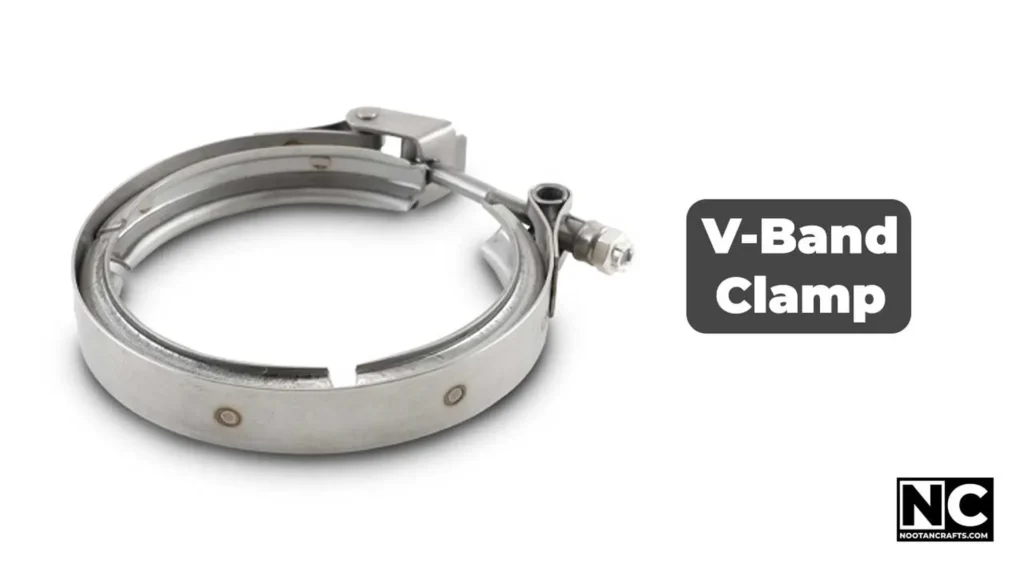
Not a hose clamp at all, strictly — it joins two flanged pipes rather than clamping a hose onto a fitting. The clamp has a V-shaped cross-section that draws two matching flanges together as it tightens, so the load is even all the way round.
- Best forTurbo housings, downpipes, exhaust sections, anything needing repeated disassembly
- NeedsMatching V-band flanges welded to both pipes
- AdvantageEven seal, tolerates heat cycling, comes apart in seconds
- Trade-offOnly works if the flanges are there in the first place
The reason it is on this list is that people searching for the strongest clamp end up here. Its real virtue is not raw strength — it is that an exhaust joint you have to open regularly can be opened without cutting or fighting rusted studs.
Best for Exhaust and Turbo Joints
Last update on 2026-10-25 / Affiliate links / Images from Amazon Product Advertising API
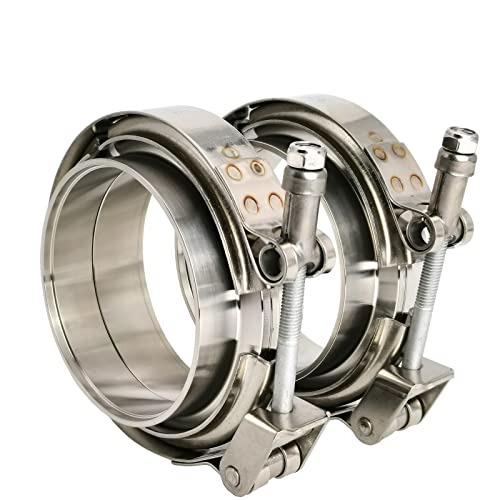
Buying the clamp on its own is the mistake people make here, because a V-band without flanges is a ring that fits nothing. This kit includes the male and female flanges to weld on, which is the whole joint rather than a third of it. Quick-release means the fastener opens without unbolting anything, which is the point on a downpipe you will be taking off again.
Sized by pipe diameter — this one is 3 inch, and V-bands do not adjust, so the size has to match the pipe exactly. If you are fabricating exhaust sections, welding V-band flanges on is the decision you will thank yourself for the next time something needs to come apart.
The Clamps Worth Knowing But Probably Not Buying
Three more families turn up in catalogues and on older machinery. None of them is what a reader of this page is shopping for, but knowing the names stops you buying the wrong thing by accident.
- Wire clamps. A single loop of heavy wire twisted closed. Almost no surface area, so they concentrate all their force on a thin line of hose. Common on very old machinery and agricultural equipment. If you find one on something you care about, replace it.
- Quick-release and lever clamps. A band closed by an over-centre lever instead of a screw. Made for joints opened daily — brewing, food processing, dust extraction — where the time saved matters more than the clamping force.
- Banding and buckle clamps. A roll of stainless strap cut to length and locked with a buckle, tensioned with a dedicated tool. The answer when the diameter is larger than any clamp sold, which is why you see them on marine exhaust and ducting.
Sizing and Fitting
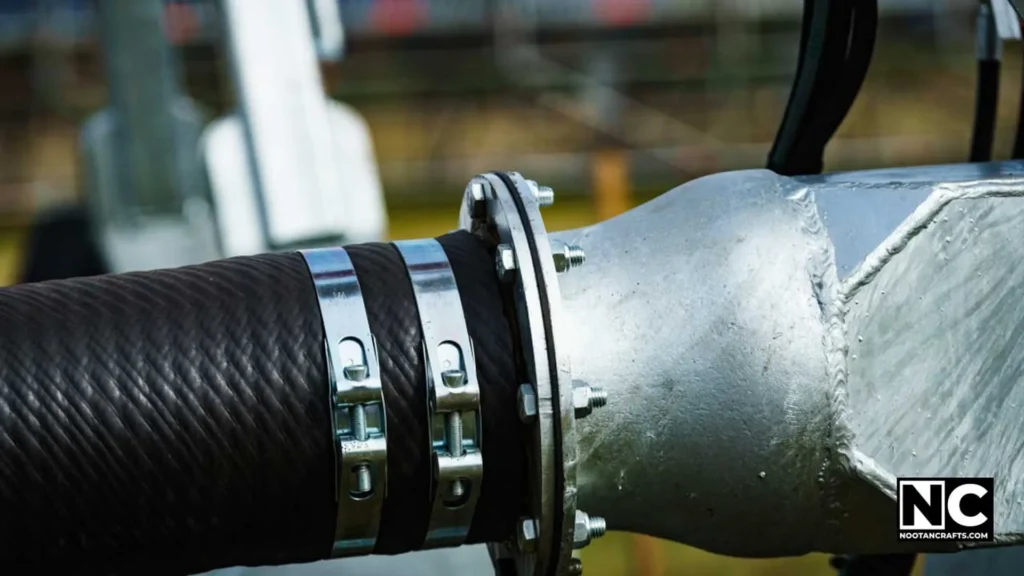
Clamps are sold by a diameter range, and the number you need is the outside diameter of the hose once it is pushed onto the fitting — not the hose’s bore, and not the fitting’s size. Push the hose on, measure across it, and pick a clamp whose range has that measurement comfortably in the middle.
- Push the hose fully onto the barbPast the raised lip, not just up to it. A clamp tightened over the lip rather than behind it will always leak.
- Position the clamp behind the barbRoughly 3-5 mm back from the hose end, sitting over the shank of the fitting. Too close to the end and it can roll off; too far back and it clamps onto nothing.
- Turn the screw housing where you can reach itThink about the next person, or yourself in two years with the engine in the way.
- Tighten to snug, then a quarter turnOr to the figure in the torque table if you own a torque screwdriver. If the rubber is bulging either side of the band, it is too tight.
- Pressurize and check, then check again coldMany joints seal warm and weep once everything contracts. The second check is the one that finds it.
On material: “stainless” on a cheap clamp often means a stainless band with a plated carbon steel screw — that is W2, and it is sold as stainless quite legitimately. Outdoors, in a marine environment, or anywhere salt reaches it, that screw seizes and rounds off long before the band fails. If the clamp needs to come off again in five years, buy W4 or W5.
Which Ones a Car Actually Uses
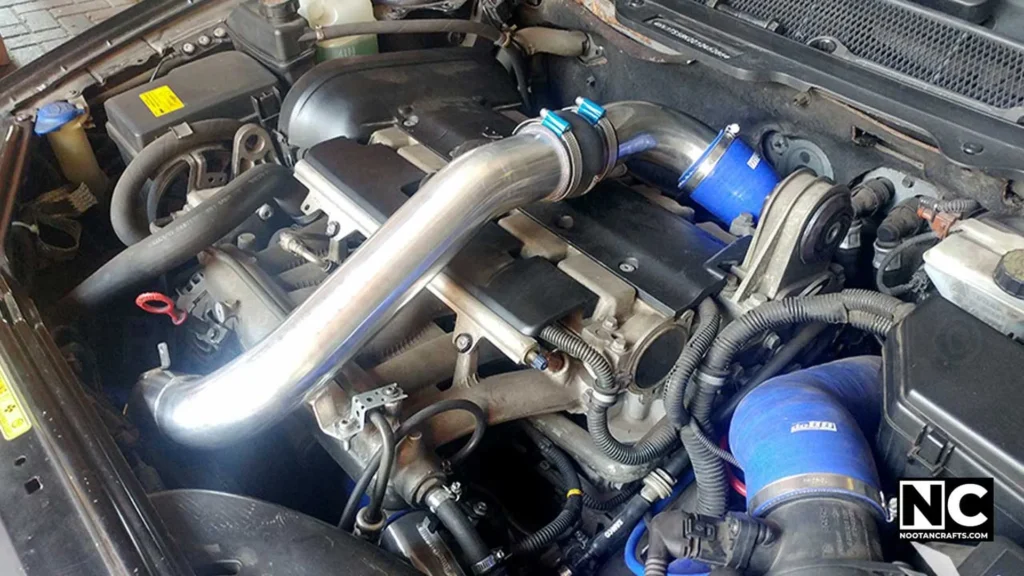
- Coolant and heater hoses — spring or constant-tension. Replacing a factory spring clamp with a worm gear clamp is a downgrade, however solid it feels when you tighten it.
- Air intake and boost pipes — worm gear on the standard rubber ducting, T-bolt on silicone or anything pressurized.
- Turbo and exhaust joints — V-band where the flanges exist.
- Fuel lines — the clamp type the manufacturer specifies, in fuel-rated material. Not a hardware-shop worm clamp on an injection system.
- CV boots — ear clamps or purpose-made boot clamps, because nothing can protrude on a rotating shaft.
- Brake lines — nothing on this list. Replace the hose assembly.
Under a bonnet the grade question answers itself: road salt reaches everything, so W4 at minimum on anything you may need to undo later. The same corrosion logic applies to any fastener that lives outdoors.
Getting a Seized Clamp Off
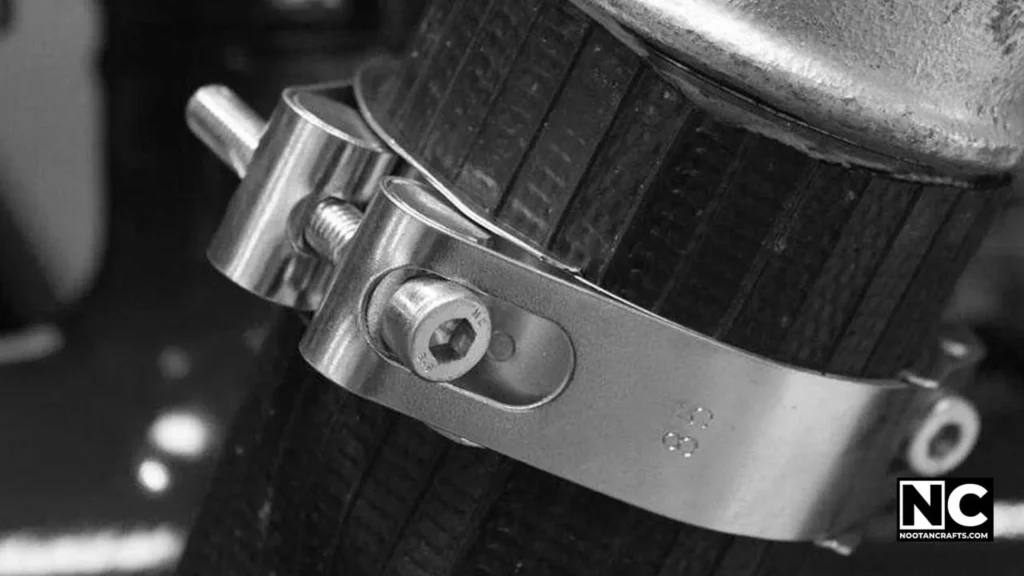
This is the other half of the cheap clamp problem, and it is the one people do not think about until they are lying under something. A W1 clamp that has spent two winters outdoors has rust in the slots and a screw head that the driver no longer bites. Turn it hard and you round the head off completely, and now the clamp cannot be tightened or loosened.
- Try a nut driver before a screwdriver. Most worm gear screws have a hex head as well as a slot, and 7 or 8 mm of full engagement grips far better than a blade in a corroded slot.
- Penetrating oil, then wait. The rust is in the thread and between the band and the housing, not just on the outside.
- Once the head is rounded, stop turning. Cut the band instead — side cutters through the band away from the hose, then peel it open. Trying harder only welds the damage in.
- Never lever against the hose. The hose is the thing you are trying to save; if it is being replaced anyway, cut the hose off and deal with the clamp on the bench.
Factory spring clamps are a different problem entirely — not corrosion, access. They are stiff, they sit in places designed around a robot arm, and released from ordinary pliers they leave at speed. That is a tool problem with a tool answer.
Recommended Accessories
Three tools, and none of them is optional if you meet the clamp it belongs to. A spring clamp without the right pliers is a fight; a torque figure without a torque screwdriver is trivia.


Last update on 2026-10-25 / Affiliate links / Images from Amazon Product Advertising API
- Knipex 85 51 250 click-clamp pliers. For factory spring clamps. They hold the clamp captive once opened, which is the difference between removing one and losing one under the engine.
- Cable-operated hose clamp pliers. The jaw is on a flexible cable, so it reaches clamps you can see but cannot get a hand to — which on a modern engine bay is most of them.
- CDI 401SM torque screwdriver, 5–40 in-lb. The tool that turns the torque table above into something you can act on. A worm gear clamp’s 35 to 50 in-lb sits squarely in the range where a driver reads properly and your hand does not.
Where This Goes Wrong
- Over-tightening. The commonest failure by a distance. A cut hose leaks worse than a loose one, and it fails later, when you have stopped watching it.
- A perforated band on silicone or soft rubber. The slots press in, the rubber extrudes into them, and the edges work through. Use non-perforated, lined, or a T-bolt. This is the one that cost me a radiator hose.
- Buying W1 for an outdoor joint. Its published rating is dry indoor use. Everywhere else it is a clamp with a shelf life.
- Two small clamps instead of one right-sized one. Doubling up on a clamp at the end of its range does not add force; it adds a second place to leak.
- Clamping over the barb lip. The band needs to sit behind the raised ridge so the ridge has something pressing it into the hose wall.
- Mixed metals outdoors. A plated screw in a stainless band — W2 — in salt air, seizes solid within a couple of years.
- Reusing an ear clamp. It sealed by deforming once. It will not do it twice.
What a Hose Clamp Is Actually Doing
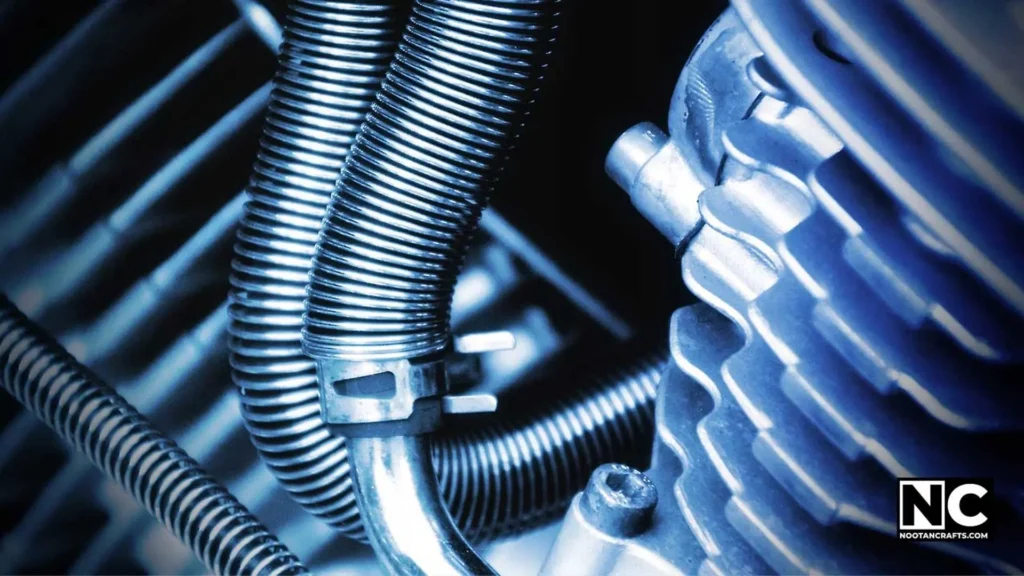
It is not holding the hose on by friction against the outside. It is squeezing the hose wall down onto the ridges of the barbed fitting underneath, so the rubber flows into those ridges and forms the seal. The clamp supplies the squeeze; the barb and the rubber do the sealing.
That is why over-tightening backfires. Past the point where the rubber has conformed to the barb, extra force only damages the hose — and it is why a clamp positioned over the lip rather than behind it never seals, no matter how hard it is done up.
It also explains the heat problem. Rubber creeps: held compressed at temperature for long enough, it takes a permanent set and no longer pushes back against the band. A fixed-circumference clamp has nothing left to take up that slack. A sprung one does. If you are keeping a general workshop kit, an assortment of stainless worm gear clamps and a few constant-tension ones covers most of what turns up — the same buy-once logic behind choosing tool brands.
Which Hose Clamp Should You Buy?
| If you’re doing this | Buy this | Why |
|---|---|---|
| Keeping a general assortment in the drawer | Embossed 304 worm gear set | Non-perforated so it cannot cut hose, W4 so nothing seizes first. |
| Anywhere salt reaches — coast, boat, gritted road | 316L worm gear | W5. The molybdenum is what resists chloride corrosion. |
| Radiator, heater or any hose that heat cycles | Mishimoto constant tension | Adjustable like a worm clamp, self-compensating like a spring one. |
| Small-bore hose, CV boots, anything permanent | Oetiker StepLess kit | Smooth inner band, no protruding housing, and the pincers are included. |
| Silicone, boost pipes, high pressure | T-bolt assortment | Solid band and a real bolt — and the wrenches come with it. |
| Exhaust or turbo joints you’ll open again | V-band kit with flanges | The flanges are the half people forget to buy. |
| Removing factory spring clamps | Clamp pliers | There is no substitute, and ordinary pliers launch them. |
Hose Clamp Questions People Actually Ask
How many types of hose clamps are there?
It depends who is counting. SAE J1508, the standard the motor industry uses, covers 32 types for OEM coolant, fuel, oil, vacuum and emission systems. In practice six families cover almost everything a car, a boat or a workshop will meet: worm gear, spring, constant-tension, ear, T-bolt and V-band. The rest are variations on those in different band widths, housings and corrosion grades.
What do W1, W2, W4 and W5 mean on a hose clamp?
They are material grades. W1 is mild steel with zinc plating throughout and is rated for dry indoor use only. W2 has a stainless band and housing but a zinc-plated mild steel screw, which is why a clamp sold as stainless can still seize. W3 is all AISI 430, W4 is all AISI 304, and W5 is all AISI 316 — the grade for salt and immersion. If a listing does not state a grade, assume the cheapest one that fits the description.
Why did my hose clamp cut the hose?
Because the band was perforated and it was tightened too far. The slots in a standard worm gear band are punched through, and under enough pressure the rubber extrudes up into them — after which the edges of the slots do the cutting. Ideal Tridon, who make both kinds, describe exactly this. On soft rubber or silicone use a non-perforated or lined clamp, or a T-bolt.
What is the strongest type of hose clamp?
T-bolt for clamping a hose onto a fitting, V-band for joining two flanged pipes. Both use a bolt rather than a pressed screw thread, which is where the extra clamping force comes from — and both have a solid band that spreads it evenly.
How tight should a hose clamp be, in torque?
Dixon publishes a maximum of 50 in-lb for a standard worm gear clamp and 60 in-lb for its Aero-Seal; a 1/2 inch band is commonly specified at 35 in-lb. T-bolts on a turbo inlet run 4 to 6 ft-lb, dropping to 4 to 5 on silicone and never above 5 on a plastic housing. Without a torque screwdriver, snug plus about a quarter turn gets you close — and if the hose is bulging either side of the band, you have gone past it.
How do I measure for the right clamp size?
Push the hose fully onto the fitting, then measure the outside diameter of the hose at that point. Pick a clamp whose adjustment range has that figure near the middle, not at either end.
Can I use a worm gear clamp on a coolant hose?
It will hold, but it isn’t the right clamp. Coolant hoses heat and cool constantly and the rubber takes a set over time, so a fixed-circumference clamp gradually goes slack. Spring or constant-tension clamps are what the factory fits, and for good reason.
Can I use a hose clamp on a brake line?
No. Brake hydraulics run far above any hose clamp’s working range and use crimped hose assemblies into threaded fittings. A leaking brake hose is replaced, never clamped. This is the one item on the page with no workaround.
How do I remove a rusted hose clamp?
Try a 7 or 8 mm nut driver on the screw head before a screwdriver — full hex engagement grips where a blade in a corroded slot does not. Give penetrating oil time to reach the thread and the gap between band and housing. Once the head is rounded, stop turning and cut the band with side cutters instead, working away from the hose. Turning harder past that point only makes it worse.
Are stainless steel clamps worth the extra?
Outdoors, near salt, or anywhere you’d have to remove it again years later, yes. Check the grade though — plenty of clamps sold as stainless are W2, with a plated carbon steel screw that seizes and rounds off first.
Can I reuse a hose clamp?
Worm gear, spring, T-bolt and V-band clamps are all reusable if the threads are clean and the band isn’t distorted. Ear clamps are not — they seal by being crimped once.
Why does my clamp keep leaking even though it’s tight?
Usually one of three things: the clamp is sitting over the barb lip instead of behind it, the hose has been cut by over-tightening, or the hose has taken a permanent set and a fixed clamp can no longer take up the slack. The third one is a constant-tension clamp’s job.
Read the Grade and the Band, Not the Price
If the joint stays cool and the pressure is low, a worm gear clamp is all it needs. If it heats and cools, use something sprung. If it is under real pressure or on silicone, use a T-bolt. And if it is a brake line, put the clamps away — that hose gets replaced.
But before any of that, check two things on the packet. W4 or better if it will ever be wet, and a solid or lined band if the hose is soft. Both of my failures — the clamp that cut a radiator hose and the ones that rusted solid — were bought without reading either. The right clamp usually costs a little more than the wrong one and a great deal less than the hose it saves.