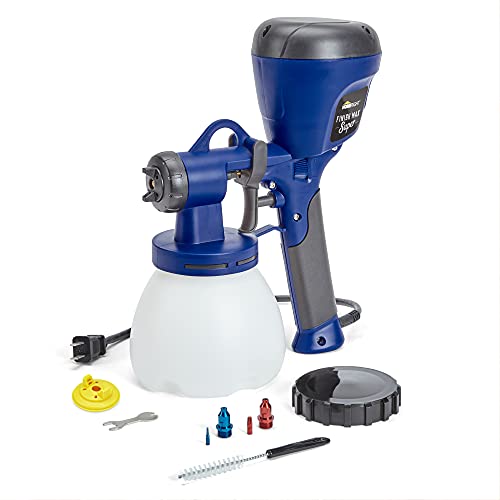
The HVLP gun I own tells me its wattage, its cup size, and that the nozzle is copper. It does not tell me the one number that decides whether a furniture topcoat lands flat or lands like sandpaper — and neither does most of what sells under a hundred and fifty dollars. So buy the HomeRight Super Finish Max: it is the cheapest sprayer here that publishes its tip sizes and ships a 1.5 mm brass tip fine enough to atomize a topcoat properly.
That one detail decides more about your finish than motor power, brand, or price. Spend more only if you have a reason: the Fuji Semi-PRO 2 for a finer finish, the Critter 118SG if you already own a compressor, the Wagner Control Spray Max if you are spraying stain rather than paint, or the Wagner FLEXiO 5000 if you are shooting a full kitchen of doors rather than one dresser.
Top Pick
Last update on 2026-09-16 / Affiliate links / Images from Amazon Product Advertising API
- Power450 W
- Tips included1.5, 2.0, 4.0 mm brass
- Cup40 oz
- Pattern width1 to 12 in
- Warranty2 years
Almost every sprayer roundup treats furniture as a smaller version of a wall. It is the opposite job. A wall sprayer is built to move a lot of thick paint fast; a furniture sprayer has to break a thin coating into a mist fine enough to flow out flat on a surface someone will look at from eighteen inches away. Those two goals pull in opposite directions, and the tip is what resolves them — which is why a maker who will not print the tip size is asking you to buy on faith.
Get it right, and the first coat feels like a magic trick: an hour of brushwork done in minutes, flat, with no marks in the corners a brush can barely reach. Get it wrong, and you have atomized an expensive can of paint onto the wall behind your workpiece. If you are still deciding whether to spray at all, the paintbrush vs paint sprayer comparison settles that question first.
What’s Inside!
- 1 – Paint Sprayer for Furniture: Buyer's Guide
- 2 – Paint Sprayer Tip Size Chart for Furniture Finishes
- 3 – Paint Sprayer for Furniture Comparison Table
- 4 – Best Paint Sprayers for Furniture in 2026: In-Depth Reviews
- 5 – How to Spray Paint Furniture: Step-by-Step
- 6 – Recommended Accessories
- 7 – Which Paint Sprayer for Furniture Should You Buy?
- 8 – Paint Sprayer for Furniture FAQ
- 9 – Final Thoughts on Choosing a Paint Sprayer for Furniture
Paint Sprayer for Furniture: Buyer’s Guide
Tip size decides the finish
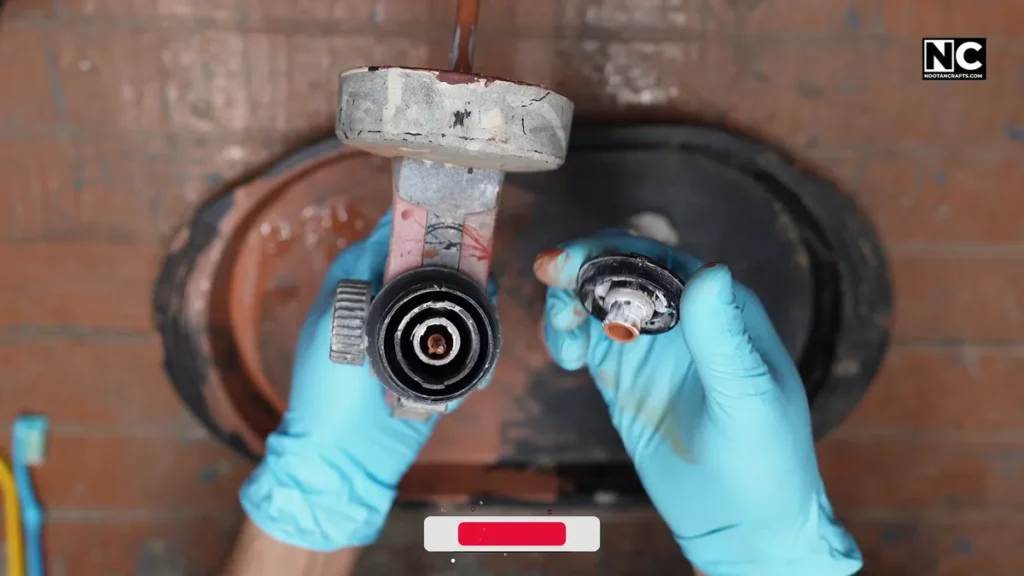
A spray tip meters how much material passes through and how finely the airstream tears it apart. Too large, and the coating leaves the gun as fat droplets that land before they flatten—that is the orange-peel texture people blame on their technique. Too small for the material, and the gun starves, spitting and drying the spray in mid-air.
The sizes are not guesswork, because the people who make the coatings publish them. General Finishes, whose waterborne topcoats are the default on a lot of furniture work, specifies a 1.1 mm to 1.3 mm spray tip with a medium air cap for High Performance topcoat. Fuji’s own guidance puts its 1.3 mm air cap set at the center of water-based work and reserves 1.8 mm for primers, industrial coatings, and wall latex. Those two numbers, from a finish maker and an equipment maker who have no reason to agree, land in the same place.
Solvent lacquer on a compressor-fed gun is a different conversation, and this is where copying an automotive setup goes wrong. On the Woodweb professional forum, a spray equipment specialist puts standard wood lacquers at 1.7 mm or 1.8 mm and calls the 1.4 mm tip “an automotive size, not woodworking” — too small for most wood products, drying the spray and forcing too many passes. Same trade, opposite end of the range, because the material and the gun are both different.
Turbine, compressor, or airless
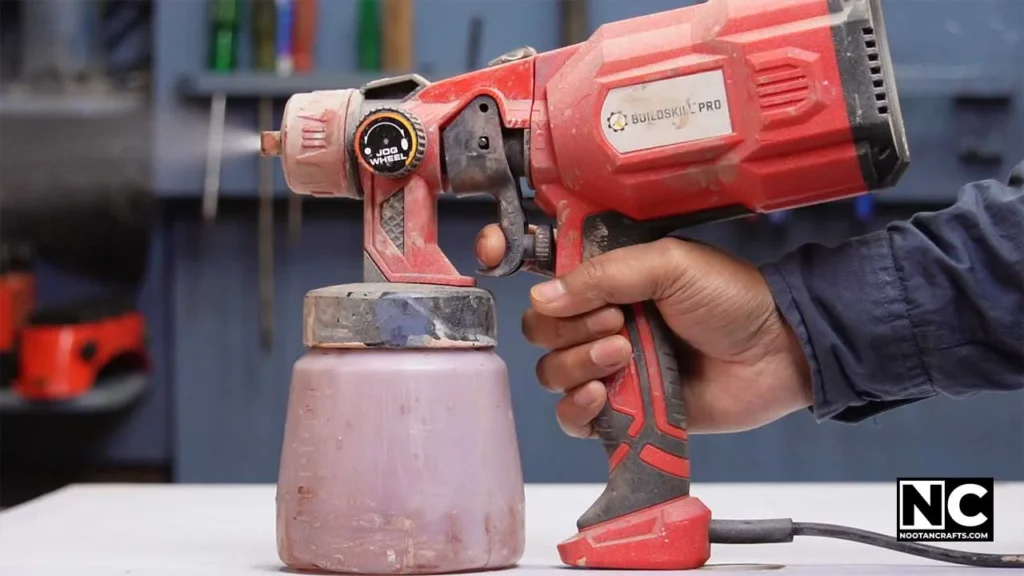
A turbine HVLP unit spins a fan to make a large volume of low-pressure air. That low pressure is why it wastes less material as overspray and why it suits small garage work. A compressor-fed gun does the same job using air you already have, and it is the cheapest way in if a compressor is already sitting there. Airless has no air at all: it forces the coating through a tiny orifice at very high pressure, which is superb for volume and much harder to control on a chair leg.
For one dresser, a turbine unit. For twenty cabinet doors on a deadline, airless starts to make sense. The HVLP spray gun guide covers turbine setup in detail.
If the maker won’t publish the tip size, you can’t match it to anything
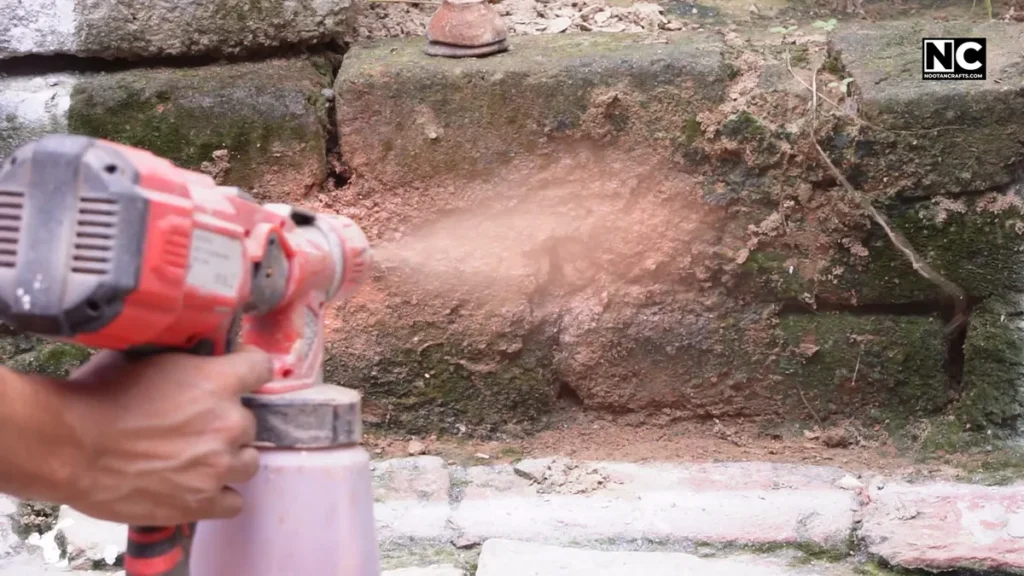
Here is the practical trap, and my own gun walks straight into it. BUILDSKILL’s HVLP handhelds are sold on wattage, motor speed, cup volume, and the fact that the nozzle is copper. Search the listings for the one number that governs atomization, and it is not there: no orifice size in millimeters, on either the BPS2100 or the BPS2300. The same is true of most budget handhelds. So when General Finishes tells you to shoot its waterborne topcoat through a 1.1 to 1.3 mm tip, there is nothing on your side of the transaction to compare it to. You find out by spraying a test panel and reading the result.
This is why the HomeRight leads this list rather than a cheaper clone. Not that it is better built — that it tells you 1.5, 2.0, and 4.0 mm, so you can fit the tip the can asks for instead of guessing.
Nobody is promising you unthinned paint
Read the manufacturer pages for every sprayer on this list and a pattern shows up. HomeRight says “less paint thinning required” — a comparative claim, not a promise of none. Critter says “some material thinning may be required.” Wagner’s Control Spray manual says thinning may be necessary and tells you not to exceed the coating maker’s own advice. Only one machine here makes the stronger claim: Wagner states the FLEXiO 5000 sprays unthinned latex and oil-based paints, stains, and urethanes, and it does that with a turbine sized for wall work rather than a fine-finish cap.
“Sprays unthinned” and “sprays furniture topcoats” are not the same claim. The machine rated for unthinned latex is built around a wall-sized air cap; the fine-finish tools all tell you to thin. If a review promises both at once from one tip, it is describing wall latex, not a topcoat. Budget for thinning, a stir stick, and a test panel—those cost nothing, and they separate a sprayed finish from a ruined one.
Paint Sprayer Tip Size Chart for Furniture Finishes
Where your can carries its own spec sheet, that number beats anything here.
| Material | Tip / air cap | Source | Which pick has it |
|---|---|---|---|
| Waterborne topcoat | 1.1–1.3 mm | General Finishes, High Performance data | Fuji (1.3 mm stock) |
| Water-based finishes generally | 1.3 mm | Fuji air cap guidance | Fuji (1.3 mm stock) |
| Fine finishing, thinnest coats | 1.0 mm | Fuji air cap guidance | Optional Fuji air cap set |
| Stain, sealer, thin lacquer | 1.5 mm | HomeRight tip set | HomeRight (1.5 mm brass) |
| Solvent wood lacquer, compressor gun | 1.7–1.8 mm | Woodweb professional forum | Critter, with a compressor |
| Primer, wall latex, thick coatings | 1.8 mm and up | Fuji air cap guidance | HomeRight (2.0 / 4.0 mm) |
| Unthinned latex, broad panels | Manufacturer rating, no mm published | Wagner FLEXiO 5000 material chart | FLEXiO 5000 (iSpray) |
One number the table cannot give you is viscosity, because it depends on your specific can on your specific day. No universal seconds-per-cup chart is worth trusting; follow the figure on the coating’s own data sheet. General Finishes, in the worked example, says to start at 5% distilled water and go up to 10% by volume, and to lay down two to three coats, no more than three.
A dust mask filters particles. Spraying finish fills the room with solvent vapor, which goes straight through it
Atomizing a coating does two things at once: it suspends droplets in the air and it accelerates solvent evaporation. A particle mask stops the first and does nothing about the second. OSHA’s spray finishing standard, 29 CFR 1910.94(c), requires exhaust ventilation sufficient to dilute solvent vapor to at least 25 percent of the lower explosive limit, and a NIOSH-approved respirator under 42 CFR part 84 for the material being sprayed where the operator works downstream of the spray.
- Cartridge respirator rated for organic vapors, not a dust mask and not a surgical mask
- Cross ventilation, not a closed garage — that lower-explosive-limit figure is a fire rule as much as a health one
- No ignition sources near solvent spray, pilot lights and space heaters included
- Spraying into a box sends it back at you — inside a wardrobe or almirah the mist has nowhere to go but out past your face; this is where a proper seal on the respirator stops being optional
- Waterborne is safer, not safe — it still atomizes into your lungs, and it still needs the respirator
Paint Sprayer for Furniture Comparison Table
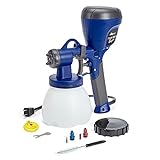
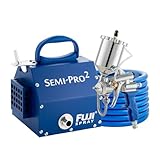
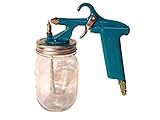


Last update on 2026-09-20 / Affiliate links / Images from Amazon Product Advertising API
Listed in review order. The Critter 118SG is a gun only — it needs a compressor you already own, which is why its price sits so far below the rest.
Best Paint Sprayers for Furniture in 2026: In-Depth Reviews
Five machines, sorted by what each one requires before it gives you a finish.
1. HomeRight Super Finish Max (Best Overall for Furniture)
Best Overall for Furniture
Last update on 2026-09-16 / Affiliate links / Images from Amazon Product Advertising API
- Power450 W
- Tips included1.5, 2.0, 4.0 mm brass
- Pre-installed tip2.0 mm green
- Cup40 oz
- Pattern width1 to 12 in
- Warranty2 years
This sprayer is for someone refinishing furniture a few weekends a year who wants one tool that covers the whole job. It wins because it includes a 1.5 mm brass tip: the finest tip in this price bracket, and the one that makes stain, sealer, and thin topcoat behave. The 2.0 mm tip it ships with installed is the wrong one for furniture work, and swapping it is the first thing to do.
HomeRight lists it for chalk paint, milk paint, latex, enamels, primers, clear sealer, polyurethane, stain and varnish, which is a wide brief for one handheld unit, and the adjustable pattern from 1 to 12 inches is what lets it cover both a chair spindle and a tabletop.
The honest caveat is cleaning, and it is the most repeated complaint from people who own one. The head does not separate from the motor body the way some Wagner units do, so cleanup means spraying solvent through and picking at a recess. DIY blogger Natalie at A Ray of Sunlight describes a black part up inside the attachment point that has to be cleaned around, and owner-reviewer Jamie Penney at Furniture Flippa warns that dried paint left in the gun causes it to skip, spray unevenly, and throw clumps. Two independent owners naming the same problem is a pattern, not bad luck. Clean it immediately, every time.
Where it wins
- 1.5 mm tip included, the finest at this price
- Three tips cover furniture through to primer
- Pattern adjusts down to 1 in for spindles and edges
- Two-year warranty, longer than most rivals
Where it doesn’t
- Head does not detach, so cleaning is fiddly
- Ships with the wrong tip installed for furniture
- Atomization is coarser than a true two-stage turbine
- Cleanup neglect causes spitting and clumping
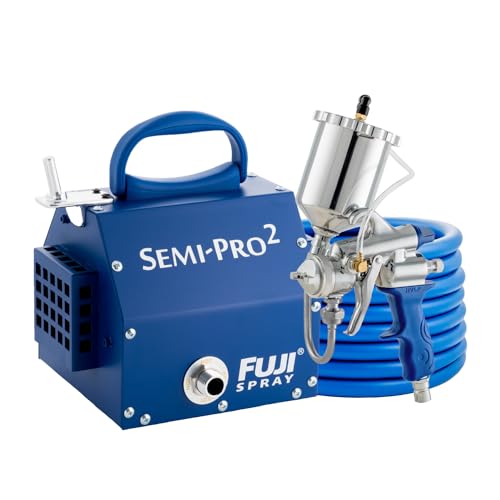
2. Fuji Semi-PRO 2 (Best Finish Quality)
Best Finish Quality
Last update on 2026-09-16 / Affiliate links / Images from Amazon Product Advertising API
- Turbine2-stage, 5.0 psi
- Air cap installed1.3 mm
- GunM-Model gravity, non-bleed
- Cup400 cc pressurized aluminum
- Hose25 ft
- Warranty2 years, parts and labor
This is the step up for someone who has outgrown a handheld and cares about the surface more than the schedule. The separate turbine and 25-foot hose mean you are holding a balanced gun rather than a motor, which matters over a long session, and the 1.3 mm air cap it ships with is exactly the size the waterborne topcoat makers specify. Nothing to buy, nothing to swap.
Fuji includes a #4 Ford viscosity cup in the box, which tells you what kind of tool this is: it assumes you will measure your thinning rather than guess it. Fuji does not publish a motor wattage for this system, and no independent teardown has been published, so any figure you see quoted for it comes from a retailer listing rather than the manufacturer.
The caveat is ergonomic, not mechanical. On Sawmill Creek, a woodworker eighteen months into ownership calls the unit wonderful but notes that the airflow switch and material flow dial carry no index marks, so settings that worked last time have to be dialed back in by feel. He also chose it over an Earlex specifically because that unit’s coarser stock needle struggled with shellac and lacquer. Note that his unit is the bottom-feed variant of the same turbine system rather than this gravity version.
Where it wins
- 1.3 mm air cap matches waterborne topcoat specs exactly
- Separate turbine means a light, balanced gun
- Viscosity cup included, so thinning is measured
- Two-year parts and labor cover
Where it doesn’t
- Several times the cost of a handheld unit
- Flow controls have no index marks to return to
- Motor power is not published by Fuji
- Turbine and hose need somewhere to live
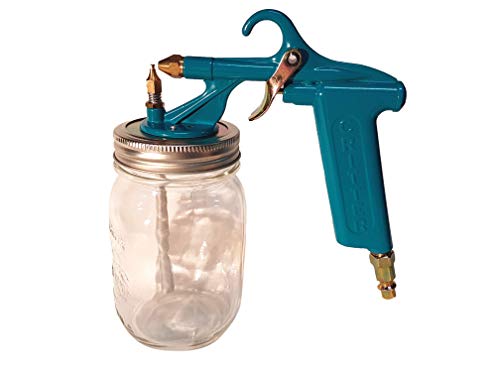
3. Critter 118SG Siphon Gun (Best Budget)
Best Budget
Last update on 2026-09-16 / Affiliate links / Images from Amazon Product Advertising API
- Compressor needed2 to 3 CFM, 3/4 hp or larger
- CupStandard 16 oz mason jar
- Spray pattern1/2 to 3 in circular
- TypeSiphon gun, no turbine
If a compressor is already in the shop, this is the cheapest way to spray furniture properly, and it has been the woodworker’s answer for decades. Critter lists it for polyurethanes, lacquers, stains, chalk paints, latex, enamels, and ceramic glazes, and the round pattern of half an inch to three inches matches chair rails, spindles, and small panels better than tabletops.
Check your compressor before you buy, because this is where the purchase succeeds or fails. Critter asks for 2 to 3 CFM from a 3/4 hp unit or larger. On Sawmill Creek, one woodworker warns that a small compressor will not sustain it for more than about four feet at a time, which means losing the wet edge mid-panel. Other owners in the same thread report their own compressors keeping up without trouble, so this is a question about your specific machine rather than a flaw in the gun. A pancake compressor is the wrong partner.
The mason jar turns out to be a genuine workflow advantage rather than a gimmick: owners in that thread cap the jar between coats and store the leftover finish in it instead of cleaning the gun out. The honest downside is that the seals are a consumable — a Fine Woodworking forum user advises buying spare seals because they tend not to last long — though that is one report rather than a chorus, so treat it as a cheap precaution rather than a known defect.
Where it wins
- Cheapest route to a real sprayed finish
- Mason jar doubles as finish storage between coats
- Small round pattern suits spindles and rails
- Almost nothing on it to break
Where it doesn’t
- Useless without an adequate compressor
- Small compressors cannot hold a wet edge
- Nozzle size is not published
- Seals wear and need replacing
4. Wagner Control Spray Max (Best for Stain and Clear Finishes)
Best for Stain and Clear Finishes

Last update on 2026-09-16 / Affiliate links / Images from Amazon Product Advertising API
- TypeTurbine HVLP, remote cup
- Cups1.5 qt plus 1 qt metal
- Rated ideal forWood, semi-transparent and solid stain
- Rated not recommendedPaint and primer
- Warranty1 year
Buy this one for stain, dye, and clear finishes on furniture, and for very little else. That is not a reviewer’s opinion — it is Wagner’s. The company’s own material compatibility chart for this sprayer rates it ideal for wood stain, semi-transparent stain, and solid stain, and lists paint and primer as not recommended. Many roundups recommend this exact model for painting cabinets. The manufacturer does not.
In that brief, it is a capable machine, and the remote cup is the reason. Carrying 1.5 quarts on the floor instead of in your hand changes what an afternoon of staining feels like, and the metal 1-quart cup handles solvent-based material that would haze a plastic one.
Owner experience lines up with the chart. Reviewing it at One Project Closer, Ethan found that latex needed thinning several times and still came out rough — exactly what Wagner’s own rating predicts. He also points out a detail no spec sheet lists: the suction tube is angled, so aiming it deliberately lets you draw the cup further down before refilling. Wagner does not publish nozzle sizes in millimeters for this unit, only pattern width, which makes matching it to a coating data sheet harder than it should be.
Where it wins
- Rated ideal for stains by the manufacturer
- Remote cup takes the weight off your hand
- Metal cup option handles solvent material
- 1.5 qt capacity suits long staining sessions
Where it doesn’t
- Wagner rates it not recommended for paint and primer
- Latex reportedly comes out rough even thinned
- No published nozzle sizes in mm
- One-year warranty, half the Fuji or HomeRight
5. Wagner FLEXiO 5000 (Best for a Full Kitchen of Cabinets)
Best for a Full Kitchen of Cabinets

Last update on 2026-09-20 / Affiliate links / Images from Amazon Product Advertising API
- TypeStationary HVLP, X-Boost turbine
- NozzlesiSpray + Detail Finish
- Hose11.5 ft
- ThinningRated for unthinned latex and oil
- Model0529091
The turbine sits on the floor, and only the gun is in your hand, which is the whole argument for it on a volume job. A handheld unit puts the motor, the cup, and the paint in your wrist; after twenty cabinet doors, that’s what ends the session, not the finish. Wagner publishes a material chart rating it ideal for paint and primer as well as all three stain types, which is a broader rating than the Control Spray Max gets from the same company.
Two nozzles do two different jobs, and the split matters more than the spec sheet suggests. iSpray is the wide one, meant for broad surfaces and unthinned wall paint. Detail Finish is the one you actually fit for cabinet doors and furniture: narrower fan, finer atomization, less material per pass. Buying this sprayer and leaving iSpray on it for furniture is the most common way to be disappointed by it.
On independent assessment rather than the maker’s own: Bob Vila’s cabinet sprayer testing named the FLEXiO 5000 its best overall for cabinets, reporting that “the finish came out smooth with no runs or uneven texture.” That is the closest thing to a fine-finish verdict any high-volume unit on this list has earned.
Wagner does not publish an orifice size in millimeters for either nozzle, so you can’t use the tip-size chart above to match it to a coating data sheet. On this machine, you set flow, pattern, and width by adjustment and judge it on a test panel — the same compromise as a budget handheld, just with a lot more adjustment available.
Where it wins
- Turbine on the floor, so your wrist holds only the gun
- Detail Finish nozzle included, not an upsell
- Wagner rates it ideal for paint, primer, and stain alike
- Independent cabinet testing picked it best overall
Where it doesn’t
- No published nozzle size to match against a data sheet
- Two-piece unit to store and drag around
- iSpray nozzle is too coarse for furniture — you must swap it
- More machine than one dresser will ever need
How to Spray Paint Furniture: Step-by-Step
- Sprayer with the correct tip fitted
- Respirator rated for organic vapors
- Sandpaper, 180 and 320 grit
- Tack cloth or microfiber
- Scrap panel for testing
- Measuring jug and stir stick
- Distilled water or the specified thinner
- Painter’s tape and drop sheet
- Sand and de-dust properlySpraying magnifies surface defects rather than hiding them, because the coat is thinner and more even than a brushed one. Sand to 180 grit, then wipe everything down. Any dust left on the piece is dust suspended in your finish.
- Fit the tip that matches your materialCheck the chart above against your can’s data sheet. On the HomeRight this means swapping the pre-installed 2.0 mm tip for the 1.5 mm one before you do anything else.
- Thin by measurement, not by eyeStart at the low end of the coating maker’s range. For General Finishes High Performance that is 5% distilled water by volume, going to 10% if needed. Stir it in; do not shake, which loads the finish with bubbles that end up on your panel.
- Test on scrap before the furnitureSpray a panel of the same material. You are looking for a wet, even sheet with no texture and no runs. Adjust flow and pattern here, not on the piece.
- Hold the gun square and closeGeneral Finishes specifies 90 degrees to the surface at 6 to 8 inches. Angling the gun makes one end of the pass heavier than the other, and arcing your wrist does the same thing across the whole panel.
- Overlap each pass by halfMove at a steady speed, start the trigger before the edge and release it after, and lap every pass halfway over the last. Hesitating in the middle of a pass is what puts a run in a cabinet door.
- Build thin coats, and stop at threeTwo or three thin coats beat one heavy one every time. General Finishes recommends no more than three coats of High Performance. Scuff lightly with 320 grit between coats and de-dust again.
- Brush anything the spray cannot land onGrill panels, cane, perforated sheet, and open shelving waste material at a rate that surprises people the first time — on a shoe rack side panel most of what I sprayed went to the wall behind it, not the workpiece. Mask behind the part, or lay those areas in with a brush and save the gun for the flat faces.
- Work out of an enclosed piece, not into itSpraying into a wardrobe or almirah carcass bounces the mist back at your face. Aim so the overspray has an exit past you rather than into you, take the doors and drawers out and shoot them flat where you can, and do not do this part without the respirator seated properly.
- Clean the gun immediatelyNot after lunch. Dried finish inside the gun is the single most common cause of spitting and clumping on the next job, and on units with a non-removable head it is difficult to reverse.
If the piece is bare or previously finished wood, settle the primer question before any of this — the primer decision guide covers when it is load-bearing and when it is wasted effort. For cleanup, the spray gun cleaning method walks through it step by step, and if you are staining rather than painting, smoothing wood after staining covers the between-coats work.
Recommended Accessories
A viscosity cup is the accessory that changes results most, because it turns thinning from guesswork into a number you can repeat. A finer front-end kit rescues a Wagner HVLP that is too coarse for furniture.
| Preview | Product | Price | |
|---|---|---|---|
 | HomeRight Paint Viscosity Measuring Cup for HVLP Spray Painting | $9.92 | Buy on Amazon |
 | Wagner Spraytech Detail Finish Nozzle for HVLP Paint & Stain Sprayers | Buy on Amazon |
Last update on 2026-09-16 / Affiliate links / Images from Amazon Product Advertising API
A spray shelter is another thing worth owning if you work in a garage, because it keeps overspray off everything you aren’t painting.


Last update on 2026-09-16 / Affiliate links / Images from Amazon Product Advertising API
Which Paint Sprayer for Furniture Should You Buy?
| If you’re doing this | Buy this | Why |
|---|---|---|
| Refinishing furniture a few weekends a year | HomeRight Super Finish Max | The 1.5 mm tip in the box is the cheapest route to a topcoat that flows out flat. |
| Chasing the best surface you can get | Fuji Semi-PRO 2 | Two-stage turbine and a 1.3 mm cap that matches what the finish makers specify. |
| Already own a decent compressor | Critter 118SG | Spends almost nothing to reach a real sprayed finish, provided the compressor holds up. |
| Staining or clear-coating, not painting | Wagner Control Spray Max | Wagner rates it ideal for stain and not recommended for paint. Take them at their word. |
| Shooting a whole kitchen of doors | Wagner FLEXiO 5000 | Turbine on the floor and a Detail Finish nozzle in the box, so your wrist lasts the job. |
Paint Sprayer for Furniture FAQ
Do I have to thin paint to spray furniture?
Almost always, yes. Every fine-finish machine in this lineup tells you thinning may be required; the one exception, the FLEXiO 5000, earns its unthinned rating with a wall-sized nozzle rather than a furniture one. Start at the low end of the coating maker’s stated range and go up only if the spray pattern needs it.
HVLP or airless for furniture?
HVLP for furniture, airless for volume. HVLP atomizes at low pressure, which means finer control and less overspray on small parts. Airless moves far more material and is harder to keep off a chair leg without runs.
What tip size should I use on cabinets?
For waterborne topcoats, 1.1 mm to 1.3 mm is what the finish manufacturers specify. For solvent lacquer through a compressor-fed gun, professionals run considerably larger, around 1.7 mm to 1.8 mm.
Can I spray furniture indoors?
Only with real ventilation and a cartridge respirator rated for organic vapors. OSHA’s spray finishing standard exists because atomized solvent is both an inhalation hazard and a fire one, and a dust mask addresses neither.
Why does my sprayed finish feel like sandpaper?
Usually dust, a tip that is too large, or a coat sprayed too dry from too far away. Check the tip against your finish first, then your distance, then how clean the piece and the room actually were.
How many coats does sprayed furniture need?
Two to three thin coats. General Finishes recommends no more than three of its High Performance topcoat. Extra coats past that add thickness without adding durability.
My sprayer’s listing does not give a nozzle size. What now?
You test. Most budget handhelds, mine included, publish wattage and cup volume but never the orifice in millimeters, so there is no number to compare against your coating’s data sheet. Thin to the low end of the maker’s range, spray a scrap panel of the same material, and read the result: texture means too dry or too coarse, runs mean too much material. That panel is the spec sheet you were not given.
Is a cheap paint sprayer good enough for furniture?
If it comes with a fine enough tip, yes. The HomeRight at the top of this list costs a fraction of the Fuji and produces a usable furniture finish because of its 1.5 mm brass tip. Price buys atomization quality and comfort, not basic capability.
Final Thoughts on Choosing a Paint Sprayer for Furniture
Match the tip to the material, then prove it on scrap before you touch the furniture. Every expensive mistake in furniture spraying — orange peel, runs, a sandpaper finish, a gun that spits halfway through a door — traces back to a tip that was wrong for the coating or a mix that was never tested. The sprayer you buy matters far less than that one habit, which is why the cheapest tool on this list can still hand you a finish worth the effort.